
流动性分析

Search documents
如何规避基数影响评估1月金融数据?——2026年1月金融数据点评
一瑜中的· 2026-02-22 11:40
Group 1 - The core viewpoint of the article emphasizes the need to assess January's financial data while considering the impact of the Chinese New Year, suggesting a comparison with previous years to mitigate seasonal distortions [2][8] - The analysis indicates that the growth of M2 in January was strong, with a month-on-month increase of 3.6 trillion, representing a high value within the observed range, second only to 2024 [12] - Corporate deposits showed exceptionally strong growth in January, with an increase of 1.4 trillion, marking the highest value in the observed range, and accounting for 113% of the annual increase from the previous year [15] Group 2 - The liquidity situation for the financial market is characterized by a moderate to strong growth in non-bank deposits, with an increase of 1.8 trillion in January, ranking second only to January 2018 [19] - Future liquidity is expected to depend on the effectiveness of policies, as current corporate deposits are heavily reliant on policy support, while consumer borrowing and direct financing through non-bank sectors remain weak [46] - The impact on major asset classes suggests that the current financial data does not provide a solid basis for assessing domestic demand recovery, with short-term export conditions appearing clearer [51]


老百姓投资黄金?一个重要指标需关注
Sou Hu Cai Jing· 2026-02-20 14:36
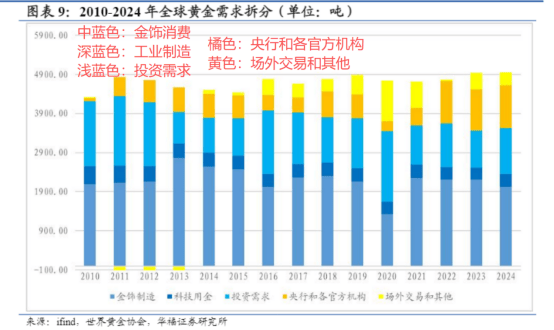
Core Viewpoint - The article discusses the investment strategies related to gold, emphasizing the importance of understanding supply and demand dynamics, particularly the role of central banks in influencing gold prices and investment decisions. Supply Side Analysis - Global gold supply comes from three main sources: gold mining, recycled gold, and hedging [5] - Gold mining accounts for over 75% of total supply, with production increasing from 2,755 tons in 2010 to an estimated 3,645 tons by 2024, reflecting a compound annual growth rate (CAGR) of 2% [6][8] - Recycled gold supply has fluctuated between 1,100 tons and 1,700 tons from 2010 to 2024, with projections for 2025-2027 estimating supply to be in the range of 1,400 tons to 1,500 tons [9] - Hedging activities contribute a small-scale supply of a few hundred tons annually, which does not significantly impact long-term price trends [10] - Overall, gold supply is stable with low volatility, making it possible to treat it as a fixed value in investment analysis [11] Demand Side Analysis - Demand for gold is driven by several factors: jewelry consumption, industrial use, investment demand, and purchases by central banks and official institutions, maintaining a stable annual demand of 4,000 to 5,000 tons [12] - The demand from central banks and official institutions has notably increased since 2021, influenced by the Federal Reserve entering a new interest rate cycle and significant changes in the global geopolitical landscape [14] Investment Strategy - The article suggests a simplified investment approach focusing on central bank gold reserve data as a key indicator for retail investors [17] - A practical method is proposed: invest in gold ETFs based on monthly central bank gold reserve announcements, with a specific buying strategy tied to these data releases [20][21] - The performance of this strategy from January 2023 to February 2026 shows a 163.52% increase for a specific gold ETF, while the strategy based on central bank data yielded a 124.99% increase [23]

择时雷达六面图:本周流动性分数好转
GOLDEN SUN SECURITIES· 2025-11-02 08:24
Quantitative Models and Construction Methods - **Model Name**: Timing Radar Six-Factor Model **Model Construction Idea**: The model aims to evaluate equity market performance based on multiple dimensions, including liquidity, economic fundamentals, valuation, capital flow, technical indicators, and crowding. It aggregates 21 indicators into four categories: "Valuation Cost-Effectiveness," "Macroeconomic Fundamentals," "Capital & Trend," and "Crowding & Reversal," generating a comprehensive timing score ranging between [-1, 1] [1][6]. **Model Construction Process**: The model uses 21 indicators across six dimensions, which are grouped into four categories. Each indicator is scored based on its respective methodology, and the scores are aggregated to form the comprehensive timing score. The detailed construction process for each indicator is provided in the report [6]. **Model Evaluation**: The model provides a comprehensive view of market conditions, offering insights into multiple dimensions that influence equity market performance [1][6]. Quantitative Factors and Construction Methods Liquidity Factors 1. **Factor Name**: Monetary Direction Factor **Factor Construction Idea**: This factor evaluates the direction of monetary policy by analyzing changes in central bank policy rates and short-term market rates over the past 90 days [11]. **Factor Construction Process**: - Calculate the average change in central bank policy rates and short-term market rates over the past 90 days - If the factor value > 0, monetary policy is considered expansionary; if < 0, it is considered contractionary [11]. **Factor Evaluation**: Provides a clear signal of monetary policy direction, aiding in liquidity assessment [11]. 2. **Factor Name**: Monetary Strength Factor **Factor Construction Idea**: Based on the "interest rate corridor" concept, this factor measures the deviation of short-term market rates from policy rates [14]. **Factor Construction Process**: - Calculate deviation = DR007/7-year reverse repo rate - 1 - Smooth the deviation and apply z-score normalization - If the factor value < -1.5 standard deviations, it indicates a future 120-day easing environment (score = 1); if > 1.5 standard deviations, it indicates tightening (score = -1) [14]. **Factor Evaluation**: Useful for assessing the relative deviation of short-term rates from policy rates [14]. 3. **Factor Name**: Credit Direction Factor **Factor Construction Idea**: Measures the trend of credit transmission from commercial banks to the real economy using long-term loan data [16]. **Factor Construction Process**: - Calculate the monthly value of long-term loans - Compute the past 12-month increment and year-on-year change - If the factor value increases compared to three months ago, it signals a positive trend (score = 1); otherwise, it signals a negative trend (score = -1) [16]. **Factor Evaluation**: Effectively captures the transmission of credit to the real economy [16]. 4. **Factor Name**: Credit Strength Factor **Factor Construction Idea**: Captures whether credit indicators significantly exceed or fall short of expectations [20]. **Factor Construction Process**: - Calculate Credit Strength Factor = (New RMB loans monthly value - median forecast) / forecast standard deviation - If the factor value > 1.5 standard deviations, it indicates a significant credit surplus (score = 1); if < -1.5 standard deviations, it indicates a significant credit deficit (score = -1) [20]. **Factor Evaluation**: Provides insights into credit market surprises [20]. Economic Factors 1. **Factor Name**: Growth Direction Factor **Factor Construction Idea**: Based on PMI data, this factor measures the trend of economic growth [23]. **Factor Construction Process**: - Use PMI data (Manufacturing PMI, Non-Manufacturing PMI, Caixin Manufacturing PMI) - Calculate the past 12-month average and year-on-year change - If the factor value increases compared to three months ago, it signals a positive trend (score = 1); otherwise, it signals a negative trend (score = -1) [23]. **Factor Evaluation**: Provides a reliable measure of economic growth trends [23]. 2. **Factor Name**: Growth Strength Factor **Factor Construction Idea**: Captures whether economic growth indicators significantly exceed or fall short of expectations [26]. **Factor Construction Process**: - Calculate PMI forecast deviation = (PMI - median forecast) / forecast standard deviation - If the factor value > 1.5 standard deviations, it indicates significant growth (score = 1); if < -1.5 standard deviations, it indicates significant contraction (score = -1) [26]. **Factor Evaluation**: Useful for identifying unexpected economic growth trends [26]. 3. **Factor Name**: Inflation Direction Factor **Factor Construction Idea**: Measures the impact of inflation trends on monetary policy and equity performance [28]. **Factor Construction Process**: - Calculate Inflation Direction Factor = 0.5 × smoothed CPI year-on-year value + 0.5 × raw PPI year-on-year value - If the factor value decreases compared to three months ago, it signals a deflationary environment (score = 1); otherwise, it signals inflation (score = -1) [28]. **Factor Evaluation**: Provides insights into inflation trends and their impact on monetary policy [28]. 4. **Factor Name**: Inflation Strength Factor **Factor Construction Idea**: Captures whether inflation indicators significantly exceed or fall short of expectations [31]. **Factor Construction Process**: - Calculate CPI and PPI forecast deviation = (reported value - median forecast) / forecast standard deviation - Compute Inflation Strength Factor = average of CPI and PPI forecast deviations - If the factor value < -1.5, it indicates significant deflation (score = 1); if > 1.5 standard deviations, it indicates significant inflation (score = -1) [31]. **Factor Evaluation**: Provides a measure of inflation surprises [31]. Valuation Factors 1. **Factor Name**: Shiller ERP **Factor Construction Idea**: Adjusts earnings for inflation to assess market valuation [34]. **Factor Construction Process**: - Calculate Shiller PE using inflation-adjusted average earnings over the past six years - Compute Shiller ERP = 1/Shiller PE - 10-year government bond yield - Normalize using z-score over the past six years [34]. **Factor Evaluation**: Offers a robust measure of equity risk premium [34]. 2. **Factor Name**: PB **Factor Construction Idea**: Measures valuation using price-to-book ratio [37]. **Factor Construction Process**: - Calculate PB × (-1) - Normalize using z-score over the past six years, truncating at ±1.5 standard deviations [37]. **Factor Evaluation**: Provides insights into market valuation levels [37]. 3. **Factor Name**: AIAE **Factor Construction Idea**: Reflects market-wide equity allocation and risk preference [40]. **Factor Construction Process**: - Calculate AIAE = total market capitalization of CSI All Share Index / (total market capitalization + total debt) - Normalize using z-score over the past six years [40]. **Factor Evaluation**: Captures overall market risk appetite [40]. Capital Flow Factors 1. **Factor Name**: Margin Financing Increment **Factor Construction Idea**: Measures market leverage and sentiment through margin financing trends [43]. **Factor Construction Process**: - Calculate margin financing balance - margin selling balance - Compare 120-day average increment with 240-day average increment - If 120-day increment > 240-day increment, score = 1; otherwise, score = -1 [43]. **Factor Evaluation**: Reflects market sentiment and leverage dynamics [43]. 2. **Factor Name**: Turnover Trend **Factor Construction Idea**: Measures market activity and capital flow through turnover trends [46]. **Factor Construction Process**: - Calculate log turnover moving average distance = ma120/ma240 - 1 - If max(10) = max(30) = max(60), score = 1; if min(10) = min(30) = min(60), score = -1 [46]. **Factor Evaluation**: Indicates market activity and liquidity [46]. 3. **Factor Name**: China Sovereign CDS Spread **Factor Construction Idea**: Reflects foreign investors' perception of China's economic and credit risk [49]. **Factor Construction Process**: - Smooth CDS spread and calculate 20-day difference - If 20-day difference < 0, score = 1; otherwise, score = -1 [49]. **Factor Evaluation**: Captures foreign investors' sentiment towards China [49]. 4. **Factor Name**: Overseas Risk Aversion Index **Factor Construction Idea**: Measures overseas market risk preference using Citi RAI Index [52]. **Factor Construction Process**: - Smooth RAI and calculate 20-day difference - If 20-day difference < 0, score = 1; otherwise, score = -1 [52]. **Factor Evaluation**: Reflects overseas market risk appetite [52].