
流动性结构

Search documents
三大变数来袭!微盘股刚刚直线跳水!商业航天板块跳水
Zheng Quan Shi Bao Wang· 2025-12-23 05:15
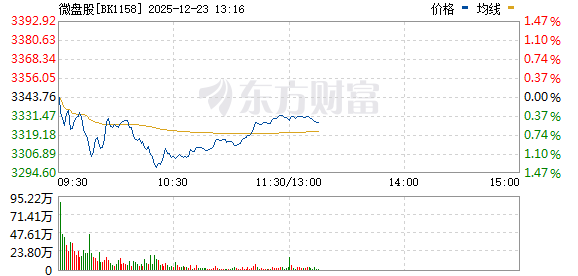
Core Viewpoint - The micro-cap stocks are experiencing significant volatility, with a notable decline following a previous drop, indicating a market focus on large-cap stocks instead [2][3]. Group 1: Market Performance - On December 23, the micro-cap stock index dropped nearly 1.5%, with the number of rising stocks in the market falling below 1,500 [7]. - The commercial aerospace sector saw a sharp decline of nearly 2.5%, affecting overall market sentiment [5]. Group 2: Factors Influencing Market Trends - Historically, micro-cap stocks tend to underperform at the end of the year or the beginning of the new year, which may be linked to liquidity structure changes [3][8]. - A significant investment of $23 billion by ByteDance in artificial intelligence is expected to boost related sectors, potentially shifting market focus back to large technology stocks [4][8]. Group 3: Liquidity and Market Dynamics - The market liquidity is increasingly concentrating on high-quality assets, as indicated by the substantial trading volumes in major stocks, with 19 stocks exceeding a trading volume of 1 trillion yuan this year [8]. - Analysts suggest that the current market is in a consolidation phase with weak trading volumes, and a trend reversal will require a combination of increased volume and improved market sentiment [9].

黄金、科技股都有人抄底 只有比特币“一蹶不振”
智通财经网· 2025-11-15 09:48
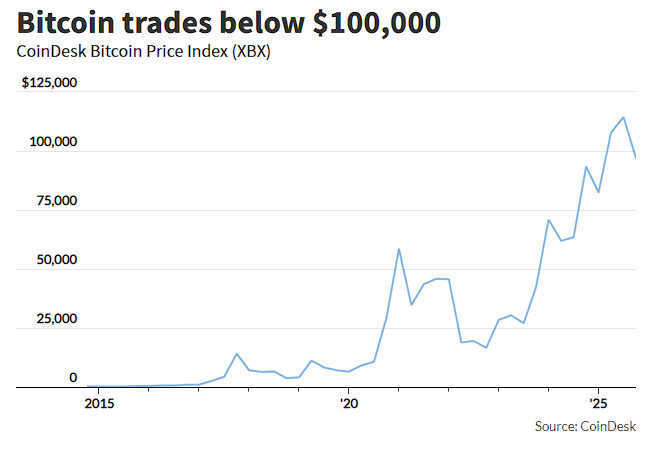
Core Viewpoint - The cryptocurrency market, particularly Bitcoin, is experiencing significant declines while traditional tech stocks are rebounding, highlighting a stark contrast in market behavior and sentiment [1][3][4]. Group 1: Market Performance - On November 14, the U.S. stock market saw a dramatic reversal, with the Nasdaq and S&P 500 indices rebounding after initial panic selling, while Bitcoin fell 5%, dropping below $94,000, marking a six-month low [1][4]. - Bitcoin has now declined for three consecutive weeks, with a total market cap loss exceeding $1 trillion since the October 10 flash crash [3][8]. - The Nasdaq 100 index and S&P 500 index rebounded strongly after hitting key support levels, while Bitcoin's performance diverged negatively from these indices [4][8]. Group 2: Bitcoin Market Dynamics - Bitcoin's correlation with the Nasdaq 100 remains high at 0.8, but it exhibits a "larger drop and weaker rise" characteristic, indicating a lack of upward momentum despite market recoveries [11][14]. - The cryptocurrency market is facing extreme pessimism, with the fear and greed index dropping to 15, the lowest level since February, suggesting a potential for further declines [15][18]. - Long-term holders have sold approximately 815,000 Bitcoins in the past 30 days, the highest level of selling activity since early 2024, indicating a significant shift in market sentiment [20][21]. Group 3: Institutional and Retail Investor Behavior - ETF trading activity has surged, accounting for 37% of the day's trading volume, significantly higher than the 27% average for the year, reflecting a strong interest in tech stocks [7]. - The outflow from Bitcoin ETFs has reached $311.3 million this week, marking the fifth consecutive week of net outflows, totaling $2.6 billion over the past five weeks [21]. - The Trump family's investments in cryptocurrency-related assets have also suffered, with declines of approximately 30% since Bitcoin's peak on October 5 [24][25].
聚焦还是均衡配置?私募四季度投资求变
Shang Hai Zheng Quan Bao· 2025-09-29 18:15
Group 1: Market Sentiment and Positioning - Over 65% of surveyed private equity firms prefer to hold heavy or full positions during the holiday, indicating a consensus on staying invested [2][3] - The stock private equity position index reached 78.41% as of September 19, marking the highest level this year, with significant increases among larger firms [3][4] - Optimism in the market is driven by the belief that recent A-share fluctuations are merely short-term adjustments, with liquidity remaining supportive for continued market performance [4][5] Group 2: Valuation and Sector Focus - Many private equity firms are adopting a more rational approach to valuations, acknowledging that some stocks have seen significant price increases since last September [5][6] - There is a shift towards focusing on undervalued sectors and high-quality growth stocks with strong earnings visibility, as some growth stocks face valuation pressures [6][7] - Strategies for the upcoming quarter vary, with some firms opting for balanced allocations while others focus on "reverse opportunities" in undervalued sectors [8][9] Group 3: Investment Strategies and Opportunities - The upcoming quarter may see a focus on sectors like precious metals and innovative pharmaceuticals, driven by macroeconomic factors such as potential Fed rate cuts [8][9] - Some firms are concentrating on technology sectors, particularly those related to AI, while also considering traditional sectors that may show signs of recovery [9]