
消费信心指数

Search documents
2026年01月28日:期货市场交易指引-20260128
Chang Jiang Qi Huo· 2026-01-28 02:50
1. Report Industry Investment Ratings - **Macro Finance**: Long - term bullish on stock indices, suggesting buying on dips; government bonds are expected to move in a range [1] - **Black Building Materials**: Short - term trading for coking coal, range trading for rebar, and waiting and seeing for glass [1] - **Non - ferrous Metals**: Waiting and seeing or holding long positions in small quantities for copper; strengthening observation for aluminum; waiting and seeing for nickel; range trading or taking profit on previous long positions for tin; range trading for gold; bullish movement for silver; range - bound oscillation for lithium carbonate [1] - **Energy and Chemicals**: Range trading for PVC, caustic soda and soda ash for the time being, range trading for styrene, rubber, urea, and methanol; weak oscillation for polyolefins [1] - **Cotton Textile Industry Chain**: Oscillatory adjustment for cotton and cotton yarn, oscillatory movement for apples and jujubes [1] - **Agriculture and Animal Husbandry**: Opportunities for short - selling on rebounds for hogs; hedging post - festival contracts on rallies for eggs; being cautious about chasing highs and waiting for rebounds to hedge for corn; bearish on rallies for soybean meal; bullish oscillation for three major oils [1] 2. Core Views of the Report The report provides trading suggestions for various futures products based on their current market conditions, including macro - economic factors, supply - demand relationships, and cost factors. It also emphasizes the importance of paying attention to policy changes, inventory levels, and external market factors [1][5][7] 3. Summaries According to Relevant Catalogs Macro Finance - **Stock Indices**: Medium - to long - term bullish, suggesting buying on dips. Market is volatile due to factors such as the Fed's interest - rate decision, China's industrial profit data, and consumer spending intentions [5] - **Government Bonds**: Expected to move in a range. There is no significant negative news in the bond market, but there is limited downward space for bond yields without more capital inflows [5] Black Building Materials - **Coking Coal**: Short - term trading. The coal market shows short - term fluctuations, but the price increase may not be sustainable due to factors like weak downstream demand and stable supply [7] - **Rebar**: Range trading. The futures price is slightly higher than the valley - electricity cost of electric furnaces and lower than the flat - electricity cost. There is no significant supply - demand contradiction in the short term [7] - **Glass**: Waiting and seeing. The supply is stable, the market speculative demand is weak, and the downstream inventory is high. The price is expected to oscillate between 1050 - 1070 [8] Non - ferrous Metals - **Copper**: High - level oscillation. Macro factors provide support, but the fundamentals are weak. It is recommended to wait and see or hold long positions in small quantities, and beware of the risk of a pullback before the Spring Festival [9] - **Aluminum**: High - level oscillation. The supply of bauxite and alumina is relatively stable, and the demand is entering the off - season. It is recommended to strengthen observation [11] - **Nickel**: Oscillatory movement. The reduction of Indonesian nickel ore quotas has boosted the price, but the fundamentals are weak. It is recommended to wait and see [13] - **Tin**: Oscillatory movement. The supply of tin concentrate is tight, and the downstream demand is mainly for rigid procurement. It is recommended for range trading or taking profit on previous long positions [13] - **Silver**: Bullish movement. Geopolitical tensions and changes in the Fed's leadership expectations have pushed up the price. It is recommended to hold long positions and be cautious about new positions [15] - **Gold**: Range trading. Similar to silver, geopolitical and Fed - related factors have led to a higher price center. It is recommended for range trading and be cautious about chasing highs [15] - **Lithium Carbonate**: Range - bound oscillation. The supply is affected by mine production, and the demand from the energy - storage terminal is good. The price is expected to be bullish [17] Energy and Chemicals - **PVC**: The bottom may have been reached. The supply is high, the demand is weak, but the valuation is low. It is recommended for long - term low - buying and positive spread trading [17] - **Caustic Soda**: Low - level oscillation. The demand is weak, and the supply pressure is high. It is recommended to wait and see [19] - **Styrene**: Oscillatory movement. The price has rebounded due to export growth and device maintenance, but the valuation is high. It is recommended to be cautious about chasing highs [19] - **Rubber**: Oscillatory movement. The supply is shrinking, but the inventory pressure remains. The price is in a state of multi - empty tug - of - war [20] - **Urea**: Oscillatory movement. The supply is increasing, the demand from compound fertilizers is rising, and the inventory is at a low level. The price is expected to oscillate between 1730 - 1830 [21] - **Methanol**: Oscillatory movement. The supply is decreasing, the demand from methanol - to - olefins is weakening, and the traditional downstream demand is also weak [23] - **Polyolefins**: Weak oscillation. The supply is increasing, the demand from PE downstream is declining, and the price is expected to be weak with limited upside [24] - **Soda Ash**: Waiting and seeing. The supply is in excess, but the cost support is strong. It is recommended to leave the market temporarily [24] Cotton Textile Industry Chain - **Cotton and Cotton Yarn**: Oscillatory adjustment. The global cotton supply - demand situation has changed, and the internal - external price difference has put pressure on the domestic market. It is recommended to be cautious in the short term and optimistic in the long term [24] - **Apples**: Oscillatory movement. The packaging and shipping in the production areas have accelerated slightly, but the overall market is still weak [26] - **Jujubes**: Oscillatory movement. The purchase price of Xinjiang gray jujubes in the 2025 production season is in a certain range, and the acquisition is based on quality [26] Agriculture and Animal Husbandry - **Hogs**: Bottom - building oscillation. In the short term, the price is restricted by supply - demand game. It is recommended to short on rebounds for off - season contracts. In the long term, be cautious about being bullish due to high - level production capacity and cost reduction [28] - **Eggs**: Rebound from a low level. The current valuation is high, and it is recommended to hedge post - festival contracts on rallies. Also, consider hedging the 05 and 06 contracts due to the possible post - poned supply pressure [30] - **Corn**: Limited upside. In the short term, the supply - demand is balanced, and it is recommended to be cautious about chasing highs. In the long term, the supply - demand situation is relatively loose, restricting the price increase [32] - **Soybean Meal**: Low - level oscillation. The short - term support for the M2603 contract is at 3000 - 3030, and the pressure for the far - month 05 contract is at 2800 - 2850. It is recommended to be bearish on rallies [32] - **Oils**: Bullish oscillation. The three major oils are expected to move strongly. It is recommended to buy on dips and hold previous long positions [38]
加元震荡 央行维稳共识下分歧掣肘上行
Jin Tou Wang· 2026-01-27 02:36
Core Viewpoint - The Canadian dollar (CAD) is experiencing a volatile start to 2026, with fluctuations against the US dollar influenced by oil prices and domestic economic conditions, while the market awaits clarity from the Bank of Canada on interest rates [1][2]. Group 1: Currency Performance - As of January 27, the CAD is trading at 0.7291 against the USD, showing a slight daily decline of 0.0656%, with a trading range between 0.7289 and 0.7299 [1]. - The CAD has depreciated approximately 1.55% against the Chinese yuan since the beginning of the year, although it has seen minor recovery due to the strengthening of non-USD currencies [1]. - The USD/CAD exchange rate is currently around 1.3680, close to the lower end of a previous downtrend channel, indicating a narrow trading range since the start of the year [1]. Group 2: Monetary Policy and Economic Outlook - The Bank of Canada is expected to maintain the benchmark interest rate at 2.25% in January, with 75% of institutions predicting stability throughout 2026, following a cumulative 100 basis points rate cut in 2025 [1][2]. - The current inflation rate in Canada is at 2.4%, slightly above the 2% target, reducing the urgency for rate cuts in the short term [1]. - The Bank of Canada is undergoing a five-year review of its monetary policy framework, leading to divergent predictions among institutions regarding future interest rate movements [2]. Group 3: Oil Prices and Economic Conditions - The CAD's performance is closely tied to international oil prices, which have stabilized around $61.10 per barrel, providing essential support for the CAD [2]. - Concerns over energy supply due to geopolitical risks and disruptions in certain regions have contributed to the recent increase in oil prices, positively impacting Canada's oil export revenues [2]. - However, domestic economic recovery remains weak, with the unemployment rate rising to 6.8% in December 2025, the highest since before the pandemic, and consumer confidence declining for three consecutive months [2]. Group 4: Technical Analysis and Market Sentiment - The USD/CAD exchange rate is currently in a downward trend since the previous high of 1.3927, with resistance around 1.3800 and support near 1.3641 [3]. - Technical indicators suggest a stalemate in market dynamics, with no clear reversal signals, indicating a pattern of limited downward movement without significant upward momentum [3]. - Future CAD movements will be influenced by three key variables: the Bank of Canada's interest rate decision, the stability of oil prices, and changes in the US dollar index and external demand [3].
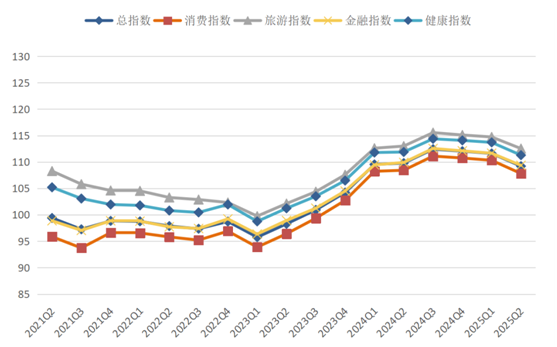
2025年第二季度海西金融、旅游、健康、消费信心指数正式发布
Mei Ri Jing Ji Xin Wen· 2025-07-24 07:34
Core Insights - The overall confidence index for the Haixi region in Q2 2025 is 109.20, showing a slight decline both quarter-on-quarter and year-on-year, indicating a stable yet cautious outlook among residents [2][3] Financial Confidence - The financial confidence index stands at 109.35, reflecting a quarter-on-quarter decrease of 2.30 and a year-on-year decrease of 0.55, but remains in the optimistic zone [2][7] - Financial investment plan index is at 109.60, with a quarter-on-quarter decline of 2.35 and a year-on-year decline of 0.60, indicating a slight reduction in investment intentions [7] Tourism Confidence - The tourism confidence index is recorded at 112.53, with a quarter-on-quarter decline of 2.20 and a year-on-year decline of 0.47, yet it remains the highest among the indices, suggesting strong tourism sentiment [2][5] - The tourism plan index is at 112.60, showing a quarter-on-quarter decline of 2.25 and a year-on-year decline of 0.45, indicating a need for attention despite overall optimism [5] Consumer Confidence - The consumer confidence index is at 107.81, with a quarter-on-quarter decline of 2.50 and a year-on-year decline of 0.62, marking it as the lowest among the indices and a primary factor in the overall index decline [2][3] Health Confidence - The health confidence index is at 111.28, with a quarter-on-quarter decline of 2.32 and a year-on-year decline of 0.60, indicating that residents maintain a positive outlook on health despite slight decreases [2][10] Living Conditions and Employment Confidence - The living conditions index is at 109.50, with a quarter-on-quarter decline of 2.33 and a year-on-year decline of 0.50, remaining in the optimistic zone [8] - The employment confidence index shows a slight decline to 107.85, with a quarter-on-quarter decrease of 2.45 and a year-on-year decrease of 0.65, reflecting cautious sentiment in the job market [8] Durable Goods and Construction Confidence - The durable goods investment index is at 107.43, with a quarter-on-quarter decline of 2.45 and a year-on-year decline of 0.57, yet remains optimistic [9] - The construction confidence index is at 110.00, showing a quarter-on-quarter decline of 2.35 and a year-on-year decline of 0.45, but still indicates a positive outlook [9]

【高端制造】向北美地区出口受到关税的不利影响,割草机、工程机械整体数据亮眼 ——行业海关总署出口月报(十一)(黄帅斌/陈佳宁)
光大证券研究· 2025-05-24 14:24
Consumer Goods - The core consumer goods include electric tools, hand tools, and lawn mowers, primarily targeting high-end markets in Europe and the United States [2] - In April 2025, U.S. retail sales showed a month-on-month increase of 0.1%, surpassing market expectations of 0%, while core retail sales (excluding automobiles and gasoline) also increased by 0.1%, below the expected 0.3% [2] - The significant drop in retail data in April is attributed to the impact of tariffs, with consumer confidence index declining by 4.8 percentage points to 52.2, the lowest level since August 2022 [2] Capital Goods - Industrial sewing machines are primarily exported to Asia, accounting for 68% of export value in 2024, with key markets including Turkey, Vietnam, and Singapore [4] - Forklift exports are mainly to Asia and Europe, with export values in 2024 accounting for 30% and 34% respectively [4] - Machine tool exports are predominantly to Asia, maintaining around 50% of export value from 2019 to 2024, with notable fluctuations in exports to Russia [4] - Mining machinery exports are concentrated in Asia, Africa, and Europe, with cumulative export values in the first four months of 2025 showing increases of 19% to Asia, 16% to Latin America, and 30% to Africa [4][7] Engineering Machinery - Cumulative export value of engineering machinery increased by 10% in the first four months of 2025, with the fastest growth seen in exports to Africa at 61% [5][6] - Cumulative export value to Africa reached 19% of total exports, an increase of 4 percentage points compared to the entire year of 2024 [6] - In the first four months of 2025, cumulative exports of forklifts to Africa grew by 37%, and to Latin America by 24% [7] Industrial Capital Goods - In April 2025, the month-on-month export growth rates for forklifts, machine tools, and industrial sewing machines were 3%, 17%, and 23% respectively [8] - Cumulative export growth rates for the first four months of 2025 were -1% for forklifts, +9% for machine tools, and +28% for industrial sewing machines [8] Overall Machinery Exports - In April 2025, the export growth rates for major categories of engineering machinery, excavators, tractors, and mining machinery were 8%, 20%, 21%, and 28% respectively [9] - Cumulative growth rates for the first four months of 2025 were 10% for major engineering machinery, 21% for excavators, 28% for tractors, and 21% for mining machinery [9]
机械行业海关总署出口月报(十一)——向北美地区出口受到关税的不利影响,割草机、工程机械整体数据亮眼
EBSCN· 2025-05-24 00:15
Investment Rating - The mechanical industry is rated as "Buy" (Maintain) [1] Core Viewpoints - The export of electric tools, hand tools, and lawn mowers to North America is negatively impacted by tariffs, while overall data for lawn mowers and engineering machinery is bright [1][10] - In April 2025, the retail sales in the U.S. showed a significant decline, indicating the negative impact of tariffs on the economy, with consumer confidence dropping to its lowest level since August 2022 [3][10] - The cumulative export growth rates for electric tools, hand tools, and lawn mowers from January to April 2025 were 10%, -6%, and 55% respectively, with significant month-on-month declines [4][10] Summary by Relevant Sections Consumer Goods - The main products include electric tools, hand tools, and lawn mowers, primarily targeting high-end consumers in Europe and the U.S. [3] - The cumulative export amounts to North America for electric tools and lawn mowers from January to April 2025 showed a year-on-year increase of 9% and 10% respectively, but the growth rates have significantly declined [4][10] Capital Goods - Industrial - The main products include forklifts, machine tools, and industrial sewing machines, with a notable increase in exports to emerging markets like Africa and Latin America [5][10] - The cumulative export growth for forklifts, machine tools, and industrial sewing machines from January to April 2025 was -1%, +9%, and +28% respectively [8][10] Capital Goods - Engineering Machinery - The cumulative export growth for engineering machinery reached double digits in the first four months of 2025, with excavators, tractors, and mining machinery showing growth rates of 21%, 28%, and 21% respectively [9][10] - The export amounts to Africa showed the fastest growth, reaching 61% year-on-year in the first four months of 2025 [6][10] Investment Recommendations - For consumer goods, companies to watch include QuanFeng Holdings, JuXing Technology, and Greebo [10] - For industrial capital goods, recommended companies include Anhui Heli, Hangcha Group, and Neway CNC [10] - For engineering machinery, companies such as YTO Group, XCMG, and SANY Heavy Industry are highlighted as potential investments [10]