消费贷利率

Search documents
国泰海通|银行:国有大行投放力度较大,不良压力或企稳
国泰海通证券研究· 2026-01-23 12:04
Core Viewpoint - Since 2024, the growth rate of consumer loans has slowed down, with state-owned banks actively responding to consumption promotion policies by significantly increasing consumer loan disbursements, while consumer finance companies continue to maintain rapid growth in scale [1][2]. Group 1: Loan Volume - As of Q3 2025, the balance of consumer loans (excluding personal housing loans) reached 21.29 trillion yuan, a year-on-year increase of 4.2%, indicating a slowdown in growth [2]. - The proportion of bank consumer loans is approximately 27%, with state-owned banks, joint-stock banks, and rural commercial banks holding 2.7 trillion, 1.8 trillion, and 1.2 trillion yuan respectively, showing year-on-year growth rates of 26.0%, 2.4%, and 12.1% [2]. - Licensed consumer finance companies, totaling 31, have a market share of about 7%, with their asset scale expected to reach 1.38 trillion yuan by the end of 2024, reflecting a year-on-year growth of 14.6% [2]. Group 2: Loan Pricing - The price war for consumer loans has intensified in 2023, with some banks offering rates as low as 2.4%. Starting from April 2025, the annualized interest rate for consumer loans may be adjusted to not less than 3% [4]. - The average loan interest rate for consumer finance companies has shown a downward trend, decreasing from 19.3% in 2019 to 14.8% in 2024 [4]. Group 3: Loan Quality - The non-performing loan (NPL) ratio for sample banks stands at 1.56%, with a slight increase of 5 basis points since the end of 2023, and the NPL balance has increased by 25% year-on-year [6]. - Data from assistive lending platforms indicate that the proportion of loans overdue by more than 90 days was 2.09% in Q3 2025, reflecting a marginal increase but still at a relatively high level [6]. Group 4: Future Outlook - In the short term, the NPL ratio for consumer loans may face upward pressure, but in the medium to long term, it is expected to stabilize as the economy improves, regulatory policies take effect, and banks enhance their risk control capabilities [7].


LPR连续8个月“按兵不动” 今年房贷利率仍有下探空间
Bei Ke Cai Jing· 2026-01-20 09:25
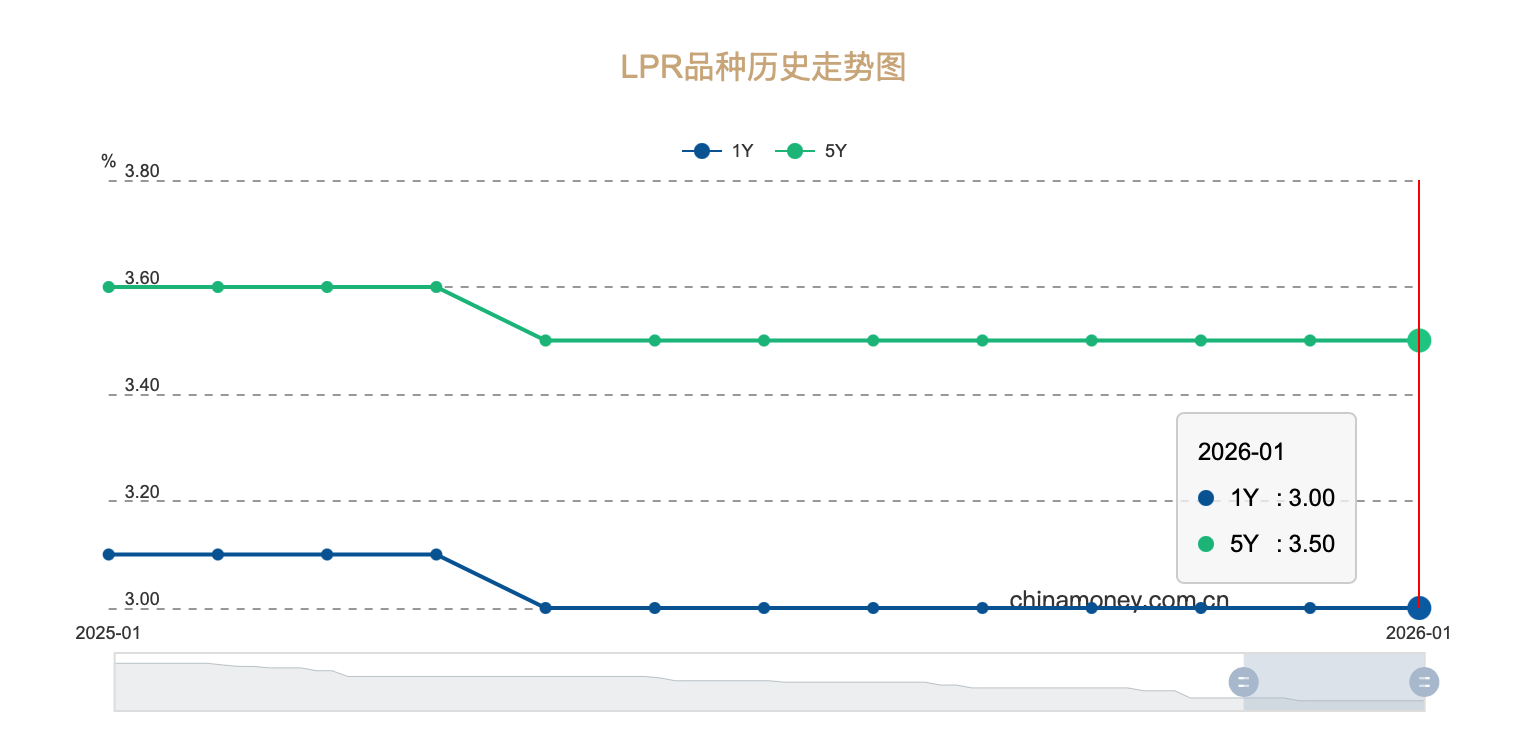
Core Viewpoint - The Loan Prime Rate (LPR) remains unchanged for the eighth consecutive month, with the 1-year rate at 3.0% and the 5-year rate at 3.5%, reflecting a stable monetary policy environment [1][6][12]. Group 1: LPR Stability - The LPR has not changed since May 2025, indicating a period of stability in interest rates [2]. - The People's Bank of China (PBOC) has indicated that there is still room for interest rate cuts in 2026, particularly in relation to consumer and mortgage loan rates [3][14]. - The current LPR pricing is influenced by stable market rates, including the 7-day reverse repurchase rate, which remains at 1.4% [7][9]. Group 2: Factors Influencing LPR - Multiple factors are constraining the LPR, including stable financing costs for commercial banks and pressures to maintain net interest margins [10][12]. - The recent stability in the LPR is attributed to strong export performance and rapid development in high-tech manufacturing sectors [12]. - Analysts suggest that the marginal effect of interest rate cuts is diminishing, making it less urgent to lower the LPR at this time [11]. Group 3: Future Outlook - There is a consensus among market participants that there is still potential for further reductions in consumer and mortgage loan rates, as they are currently at historical lows [14]. - Predictions indicate that the LPR may have room to decrease in 2026, supported by lower deposit rates and a potential reduction in the reserve requirement ratio by the PBOC [15][16]. - External factors, such as the U.S. Federal Reserve's interest rate cuts, may ease constraints on China's market rates, potentially leading to broader monetary policy adjustments [17].