混合办公

Search documents
2026年,混合办公成常态,AI 驱动企业“运营”员工体验
3 6 Ke· 2026-02-11 23:12
Core Insights - The article discusses the evolving workplace trends leading up to 2026, emphasizing the shift to hybrid work and the integration of AI into daily workflows. Companies are expected to optimize their operational frameworks to enhance employee engagement and resilience in a challenging environment [1][2]. Group 1: Hybrid Work as the Standard - Hybrid work has become the mainstream model for knowledge work, with approximately 91% of employers offering some form of flexible work arrangements [3]. - The focus for leaders is shifting from how many days employees should be in the office to maximizing the value of in-office time [3]. - A study by Trip.com indicates that a hybrid model with two days of remote work can reduce turnover rates by about one-third without impacting performance [3]. Group 2: Employee Engagement Challenges - Global employee engagement has dropped to 21% in 2024, with manager engagement at 27%, showing no signs of improvement [3]. - Factors contributing to this decline include heavy workloads and rapid changes, with 73% of HR leaders noting employee fatigue from ongoing transformations [3][4]. Group 3: Integration of AI - AI is transitioning from an exploratory tool to a foundational infrastructure, with around 75% of companies planning to adopt AI by 2027 [2]. - The use of AI can enhance productivity by 5% to 25% in tasks such as writing and programming when combined with proper training and oversight [7]. Group 4: Employee Well-being and Burnout - A significant portion of employees (48%) and managers (53%) report experiencing burnout, which negatively impacts morale and execution [5][8]. - Companies with superior employee experiences see a revenue growth rate 31% higher than their peers [8]. Group 5: Regulatory Impact - The implementation of the EU's Pay Transparency Directive by June 7, 2026, will require employers to disclose salary information and address pay gaps exceeding 5% [11]. - The EU AI Act, effective from August 2, 2026, will impose comprehensive regulations on high-risk AI systems used in HR [11]. Group 6: Organizational Change Management - Continuous organizational change is exhausting employees, with 73% of HR leaders acknowledging this fatigue [13]. - Only 45% of employees are achieving the change goals set by their companies, indicating a significant gap in execution [13]. Group 7: Skills and Talent Competition - The World Economic Forum predicts that by 2027, 44% of workers will need to update their core skills, highlighting the rapid pace of skill obsolescence [18]. - In 2025, 74% of employers reported difficulty in finding skilled talent, indicating a persistent challenge in recruitment [15]. Group 8: Employee Experience Measurement - Companies should focus on practical skill mapping and integrate training into daily workflows to enhance employee readiness [20]. - A comprehensive employee experience index that combines engagement data with operational metrics will provide valuable insights for decision-making [22].
The five-day office comeback: Why stricter return-to-office mandates may push top performers out the door
Yahoo Finance· 2026-02-04 18:30
Core Insights - The return-to-office trend has shifted from a debate to a directive, with many companies mandating in-person work despite the success of remote and hybrid models during the pandemic [1] - Approximately one in three American companies now require employees to work fully in person, indicating a significant shift in workplace policies [2] - Executives argue that in-person work enhances efficiency, creativity, and company culture, although this approach is unpopular among younger employees [3] Company Policies - Companies like Stellantis and Home Depot have implemented a five-day-a-week in-office requirement, joining other major employers such as Amazon, AT&T, and JPMorgan Chase [2] - Home Depot's CEO emphasized that in-person engagement supports employees and reinforces a people-centric culture [3] Employee Sentiment - There is growing tension between leadership and staff regarding the return-to-office mandates, with many employees feeling micromanaged and controlled [4] - Employees who do not meet performance quotas are being required to return to the office full-time, leading some to seek roles that offer more flexibility [5] - The shift back to in-person work is perceived by some employees as a move towards control rather than productivity [4][5]
底特律三巨头开始“全员坐班”
汽车商业评论· 2026-02-03 23:09
Core Viewpoint - Stellantis is transitioning back to a five-day in-office workweek for its U.S. employees by March 2026, emphasizing the importance of face-to-face collaboration for product delivery and service quality [4][5][10]. Group 1: Company Strategy and Changes - Stellantis has faced significant turmoil over the past year, including the unexpected departure of CEO Carlos Tavares and declining sales in the North American market, leading to inventory pressures and necessary layoffs [8][25]. - The company is implementing a plan named "Back Together We Win," which mandates that all U.S. white-collar employees return to the office five days a week, with a clear timeline for different employee levels [10][11]. - Stellantis previously supported remote work, allowing non-production employees to work from home 70% of the time, but has shifted to a more stringent in-office requirement, indicating a change in management approach [13][25]. Group 2: Comparison with Competitors - Competitors General Motors and Ford are maintaining a more flexible hybrid work model, with GM requiring employees to be in the office three days a week and Ford planning to require four days starting September 2025 [6][20][18]. - Stellantis's aggressive return-to-office policy contrasts with its competitors, who have not yet mandated a full five-day workweek, highlighting Stellantis's unique position among the Detroit automakers [17][14]. Group 3: Market Context and Challenges - Stellantis's decision to enforce a five-day workweek is partly driven by the need to address challenges such as high dealer inventory and declining stock prices, which have resulted from strategic missteps in the North American market [26][25]. - The company plans to invest approximately $13 billion in the U.S. over the next four years to support new models and job creation, but this investment is also linked to pressures from tariff costs [27][28]. - The effectiveness of the return-to-office policy in improving productivity and sales remains uncertain, as studies show mixed results regarding the impact of in-office work on efficiency [22][23].



企业迁移至本地办公中心或采用联合办公会员制 可节省55%房地产成本
Cai Jing Wang· 2026-01-14 03:10
Core Insights - The report by IWG indicates a significant shift towards flexible office space solutions in China, driven by challenges in the commercial real estate market [1] - Long-term leases are becoming less attractive for companies facing demand uncertainty and cost pressures, leading to increased interest in hybrid and flexible office models [1] Group 1: Market Trends - According to Fitch's report, the oversupply of office buildings in China is leading to rising vacancy rates and downward pressure on rental prices, with overall rental levels expected to remain stable or slightly decline by 2026 [1] - In Beijing, the average rent for premium office space has decreased by over 16% year-on-year, enhancing tenant bargaining power [1] - The demand for flexible and hybrid office solutions is further reinforced by tenants' focus on spaces that enhance efficiency, adaptability, and employee experience [1] Group 2: Cost Savings and Productivity - Research by IWG and Arup shows that companies migrating to local office centers or adopting co-working membership models can save up to 55% on real estate costs, with potential savings in the U.S. reaching $122 billion by 2045 [1] - Hybrid working models can increase employee productivity by 11%, resulting in an average savings of approximately $11,000 per employee [1] - This transition allows companies to convert capital expenditures into operational expenses, alleviating long-term lease pressures and enhancing overall flexibility [1] Group 3: Company Growth - IWG's China head, Hu Mao, noted that in 2025, the company signed 80 new centers and opened nearly 30 centers, marking the fastest growth year to date [2] - The flexible office space model is becoming the optimal combination for companies in China to reduce costs, improve efficiency, and manage risks [2]
思科20251118
2025-11-19 01:47
Summary of Cisco's Earnings Call Company Overview - **Company**: Cisco - **Date**: November 18, 2025 Key Industry Insights - Cisco merged opportunities in Enterprise, Sovereign, and New Cloud sectors, revealing over $200 million in orders to showcase AI-driven growth opportunities and update market information, primarily involving systems and optical products [2][3] - AI revenue is derived mainly from Series A K, Silicon One, and optical products, with systems and optical products each accounting for 50% of the revenue [2][9] - Demand for DCI (Data Center Interconnect) related products has significantly increased, particularly for coherent pluggable optics [2][9] Core Business Strategies - Cisco's deep involvement in the design process with Hyper Scalers and the implementation of a Silicon strategy have reduced reliance on external supply chains, enabling success in the AI sector and effectively addressing supply chain challenges [2][8] - Collaboration with NVIDIA on the N9,200 switch may lower profit margins due to the use of external chips, but the integration of software and enterprise sales channel advantages enhances customer satisfaction and market competitiveness [2][11] Market Position and Competition - Cisco believes that white box switches do not pose a substantial threat to its market position and gross margins, as it possesses silicon technology and operating systems, maintaining close relationships with Hyper Scaler customers to meet complex network demands [2][13] - The company is optimistic about the growth of its security business, targeting a long-term growth rate of 15% to 17% annually, despite recent underperformance due to a transition period between old and new products [4][17] Financial Performance and Projections - Cisco's $2 billion pipeline includes opportunities from Sovereign enterprises and emerging cloud vendors, with the timing of project rollouts dependent on market demand and project progress [5][6] - The company expects that the conversion of orders to revenue typically takes about six months, but it can be quicker, around 90 days, depending on external factors [7] Product Development and Customer Needs - The hybrid work trend has impacted Cisco's collaboration business, which remains stable due to a strong product portfolio and cash flow generation capabilities [4][19] - Cisco's strategy for product updates involves a gradual approach, allowing customers to transition from older products to newer models, ensuring service continuity and security [15][16] Future Outlook - Cisco is optimistic about the future, particularly in AI and security sectors, and is positioned to leverage its dual technology strengths in networking and security [21][22] - The company emphasizes the importance of enhancing remote participant experiences in hybrid work environments and continues to focus on AI advancements as a key growth area [22][23] Additional Considerations - The transition to cloud subscriptions in the Slunk business has altered revenue recognition methods, leading to short-term revenue softness but aligning with long-term strategic goals [18] - Cisco's diverse supply chain strategy, including both proprietary and third-party components, ensures production stability and mitigates risks associated with single supply chain dependencies [11]

混合办公空间需求持续攀升,IWG在大湾区再添新地标
Zheng Quan Shi Bao Wang· 2025-11-17 05:56
Group 1: Company Overview - IWG Group, a leading global office platform, has opened its first high-end flexible office space, Regus Jin Ying Future Center, in Zhongshan, responding to the increasing demand for flexible workspaces in the Greater Bay Area [1] - The new center is located in a landmark building standing 238 meters tall and aims to provide diverse and international office solutions for both established companies and startups [1] - IWG operates several flexible office brands, including Regus and Spaces, and plans to add 899 shared office centers in 2024, serving 83% of the Fortune 500 companies [1] Group 2: Financial Performance - In Q3 2025, IWG reported system-wide revenue of $1.1 billion, a 4% year-on-year increase, highlighting strong global demand for flexible office solutions [2] - The managed and franchised segment saw a remarkable 36% year-on-year revenue growth, indicating the rapid adoption of flexible office models worldwide [2] - IWG signed 335 new centers and opened 215 during the period, both representing over 40% growth compared to the same period last year, showcasing strong expansion momentum [2] Group 3: Market Potential - IWG sees significant potential in the Chinese market, having signed over 60 new centers in major cities like Shanghai and Shenzhen, as well as in smaller cities [2] - The new centers will leverage IWG's international network, which spans over 120 countries and more than 5,000 locations, to provide seamless office experiences for clients [2] - The company's flexible office network in China is rapidly growing, driven by the dual demand from corporate clients for flexible solutions and property owners seeking to enhance asset value through IWG's brand and operational capabilities [3]
混合办公网络快速扩张 IWG集团在华布局提速
Xin Hua Cai Jing· 2025-11-13 02:50
Core Insights - IWG Group reported steady revenue growth and rapid network expansion driven by the global adoption of hybrid work models and a light-asset strategy [1][2] - The company achieved a system-wide revenue of $1.1 billion in Q3, reflecting a 4% year-on-year increase, highlighting the strong demand for flexible workspace solutions [1] - The managed and franchised segment saw a remarkable revenue growth of 36% year-on-year, indicating the rapid penetration of flexible office models globally [1] Revenue and Performance - IWG's Q3 system-wide revenue reached $1.1 billion, a 4% increase compared to the previous year [1] - The managed and franchised segment's revenue grew by 36% year-on-year, showcasing the increasing demand for flexible office solutions [1] Expansion and Market Presence - In Q3, IWG signed 335 new centers and opened 215 centers, both representing over 40% growth compared to the same period last year [1] - The company added 190,000 workspaces to its reserve, which is expected to contribute over $1.6 billion in system-wide revenue annually once fully operational [1] Regional Focus - IWG's expansion in China is particularly rapid, with over 60 new centers signed in the first three quarters of 2025, covering major cities like Shanghai and Shenzhen, as well as smaller cities [2] - The company's light-asset strategy and expanding local partnership network enable it to better meet the growing market opportunities from first-tier to smaller cities in China [2]
Tyler Technologies (TYL) Soars 6.6%: Is Further Upside Left in the Stock?
ZACKS· 2025-10-09 13:05
Company Overview - Tyler Technologies (TYL) shares increased by 6.6% to close at $517.57, following a notable trading volume, contrasting with a 13% loss over the past four weeks [1] - The stock's appreciation is linked to optimism regarding demand for its solutions as the public sector shifts to scalable cloud-based systems from outdated on-premise systems [2] Financial Performance - Tyler Technologies is expected to report quarterly earnings of $2.88 per share, reflecting a year-over-year increase of 14.3% [3] - Revenue projections stand at $594.76 million, indicating a 9.5% rise compared to the same quarter last year [3] Market Sentiment - The consensus EPS estimate for Tyler Technologies has remained unchanged over the last 30 days, suggesting that stock price movements may not sustain without earnings estimate revisions [4] - The company currently holds a Zacks Rank of 3 (Hold), indicating a neutral outlook [4]


携程推行居家办公背后
Sou Hu Cai Jing· 2025-09-05 17:03
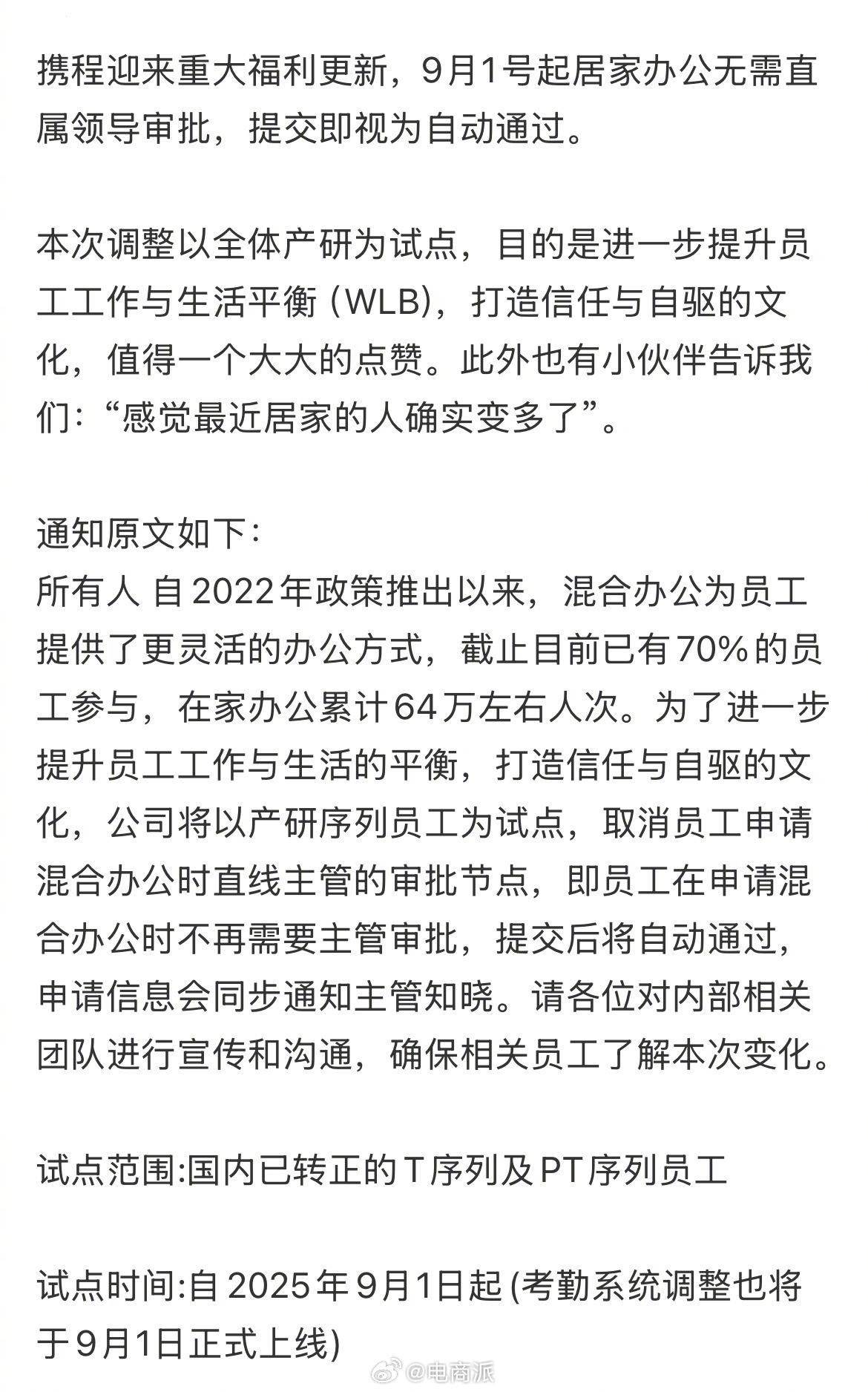
Group 1 - Ctrip has implemented a policy allowing all product and research employees to apply for remote work without direct supervisor approval, effective from September 1 [1] - The company aims to enhance work-life balance and foster a culture of trust and self-drive, starting with product and research employees as a pilot [1] - Since the introduction of the hybrid work model in 2022, 70% of employees have participated, with approximately 640,000 instances of remote work recorded [2] Group 2 - Ctrip's co-founder and chairman, Liang Jianzhang, advocates for hybrid work due to its benefits in employee satisfaction, traffic reduction, environmental protection, and family harmony [2] - A study conducted by Liang and his team from 2021 to 2022 involved 1,612 employees and demonstrated that hybrid work improves employee performance, retention, and satisfaction [2] - Liang published research in top academic journals, confirming that flexible hybrid work enhances employee satisfaction and retention without compromising performance [2] Group 3 - Ctrip's financial performance has shown consistent growth, with Q2 2025 net revenue reaching 28.673 billion and net profit at 9.194 billion, resulting in a net profit margin of 32.1% [5] - Ctrip's net profit margin is higher than Tencent's 28.4% and slightly lower than NetEase's 33.3%, indicating strong financial health compared to other major internet companies [5] - In the ranking of internet companies for the first half of 2025, Ctrip achieved a net profit of 9.123 billion, placing it among the top performers [6][7][8]

4000亿携程的赌局
Hua Er Jie Jian Wen· 2025-09-04 12:23
Core Viewpoint - Ctrip has adopted a unique approach by allowing employees to work from home without approval, amidst a trend of major internet companies tightening attendance policies. This decision comes as the company reports a record high quarterly revenue of 14.8 billion yuan and maintains a gross margin above 80% [2][3]. Business Performance - Ctrip's Q2 2025 net operating revenue reached 14.8 billion yuan, a year-on-year increase of 16% and a quarter-on-quarter increase of 7%, slightly exceeding market expectations [3]. - Revenue growth was observed across all business segments: accommodation booking revenue was 6.2 billion yuan (up 21% YoY), transportation ticketing revenue was 5.4 billion yuan (up 11% YoY), vacation business revenue was 1.1 billion yuan (up 5% YoY), and business travel management revenue was 0.692 billion yuan (up 9% YoY) [4]. - Adjusted operating profit for Q2 was 4.67 billion yuan, a 10.4% increase YoY, surpassing market expectations by approximately 390 million yuan [4]. Market Trends - The international business segment showed significant growth, with total bookings on Ctrip's international OTA platform increasing by over 60% YoY. Outbound travel bookings have recovered to 120% of 2019 levels, exceeding the industry average recovery of 84% [5]. - The domestic tourism market is booming, with 3.285 billion domestic trips taken in the first half of 2025, a 20.6% increase YoY, and total spending of 3.15 trillion yuan, up 15.2% YoY [5]. Competitive Landscape - The online travel market in China is projected to exceed 1.7 trillion yuan by 2025, intensifying competition among players. Ctrip's market share is being challenged by new entrants like JD.com and Douyin, which are adopting aggressive pricing and innovative marketing strategies [7][9]. - JD.com aims to reduce industry costs by one-third with a "three-year zero commission" policy, while Douyin leverages content-driven marketing to enhance user engagement and shorten the booking decision process [7][8]. Strategic Responses - Ctrip is focusing on enhancing its technology and service offerings to address competitive pressures, including the introduction of an upgraded AI-based itinerary planner to improve user experience [10][11]. - The company is also aware of its vulnerabilities in the mid-to-low star hotel market, which is being targeted by competitors like Meituan and Douyin [10]. Future Outlook - Analysts predict that Ctrip's domestic revenue will maintain a steady growth rate of around 10% in Q3 2025, while outbound travel revenue growth is expected to normalize to low double digits [6].