
港股红利低波策略

Search documents
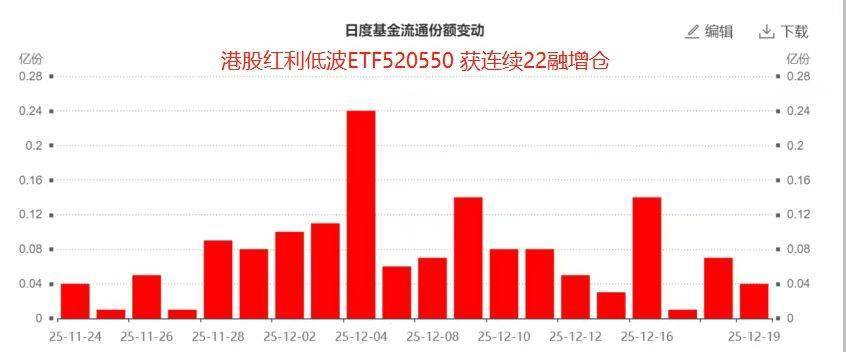
股息率直逼7%!南下资金连续22日加码港股红利低波ETF(520550)
Sou Hu Cai Jing· 2025-12-22 06:27
Group 1 - The core viewpoint of the article highlights that the Hong Kong stock market's dividend low-volatility strategy is becoming a "safe haven" for investors amid global market fluctuations and interest rate uncertainties [1] - The Hong Kong dividend low-volatility ETF has seen a continuous net inflow of funds for 22 trading days, with a cumulative net inflow of nearly 1 billion RMB since the beginning of the year, indicating strong long-term investor confidence in this strategy [1][3] Group 2 - The high dividend yield of the Hong Kong dividend low-volatility index has reached nearly 7%, significantly higher than major mainland indices and leading among global markets, making it an attractive option for investors seeking stable returns [3] - The high dividend assets in the Hong Kong market are primarily concentrated in stable sectors such as finance, energy, telecommunications, and public utilities, which have strong cash flows and consistent dividend policies [3][4] Group 3 - The low-volatility attribute of the Hong Kong dividend low-volatility index aligns with the current market risk preferences, as it offers a stable income and aims to control net asset value drawdowns, serving as a "ballast" in investment portfolios [4] - The strategy is not focused on short-term gains but rather on achieving steady asset appreciation through stable dividend income [4] Group 4 - The ongoing inflow into the Hong Kong dividend low-volatility ETF reflects a rational choice by market funds based on the current macroeconomic environment, favoring assets with high growth certainty and sustainable cash returns [5] - The downward trend in risk-free interest rates enhances the attractiveness of dividend returns, and the promotion of a "dividend culture" among listed companies is expected to deepen [5]

策略升级构建韧性组合
Zhong Guo Zheng Quan Bao· 2025-09-21 20:17
Core Viewpoint - The recent performance of dividend funds has come under pressure due to a shift in market focus towards technology growth stocks, leading to investor concerns about the effectiveness and value of dividend strategies [1][2]. Summary by Sections Dividend Funds Under Pressure - From September 18 to 19, the stock price of Industrial and Commercial Bank of China experienced two consecutive declines, with other bank stocks also performing poorly, resulting in a 4.21% drop in the banking index, the largest decline among 31 Shenwan first-level industry indices [1]. - Approximately 90% of equity dividend funds reported negative returns last week, and around 70% of these funds have negative returns over the past month [1]. Market Sentiment and Concerns - Investors expressed confusion and dissatisfaction regarding the performance of dividend funds on social media, with some humorously suggesting they were "hiding from the market" within these funds [2]. - Concerns were raised about the potential of holding dividend funds at high prices due to the recent downturn in bank stocks [2]. Effectiveness of Dividend Strategies - According to Huaxia Fund, the dividend strategy has not lost its effectiveness; rather, there has been a short-term shift in market style. High dividend assets provide long-term stable returns and low volatility, serving as a ballast in investment portfolios [2]. - The relationship between technology growth and dividend assets is seen as complementary, with dividend strategies likely remaining effective in the long term, especially in the context of global economic uncertainties [2]. Defensive Capabilities of Dividend Strategies - Haitong Securities noted that the appeal of dividend strategies has grown due to their defensive capabilities during volatile market conditions. For instance, from 2021 to 2024, dividend indices outperformed the broader market during periods of decline [3]. - Dividend assets are not only favored during market downturns but also represent a long-term choice for conservative investors, particularly in a low-interest-rate environment [3]. Recommendations for Dividend Strategy Enhancement - Institutions suggest that investors consider a "barbell strategy," which involves combining dividend assets with high-growth assets to capture structural opportunities while maintaining a resilient investment portfolio [4]. - Specific recommendations include investing in Hong Kong dividend funds, which are characterized by deep value and stable performance, particularly in mature sectors like energy and finance [4]. - Investors are also encouraged to explore various dividend index products, such as free cash flow series and dividend quality index products [4].
