
火星任务

Search documents
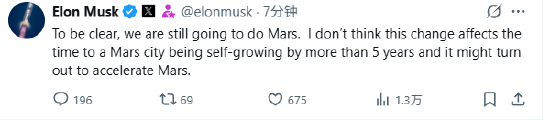
马斯克再回应SpaceX将重心转移至月球:最终将加速火星任务
Xin Lang Cai Jing· 2026-02-15 01:56
Core Viewpoint - Elon Musk clarified that SpaceX will continue to advance its Mars mission despite shifting focus towards lunar exploration, suggesting that this change will not delay the timeline for establishing a self-sustaining city on Mars by more than 5 years and may ultimately accelerate the Mars mission [1] Group 1 - SpaceX is maintaining its commitment to Mars missions while also prioritizing lunar exploration [1] - The timeline for building a self-sustaining city on Mars is projected to be delayed by no more than 5 years due to the shift in focus [1] - The change in focus towards the Moon may potentially expedite the overall Mars mission [1]

SpaceX启动IPO投行遴选,马斯克或成首位万亿美元富豪
Xin Lang Cai Jing· 2025-12-15 13:33
Core Insights - SpaceX is seeking to go public in the second half of next year with a target valuation of approximately $1.5 trillion, comparable to Saudi Aramco's record valuation of about $1.7 trillion in 2019 [1] - Elon Musk holds about 42% of SpaceX, positioning him to potentially become the world's first trillionaire [1] - SpaceX executives are in the process of selecting Wall Street bankers to provide advisory services for the IPO, marking a significant step towards the public offering [1] Financial Highlights - The latest internal stock price for SpaceX is set at $421 per share, reflecting a company valuation of $800 billion, which is double the valuation of approximately $400 billion earlier this year [1] - The funds raised from the IPO are intended for increasing the launch frequency of the Starship rocket, deploying AI data centers in space, and advancing both unmanned and manned missions to Mars [1]
史上最大IPO,要来了
Zhong Guo Ji Jin Bao· 2025-12-13 23:26
Core Viewpoint - SpaceX is preparing for a potential IPO, aiming for a valuation of approximately $800 billion, which could make it the largest IPO in history [2][5]. Group 1: IPO Preparation - SpaceX is advancing an internal share transfer transaction, indicating serious consideration for going public next year [2]. - The company’s CFO, Bret Johnsen, mentioned that if executed well and market conditions are favorable, the IPO could raise significant funds [4]. - The potential IPO fundraising could exceed $30 billion, making it the largest IPO ever if realized [5]. Group 2: Valuation and Market Position - The latest secondary market transaction priced shares at $421, nearly double the $212 per share from July, raising the company's valuation from $400 billion to $800 billion [4]. - This valuation surpasses OpenAI's record of $500 billion, reaffirming SpaceX's position as the highest-valued private company globally [5]. - The company aims for an overall valuation of about $1.5 trillion, approaching the record set by Saudi Aramco during its 2019 IPO [6]. Group 3: Business Operations and Future Plans - SpaceX is recognized as the leading rocket company in terms of launch frequency, primarily through its Falcon 9 rocket [9]. - The company is also a leader in low Earth orbit internet services via its Starlink system, currently serving millions of users [10]. - The funds from the IPO are intended to enhance the launch frequency of the Starship rocket, deploy AI data centers in space, and advance both crewed and uncrewed Mars missions [4].
美国《大西洋月刊》:未来宇航员可能是探险家
Huan Qiu Shi Bao· 2025-06-19 22:38
Core Viewpoint - The article discusses the evolving profile of astronauts needed for future Mars missions, emphasizing the necessity for individuals with unique backgrounds, such as adventurers, who can thrive in extreme and isolated environments [2][3][4]. Group 1: Astronaut Selection for Mars Missions - Current astronauts are primarily selected from backgrounds in engineering, piloting, or science, but for Mars missions, NASA may need to consider candidates with experience in crisis situations and teamwork, such as outdoor adventurers [2][4]. - Joseph Dituri, a unique candidate with a background in deep-sea exploration, exemplifies the type of individual who could bring different skills to the astronaut role, despite not fitting the traditional mold [3][4]. Group 2: Challenges of Mars Missions - Mars missions will require astronauts to endure a journey exceeding 200 days, necessitating exceptional psychological resilience and teamwork skills due to the prolonged isolation and potential stressors [2][4][5]. - NASA is already preparing for six-month missions and is considering the implications of longer space travel, indicating a shift in how astronaut capabilities are evaluated [4][5]. Group 3: Historical Context of Astronaut Selection - Historically, NASA has selected astronauts from military and aviation backgrounds, but the unique demands of Mars missions may require a reevaluation of this approach [4][5]. - The agency has previously considered unconventional candidates, such as balloonists and mountaineers, but ultimately opted for pilots due to concerns about finding suitable candidates from those fields [4].
