
火箭回收复用技术

Search documents
商业航天主题指数实现八连阳 可回收技术的概念股获融资客青睐
Xin Lang Cai Jing· 2026-01-06 23:25
Core Viewpoint - The commercial aerospace sector has shown strong momentum, with the Wande Commercial Aerospace Theme Index achieving an 8-day consecutive rise and a cumulative increase of over 36% since December 24, 2025 [1] Group 1: Industry Trends - The recovery and reuse of rockets significantly reduce launch costs and enhance the responsiveness of launch missions [1] - There are currently 30 stocks in the A-share market related to the reusable technology industry chain, primarily distributed across defense, machinery, and construction sectors [1] Group 2: Financing and Investment - Since the fourth quarter of last year, stocks related to reusable technology have attracted significant interest from investors, with a total financing balance of nearly 29.9 billion yuan as of January 5, 2026, representing an increase of over 65% compared to the end of the third quarter of 2025 [1] - Specific stocks such as Aerospace Electric, Aerospace Power, and Rigol Navigation have seen financing balances increase by over 100% [1] Group 3: Institutional Interest - Nine stocks have been identified that received research from more than ten institutions since the fourth quarter of last year, with a financing increase of over 30% as of January 5 compared to the end of the third quarter, including Rigol Navigation, Chaojie Co., and Srey New Materials [1]
2025 年发射次数创新高,我国火箭发射有望持续加速
Changjiang Securities· 2026-01-05 05:17
Investment Rating - The investment rating for the industry is "Positive" and is maintained [7] Core Insights - In 2025, China's space launches reached a record high with a total of 92 launches, significantly up from 68 in 2024, indicating a robust growth trajectory for the commercial space industry [2][4] - The acceleration in launches is attributed to advancements in technology and funding solutions, suggesting that the commercial space sector is poised for rapid development [2][4] - The report emphasizes the importance of monitoring key suppliers within the commercial space industry, particularly leading companies, satellite assembly firms, and core component suppliers [2][4] Summary by Sections Launch Statistics - In 2025, China completed 92 space launches, with 90 successful and 2 failures, marking a substantial increase from the previous year's 68 launches [4] - The second half of 2025 saw a notable increase in launch activity, with 57 launches compared to 35 in the first half [4] Future Projections - The report anticipates that the number of launches in 2026 will continue to rise, potentially exceeding 100 launches, driven by new rocket technologies and the establishment of the Commercial Space Administration [4] Role of Private Enterprises - Private space companies are expected to play a more significant role in 2026, with the Shanghai Stock Exchange introducing new listing rules to support commercial rocket enterprises [4] - The IPO of Blue Arrow Aerospace aims to raise 7.5 billion yuan, with a portion allocated for enhancing reusable rocket capabilities [4] Global Context - The global space launch market also saw an increase, with total launches surpassing 300 for the first time, indicating a competitive landscape [4] - The U.S. accounted for approximately 60% of global launches, highlighting the international dynamics of the space race [4]
山东海阳,凭啥能频频给全国网友“刷”火箭?
Qi Lu Wan Bao· 2025-12-13 22:53
Core Viewpoint - The successful launch of the "Yinli No.1" (Yao II) rocket marks a significant milestone for China's commercial space industry, showcasing the capabilities of the Yantai Oriental Spaceport and its strategic importance in the global aerospace sector [3][9]. Group 1: Launch Details - The "Yinli No.1" (Yao II) rocket was launched on October 11 from the offshore area near Haiyang, with a successful mission that included the deployment of three satellites [3][4]. - The rocket has a launch capacity of 200 to 400 kilograms, capable of deploying multiple satellites in a single mission, enhancing China's satellite launch capabilities [3][4]. Group 2: Infrastructure and Development - The Yantai Oriental Spaceport has established itself as China's first commercial offshore launch port, benefiting from a robust industrial foundation and a comprehensive development strategy [6][9]. - The spaceport has successfully completed 20 offshore launch missions, deploying a total of 130 satellites, and has developed a high-frequency launch capability of "two launches per week nearshore and one launch every two weeks offshore" [7][8]. Group 3: Future Plans and Ambitions - Yantai aims to transition from a focus on launch capabilities to a comprehensive aerospace industry chain, with plans to enhance liquid rocket development and establish a full manufacturing chain for rockets and satellites [10][11]. - The city is positioning itself as a core area for the development of the commercial aerospace industry in Shandong Province, with ongoing policy support and investment aimed at fostering growth [9][11]. Group 4: Economic and Strategic Impact - The development of the aerospace industry in Yantai is expected to significantly contribute to China's ambitions in commercial space, enhancing the nation's capabilities and competitiveness in the global market [12].

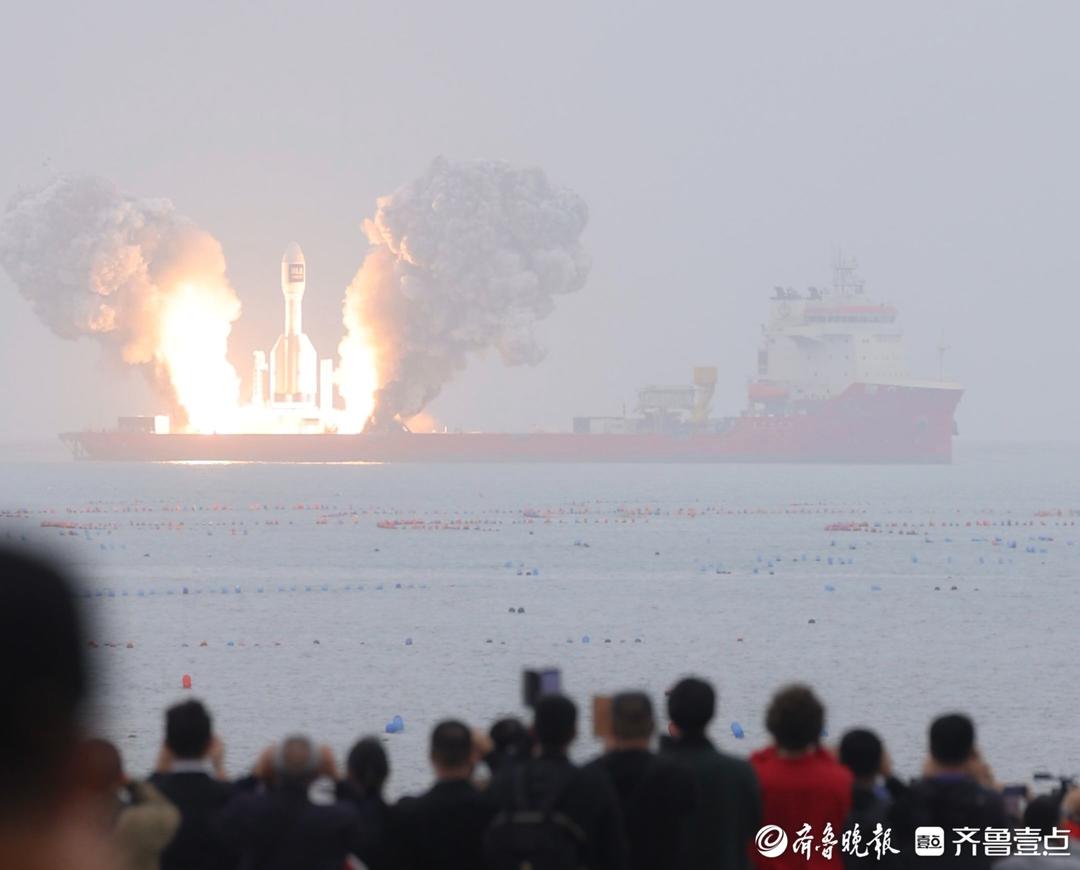
智神星一号复用火箭一级动力海上试车成功
Ke Ji Ri Bao· 2025-11-04 23:52
Core Insights - The company successfully completed the engine system test for the Zhishen-1 reusable liquid launch vehicle, marking a significant milestone towards its maiden flight scheduled for 2026 [1][2] - Zhishen-1 is designed for at least 25 reuse cycles and has a maximum payload capacity of 7 tons to low Earth orbit [1] - The company has developed several key technologies for the rocket's recovery and reuse, including a unique seven-engine parallel configuration and advanced manufacturing techniques [2] Group 1 - The Zhishen-1 rocket's first stage engine system test was successfully conducted at the Dongfang Spaceport, indicating that all major ground tests are complete and the rocket is ready for its first flight [1] - The rocket's first stage utilizes a configuration of seven self-developed CQ-50 engines, with a takeoff mass of approximately 283 tons [1] - The recent test validated the operational feasibility of the rocket's fueling and storage processes, as well as the compatibility of the pressurization and engine systems [1] Group 2 - The Zhishen-1's maiden flight is planned to take place at the Jiuquan "Dongfeng Commercial Aerospace Innovation Test Zone," where the company is finalizing its self-built launch facility [2] - The facility will have capabilities for autonomous testing, fueling, and launching (recovery), and is nearing completion [2] - The company has conducted wind tunnel tests for the recovery guidance control system, providing critical data for its design [2]