智神星一号可重复使用液体运载火箭

Search documents
商业航天“明星企业”星河动力、星际荣耀,IPO有新进展
Shang Hai Zheng Quan Bao· 2026-01-21 02:25
Group 1 - Xinghe Power completed its IPO counseling filing with the Beijing Securities Regulatory Bureau in October 2025, joining the IPO queue for commercial rocket companies [3] - Founded in 2018, Xinghe Power is the first private commercial rocket enterprise in China to achieve mass production, high-density launches, and commercialization of rockets [3] - In 2025, the main engine CQ-50 of the reusable liquid launch vehicle Zhishen-1 completed over 10,000 seconds of cumulative testing, achieving a significant breakthrough with a wide thrust range capability of 32% to 105% [3] - Xinghe Power has successfully completed the testing of the Zhishen-1 rocket's second-stage power system and the first-stage seven-engine parallel test on a sea platform, with the large ground tests for this rocket model now fully concluded [3] - On January 20, Xinghe Power announced the successful full-system hot test of the main engine (CQ-90) for the Zhishen-2 large reusable launch vehicle at the Niutoushan engine test site in Chizhou, Anhui [3] Group 2 - Star Glory Aerospace Technology Group Co., Ltd. was established in October 2016 and successfully launched its independently developed SQX-1 rocket in 2019, becoming the first private commercial launch vehicle company in China to achieve orbit [6] - The company has planned a technology development path from solid to liquid, from small to large, and from space to ground, with a product line of the Double Curve series of launch vehicles [6] - The updates on the IPO counseling progress for both Xinghe Power and Star Glory indicate that the IPO process for commercial aerospace is proceeding normally [6]

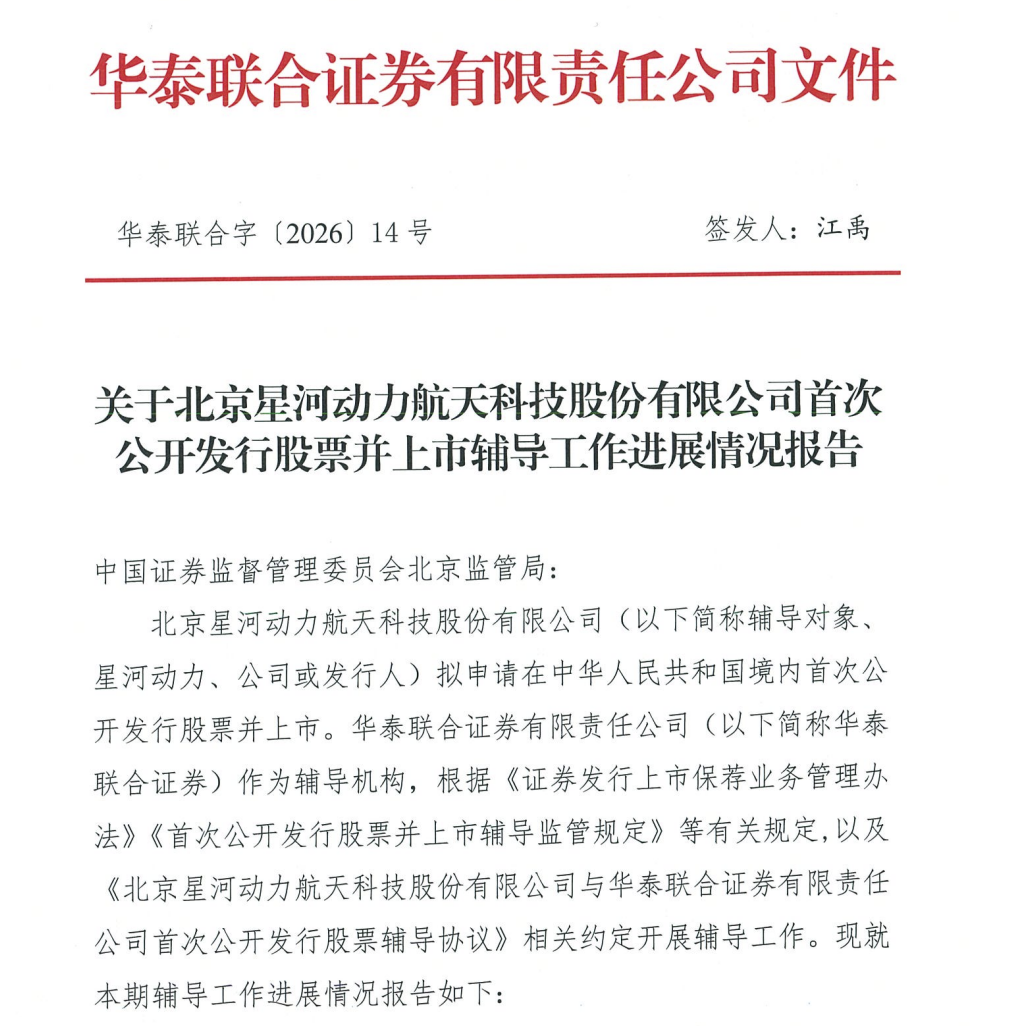
两大商业航天明星企业,IPO有新进展
Xin Lang Cai Jing· 2026-01-21 01:41
Core Viewpoint - The recent updates on the IPO counseling progress of Beijing Xinghe Power Aerospace Technology Co., Ltd. and Star Glory Aerospace Technology Group Co., Ltd. indicate that the IPOs in the commercial aerospace sector are advancing normally [8][16]. Group 1: Beijing Xinghe Power Aerospace Technology Co., Ltd. - Beijing Xinghe Power updated its IPO counseling progress, with Huatai United Securities as the counseling institution [1][9]. - The company was registered for IPO counseling with the Beijing Securities Regulatory Bureau in October 2025, joining the IPO queue for commercial rocket companies [4][12]. - Founded in 2018, Xinghe Power is the first private commercial rocket enterprise in China to achieve mass production and high-density launches [4][12]. - The CQ-50 main engine of the reusable liquid launch vehicle, Zhi Shen Xing-1, completed over 10,000 seconds of cumulative testing in 2025, achieving a significant breakthrough with a wide thrust range capability of 32% to 105% [4][12]. - Xinghe Power has completed various tests, including the second-stage power system test of Zhi Shen Xing-1 and the first-stage seven-engine parallel test on a sea platform, with the large ground test of this rocket model now concluded [4][12]. - The Yao Yi rocket has completed assembly and testing and is set to commence its maiden flight [4][12]. - On January 20, Xinghe Power successfully conducted a full-system hot test of the CQ-90 main engine for the Zhi Shen Xing-2 reusable launch vehicle at the Niutoushan engine test site in Chizhou, Anhui [4][12]. Group 2: Star Glory Aerospace Technology Group Co., Ltd. - Star Glory updated its IPO counseling progress, with Tianfeng Securities and CITIC Securities as the counseling institutions [4][15]. - Established in October 2016, Star Glory successfully launched its independently developed SQX-1 rocket in 2019, becoming the first private commercial launch vehicle company in China to achieve orbit [15]. - The company has planned a technology development path from solid to liquid, small to large, and from sky to ground, with a focus on both solid and liquid rockets [15]. - Star Glory's development strategy includes a phased approach of "application generation, development generation, pre-research generation, and exploration generation," implementing a strategy of "small steps, rapid iterations, and continuous evolution" [15].
稚晖君发布首款个人机器人启元Q1;星河动力:遥一火箭即将开展首飞任务丨智能制造日报
创业邦· 2026-01-01 03:19
Group 1 - The global automotive OLED panel shipment is expected to grow by 11.8% year-on-year in 2025, reaching approximately 3.05 million units, despite a slowdown in adoption due to the electrification and digitalization of the automotive industry [2] - The first flight mission of the Yao-1 rocket by Xinghe Power is imminent, with significant breakthroughs in the main engine's variable thrust capability and successful completion of various testing phases [2] - The world's largest single-unit lithium iron phosphate (LFP) production base has been launched in Yichang, with an annual capacity of 450,000 tons and an expected annual output value of 14.5 billion yuan, marking a record in industry construction [2]

商业航天进入井喷式发展新时代
HUAXI Securities· 2025-11-08 12:15
Investment Rating - The industry rating for the defense and military industry is "Recommended" [1] Core Viewpoints - The commercial aerospace sector in China is entering a new era of explosive growth, with the market size projected to reach approximately 2.3 trillion yuan by 2024, reflecting a compound annual growth rate of about 22% since 2015 [4] - The report highlights that the frequency of commercial launches in China is increasing, with 26 commercial launches completed in 2023, accounting for 38.8% of total launches, and a forecast of 68 launches in 2024, with commercial launches expected to rise to 48.5% [4] - The report identifies three main trends in the current domestic commercial aerospace industry: low-orbit, intelligent, and integrated development, emphasizing the shift from traditional communication to a more intelligent ecosystem [5][6] - The integration of artificial intelligence is reshaping the satellite application industry, moving from a demand-based service model to a real-time response model [7] - The concept of "space computing" is emerging as a significant breakthrough, allowing satellites to process data in orbit, enhancing real-time decision-making capabilities [8][9] Summary by Sections Market Growth - The commercial aerospace market in China is expected to approach 10 trillion yuan by 2030 if it continues to grow at a rate of 25% [4] - The report notes that the commercial aerospace industry is entering a high-speed growth phase from 2026 to 2028, with satellite applications becoming a new type of space information infrastructure supporting the economy and technology [6] Technological Advancements - The report discusses the transition from "ground-based computing" to "space-based computing," highlighting the advantages of deploying data centers in space, such as efficient energy supply and reduced operational costs [8][10] - The development of the "Three-Body Computing Constellation" aims to establish a significant space computing infrastructure, with plans to deploy over 50 satellites by 2025 and reach a total of 1,000 satellites by 2030 [11][12] Investment Opportunities - Key companies benefiting from this growth include: - Putian Technology, involved in the "Three-Body Computing Constellation" project, contributing to satellite communication and ground station construction [14] - Holley Technology, which has seen rapid growth in commercial aerospace orders and has established deep partnerships with major satellite manufacturers [15] - Shanghai Huanxun, a core supplier for satellite communication systems, involved in various low-orbit satellite projects [15] - Zhenray Technology, a supplier of core chips and components for satellite internet, with significant revenue expected from satellite communication [15]
突然,直线涨停!三大利好,重磅驱动!
Zheng Quan Shi Bao Wang· 2025-11-07 04:39
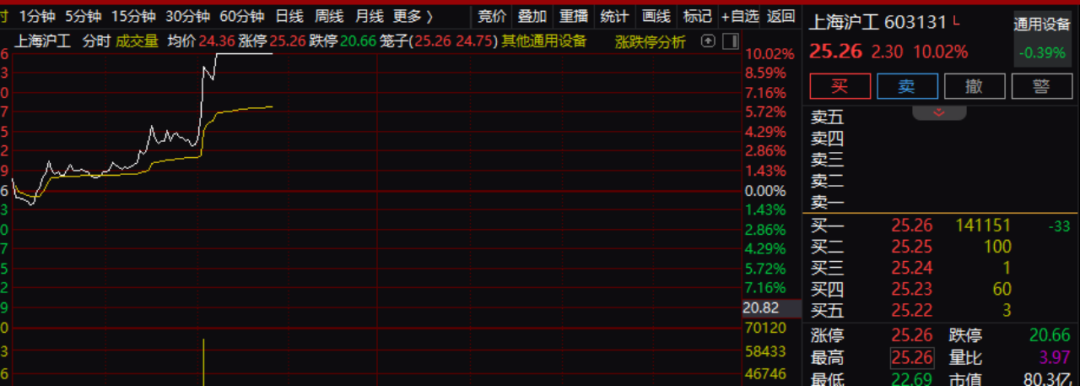
Core Viewpoint - The commercial aerospace sector in China is experiencing a significant surge, driven by recent technological advancements, supportive government policies, and competitive dynamics in the global market [1][4][5]. Group 1: Market Dynamics - The A-share commercial aerospace sector saw a sharp rise, with companies like Shanghai Huguang hitting the daily limit and others like Aerospace Zhizhuang and Shanghai Hanxun also experiencing gains [1][2]. - Analysts attribute this sudden market movement to three main factors: successful tests of reusable rockets, supportive government plans, and international developments in satellite technology [1][4]. Group 2: Technological Advancements - Star River Dynamics successfully completed the ground testing of the Zhishen-1 reusable liquid rocket's first-stage propulsion system, marking a significant milestone towards its maiden flight [4]. - The Zhishen-1 is designed for at least 25 reuses and targets the large satellite launch market, indicating a shift towards more sustainable space operations [4]. Group 3: Government Policies - The 14th Five-Year Plan emphasizes the construction of a "strong aerospace nation," highlighting the importance of commercial aerospace alongside other sectors [1][4]. - Future government reports are expected to further promote the development of commercial aerospace and related industries as new growth engines for the economy [4][5]. Group 4: Global Competition - The global commercial aerospace landscape is intensifying, with the U.S. leading in technological innovation and market presence, while China is rapidly catching up [5][6]. - The competition for satellite orbits and frequency resources is becoming critical, with countries recognizing the strategic value of low Earth orbit and satellite communication systems [6]. Group 5: Market Potential - The global commercial aerospace market is projected to reach $480.3 billion by 2024, accounting for 78% of the global aerospace economy [5]. - China's commercial aerospace market is expected to grow from 324.4 billion yuan in 2017 to 713.3 billion yuan by 2024, reflecting a compound annual growth rate of 11.9% [5].
突然,直线涨停!三大利好,重磅驱动!
券商中国· 2025-11-07 04:36
Core Viewpoint - The commercial aerospace sector in China is experiencing a significant surge, driven by recent developments in reusable rocket technology, supportive government policies, and competitive dynamics in the global market [1][2][4]. Group 1: Recent Developments - Beijing's Xinghe Power Aerospace successfully completed the ground testing of the first stage power system for the reusable liquid rocket, Zhishen-1, marking the completion of all major ground tests and preparing for its maiden flight [2][5]. - The successful static ignition test of the reusable rocket Zhuque-3 has also been completed, indicating readiness for its first launch [5]. - The commercial aerospace concept has gained momentum, with several companies like Shanghai Huguang and others experiencing significant stock price increases [1][4]. Group 2: Policy Support - The 14th Five-Year Plan emphasizes the construction of a manufacturing powerhouse, quality powerhouse, aerospace powerhouse, and other strong nations, highlighting the importance of commercial aerospace [2][6]. - The 2024 Government Work Report aims to actively develop commercial aerospace and low-altitude economy as new growth engines, further reinforcing the policy framework for the sector [6]. Group 3: Global Competition - Elon Musk announced plans to expand SpaceX's Starlink V3 satellite scale and establish data centers in space to address the growing demand for computing power in the AI era, indicating a rising interest in space-based computing resources [2][6]. - The U.S. has launched over 10,000 satellites, significantly impacting global communications, and China is expected to accelerate its launch schedule in the coming years [4][9]. Group 4: Market Potential - The global commercial aerospace market is projected to reach $480.3 billion by 2024, accounting for 78% of the global aerospace economy [9]. - China's commercial aerospace market is expected to grow from 324.44 billion yuan in 2017 to 713.32 billion yuan by 2024, with a compound annual growth rate of 11.9% [9]. - The competition for satellite orbits and frequency resources is intensifying, with countries recognizing the strategic value of low Earth orbit and frequency resources [9]. Group 5: Future Outlook - By the end of 2025, China is anticipated to witness a series of maiden flights for various reusable rockets, including those from China Aerospace Science and Technology Corporation and other private companies [10].


我国商业航天发展驶入快车道
Zheng Quan Ri Bao Zhi Sheng· 2025-11-05 15:38
Core Insights - The commercial space industry in China is experiencing rapid growth, becoming a key driver of technological innovation and economic growth, with significant advancements expected by 2025 [1][2] - The industry is characterized by a market-oriented approach, with enterprises leading in satellite manufacturing, launch services, and ground equipment manufacturing across various sectors [2] - A surge in financing events has been observed, indicating strong capital inflow into the commercial space sector, with a total of 31 financing events completed by July 2025, amounting to 2.143 billion yuan [3][4] Industry Development - China's commercial space industry has established three major industrial clusters: Beijing-Tianjin-Hebei, Yangtze River Delta, and Pearl River Delta, creating a comprehensive industrial system [2] - The frequency and technology of launches have significantly increased, with notable successful launches in October, showcasing the industry's capabilities [2] - By 2030, the market size of China's commercial space industry is projected to reach 7.8 trillion yuan, highlighting its potential for future growth [5] Financing and Investment - Recent months have seen an acceleration in financing activities, with companies like Star Glory Aerospace and Xinghe Power securing substantial funding [4] - The IPO process for several commercial space companies is also advancing, indicating a growing interest from the capital markets [4] - The development of the commercial space industry is supported by multiple factors, including policy incentives, capital influx, enhanced innovation capabilities, and increasing market demand [4]

智神星一号复用火箭一级动力海上试车成功
Ke Ji Ri Bao· 2025-11-04 23:52
Core Insights - The company successfully completed the engine system test for the Zhishen-1 reusable liquid launch vehicle, marking a significant milestone towards its maiden flight scheduled for 2026 [1][2] - Zhishen-1 is designed for at least 25 reuse cycles and has a maximum payload capacity of 7 tons to low Earth orbit [1] - The company has developed several key technologies for the rocket's recovery and reuse, including a unique seven-engine parallel configuration and advanced manufacturing techniques [2] Group 1 - The Zhishen-1 rocket's first stage engine system test was successfully conducted at the Dongfang Spaceport, indicating that all major ground tests are complete and the rocket is ready for its first flight [1] - The rocket's first stage utilizes a configuration of seven self-developed CQ-50 engines, with a takeoff mass of approximately 283 tons [1] - The recent test validated the operational feasibility of the rocket's fueling and storage processes, as well as the compatibility of the pressurization and engine systems [1] Group 2 - The Zhishen-1's maiden flight is planned to take place at the Jiuquan "Dongfeng Commercial Aerospace Innovation Test Zone," where the company is finalizing its self-built launch facility [2] - The facility will have capabilities for autonomous testing, fueling, and launching (recovery), and is nearing completion [2] - The company has conducted wind tunnel tests for the recovery guidance control system, providing critical data for its design [2]
星河动力智神星一号即将开展首飞发射
Zhong Guo Jing Ji Wang· 2025-11-04 14:34
Core Insights - The successful test of the first stage propulsion system for the Zhishen-1 reusable liquid launch vehicle marks a significant advancement for the company, indicating readiness for the upcoming maiden flight [1] - Zhishen-1 is designed for at least 25 reuse cycles, targeting the large satellite launch market with a lift-off mass of approximately 283 tons and a low Earth orbit capacity of 7 tons [1] - The company has developed several core technologies for the recovery and reuse of the first stage, including a unique seven-engine parallel scheme and advanced manufacturing techniques like 3D printing [1] Company Developments - The maiden flight of Zhishen-1 is planned to take place at the "Dongfeng Commercial Aerospace Innovation Experimental Zone" in Jiuquan, with the construction of the launch site nearing completion [2] - The launch site will enhance the company's capabilities in autonomous testing, fueling, and launching (recovery), thereby improving its core competitiveness [2]

晚报 | 11月5日主题前瞻
Xuan Gu Bao· 2025-11-04 14:28
Commercial Aerospace - Xinghe Power successfully completed the test of the Zhishen-1 reusable liquid rocket's first stage power system, marking a significant step towards its maiden flight [1] - The Zhishen-1 is designed for at least 25 reuse cycles and targets the large satellite launch market, with plans for orbital recovery tests starting in 2026 [1] - Analysts believe the commercial aerospace industry will enter a high-speed growth phase by 2025, driven by advancements in reusable technology and cost reduction [1] Foldable Screens - Apple is expected to release a foldable iPhone next year, with a starting price around 16,000 yuan, competing with Huawei's Mate X6 [2] - The foldable iPhone is projected to have a shipment volume of 8-10 million units in 2026, potentially increasing to 25 million units by 2027 [2] - The supply chain for the foldable iPhone is in a critical validation phase, with significant focus on hinge and ultra-thin glass technologies [2] AI in Healthcare - The National Health Commission has issued guidelines to promote and regulate the application of AI in healthcare, aiming for widespread use of intelligent decision-making tools by 2027 [3] - By 2030, the goal is to achieve full coverage of intelligent assistance in primary healthcare settings [3] - The integration of AI in healthcare is seen as a key driver for high-quality development in the health industry [4] AI Glasses - The AI glasses market is experiencing rapid growth, with major tech companies accelerating their investments [4] - The global shipment of AI glasses is expected to reach 4.065 million units in the first half of 2025, a year-on-year increase of 64.2% [4] - By 2030, the market for AI glasses could exceed 30 billion USD, driven by advancements in technology and expanding application scenarios [5] Stem Cells - An international research team has developed a scalable production method for human kidney organoids, which could significantly reduce waiting times for chronic disease patients [5] - This method allows for the high-precision generation of thousands of kidney organoids in a controlled environment [5] Satellite Internet - The upcoming China Surveying and Mapping Geographic Information Conference will focus on the development of the Beidou navigation application industry, which is expected to see significant growth [6] - The demand for core components and terminal devices in the satellite navigation industry is anticipated to increase, driven by advancements in technology and policy support [6] Innovative Drugs - The National Medical Insurance Administration is negotiating the pricing of innovative drugs for the 2025 National Basic Medical Insurance Drug List, with 120 companies participating [7] - The global innovative drug market is projected to reach 1.1 trillion USD in 2024, with significant growth expected by 2030 [7] - The diversification of profit models is likely to enhance the profitability of innovative drug companies [7] Consumer Electronics - Nintendo has raised its sales forecast for the Switch 2 to 19 million units by March next year, reflecting strong demand [8] - The consumer electronics industry is expected to evolve towards smart, ecological, and sustainable development, with AI becoming a core driver [8] - The global tablet shipment reached 39.035 million units in the second quarter of 2025, marking a 9.3% year-on-year growth [8]