牛市躁动行情

Search documents
兴业证券:历史上的牛市躁动行情有何规律?
智通财经网· 2025-12-23 12:37
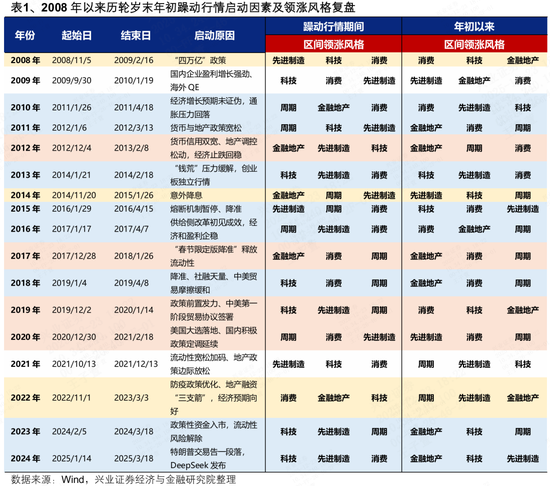
Core Viewpoint - The current bull market is supported by a solid foundation, including an expansionary economic policy tone, improving domestic fundamentals, and ample liquidity in the market [1][5]. Group 1: Economic Indicators and Market Conditions - The economic work conference continues to maintain a positive expansionary tone from last year [5]. - Key data is expected to validate the improvement in domestic fundamentals, with the end of the year and the beginning of the new year serving as critical windows for verifying the upward trend in PPI [5]. - Domestic macro liquidity is abundant, with options for further policy easing such as reserve requirement ratio (RRR) cuts and interest rate reductions [5]. Group 2: Historical Patterns of Bull Market Trends - Historical bull market trends can be categorized into three types based on their initiation timing and catalysts: November starts requiring strong macro policy shifts, December starts following market disturbances, and January-February starts which are common for most bull markets [1][2]. - The analysis of past bull market trends from 2008 onwards shows that even in the absence of strong macro policy shifts, market rallies can still commence following the resolution of prior disturbances [2][9]. Group 3: Potential Catalysts for Market Movement - Key events that may signal the start of a market rally include the resolution of uncertainties that previously suppressed the market, the implementation of easing policies like RRR cuts, and key data that confirms improving fundamentals [8]. - The next potential catalysts for further market excitement include the possibility of RRR cuts and interest rate reductions at the end of the year and early January, as well as key data releases such as PPI, PMI, M1, social financing, and corporate earnings forecasts [8]. Group 4: Market Performance Characteristics - During bull market rallies, the leading sectors typically do not experience significant structural shifts, maintaining a correlation with the performance of sectors from the beginning of the year [9]. - In past bull market rallies, the leading sectors included traditional value stocks and blue-chip companies, with a consistent performance observed across the rallies in 2017, 2019, and 2020 [9].


兴证策略张启尧团队:历史上的牛市躁动行情有何规律?
Xin Lang Cai Jing· 2025-12-23 11:05
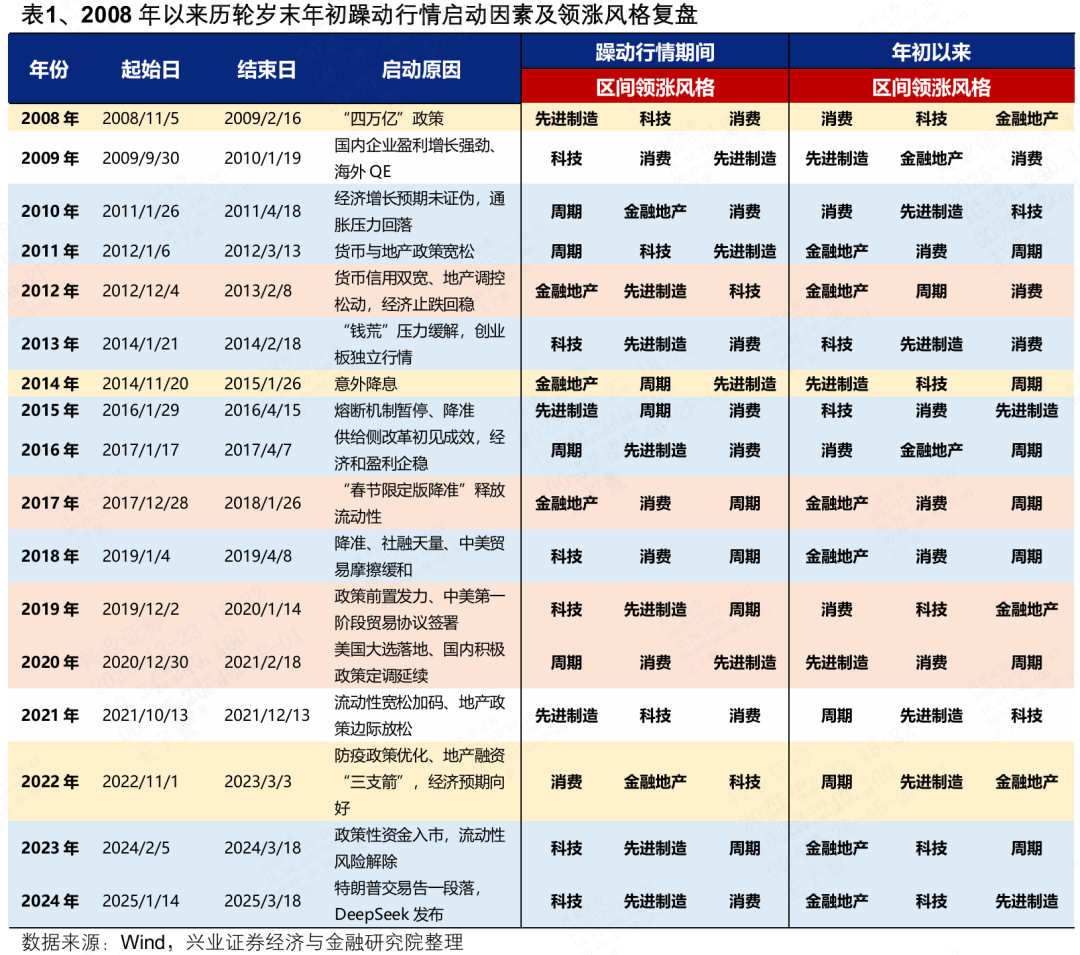
Core Viewpoint - The article analyzes the historical patterns of stock market rally initiations since 2008, categorizing them based on their starting times and catalysts, highlighting the significance of macroeconomic policies and market conditions in triggering these rallies [1][3]. Group 1: Historical Rally Patterns - The article identifies three main categories of rally initiation times: 1. January-February starts, which are the most common for historical rallies [1][3]. 2. November starts, which require a clear shift in macroeconomic policy [1][3]. 3. December starts, which occur after strong market performance but face disturbances that, once resolved, lead to a rally [1][3]. Group 2: Key Factors for Rally Initiation - The analysis of the rallies in 2017, 2019, and 2020 reveals that they often began despite lacking strong macroeconomic policy shifts, indicating that market sentiment can drive early rallies [15][20]. - Important factors contributing to the initiation of these rallies include: 1. Positive policy signals from year-end meetings that bolster market sentiment [15][20]. 2. Improvement in economic fundamentals and corporate earnings, with no significant disturbances in economic data or earnings forecasts [15][20]. 3. Loose monetary policy and ample liquidity supporting market growth [15][20]. Group 3: Signals for Rally Initiation - The article outlines three main types of events that can signal the start of a rally: 1. Resolution of prior uncertainties that have suppressed the market [19]. 2. Implementation of easing policies such as rate cuts that can ignite market enthusiasm [19]. 3. Key economic data that confirms improving fundamentals, enhancing investor participation [19]. Group 4: Industry Performance During Rallies - The analysis indicates that during the rallies of 2017, 2019, and 2020, the leading sectors did not experience significant shifts, maintaining a correlation with the performance trends established earlier in the year [20]. - The leading sectors during these rallies included: 1. In 2017, low-valuation value stocks and blue-chip companies dominated the market [20]. 2. In 2019, the TMT sector continued to thrive, with the rise of the new energy industry [20]. 3. In 2020, the focus remained on high-end manufacturing and consumption, with some resource sectors benefiting from favorable monetary policies [20].