宏观政策转向

Search documents
OEXN:5000美元关口博弈 宏观策略转向
Xin Lang Cai Jing· 2026-02-17 14:25
Core Viewpoint - The gold price is currently in a stalemate around the $5000 mark, with fluctuations influenced by seasonal trading patterns and macroeconomic factors [1][2]. Market Analysis - Gold prices briefly reached $5032 but retreated to approximately $4978.1 due to a lack of momentum as major trading centers entered holiday mode [1][2]. - The current consolidation phase is seen as a self-correction after extreme volatility, with expectations of a new trading channel forming around the $5000 level [1]. - High volatility is anticipated to continue in the short term as the market seeks a bottom [1]. Silver Market - The performance of spot silver has been relatively weak, with a 1.75% daily decline indicating pressure above the $80 mark, primarily due to speculative positions withdrawing in the absence of new liquidity [1][2]. Macroeconomic Factors - The Federal Reserve's neutral stance is expected to persist until mid-year, providing a period of observation for precious metals [3]. - Recent cooling inflation data has led to increased market expectations for a third rate cut in December, which is likely to benefit safe-haven assets [3]. Geopolitical and Policy Influences - Geopolitical tensions and potential tariff policies remain core drivers supporting gold prices in the medium to long term [4]. - Any significant pullback in gold prices may be viewed as a strategic buying opportunity amid ongoing macroeconomic uncertainties [4]. - The appeal of gold as a risk-hedging tool is expected to strengthen in the context of anticipated turmoil in 2026, driven by a growing demand for tangible assets [4].


金价跳水、失守5200!“黑色星期五”席变贵金属市场
Sou Hu Cai Jing· 2026-01-30 06:52
Core Insights - The recent sharp decline in spot gold prices, which fell over 4% and dropped below $5200, is attributed to macro policy shifts, overheated market sentiment, and trading system resonance, indicating a high-level correction phase for the gold market [1] - The Federal Reserve's decision to maintain the benchmark interest rate, halting the previous rate-cutting cycle, significantly corrected optimistic market expectations and led to a rebound in the dollar index, putting pressure on gold prices [3] - The surge in gold prices in early January, nearing a 30% vertical rise, attracted a large amount of high-leverage speculative funds, creating substantial profit margins in the $5200 to $5600 range [4] Market Dynamics - The early Friday morning dip in gold prices triggered massive automated liquidation orders, leading to a snowball effect of selling, which escalated into a technical sell-off [5] - The simultaneous increase in trading margin requirements by the Shanghai Gold Exchange and the Chicago Mercantile Exchange accelerated the price drop through forced deleveraging [5] - Platinum and palladium experienced even more severe declines than gold, highlighting the vulnerability of these less liquid metals amid a downturn in global manufacturing PMI data [5][7] Investor Sentiment - The decline in gold, a traditional safe-haven asset, has led to a sharper drop in platinum and palladium, which rely heavily on speculative trading without physical hedging support [7] - The recent market turmoil serves as a wake-up call for investors, emphasizing the importance of risk awareness over blind speculation in volatile markets [7] - The $5000 to $5200 range is expected to become a new psychological battleground for spot gold, as the market adjusts to the Federal Reserve's policy shift and seeks new support logic [7]
有色金属近来持续大涨底层逻辑及未来前景|财富与资管
清华金融评论· 2025-12-29 10:39
Core Viewpoint - The recent surge in non-ferrous metal prices is driven by three main factors: the wave of "de-dollarization" and rising risk aversion, a shift in macroeconomic policies, and intensified supply-demand conflicts [2][4]. Group 1: Key Factors Driving Price Increases - The "de-dollarization" trend and heightened risk aversion are primarily influenced by geopolitical tensions, such as the U.S. Coast Guard's seizure of the "Century" oil tanker, which has led countries to sell U.S. debt and invest in strategic commodities like gold and silver [4][5]. - A shift in macroeconomic policy, including a cumulative 75 basis points cut in interest rates by the Federal Reserve in 2025, has weakened the dollar and increased the attractiveness of non-ferrous metals priced in dollars. Expectations of further rate cuts in early 2026 are driving capital into the non-ferrous metal market [5]. - Structural supply-demand tensions are evident, with supply shortages in copper due to production halts in key mining regions like the Democratic Republic of Congo and Chile. Additionally, silver has faced a supply gap for five consecutive years, with a projected shortfall of 2,954 tons in 2025, driven by surging demand in solar applications [5]. Group 2: Market Performance and Future Outlook - Prices of various non-ferrous metals have reached new highs, with gold surpassing $4,500 per ounce (up approximately 70% in 2025), silver rising to $74 per ounce (up about 160%), and LME copper exceeding $12,000 per ton [7]. - In response to the price surge, the Shanghai Futures Exchange raised the trading limits for gold and silver futures to 15% and increased margin requirements to a maximum of 17%, signaling a need for rational investment in the market [7]. - Looking ahead, short-term volatility in non-ferrous metal prices may increase, particularly for metals like nickel and palladium, which have diverged from fundamental values. Potential declines in precious metal prices could occur if U.S. stock markets experience significant downturns or if expectations for Fed rate cuts diminish [7].

兴业证券:历史上的牛市躁动行情有何规律?
智通财经网· 2025-12-23 12:37
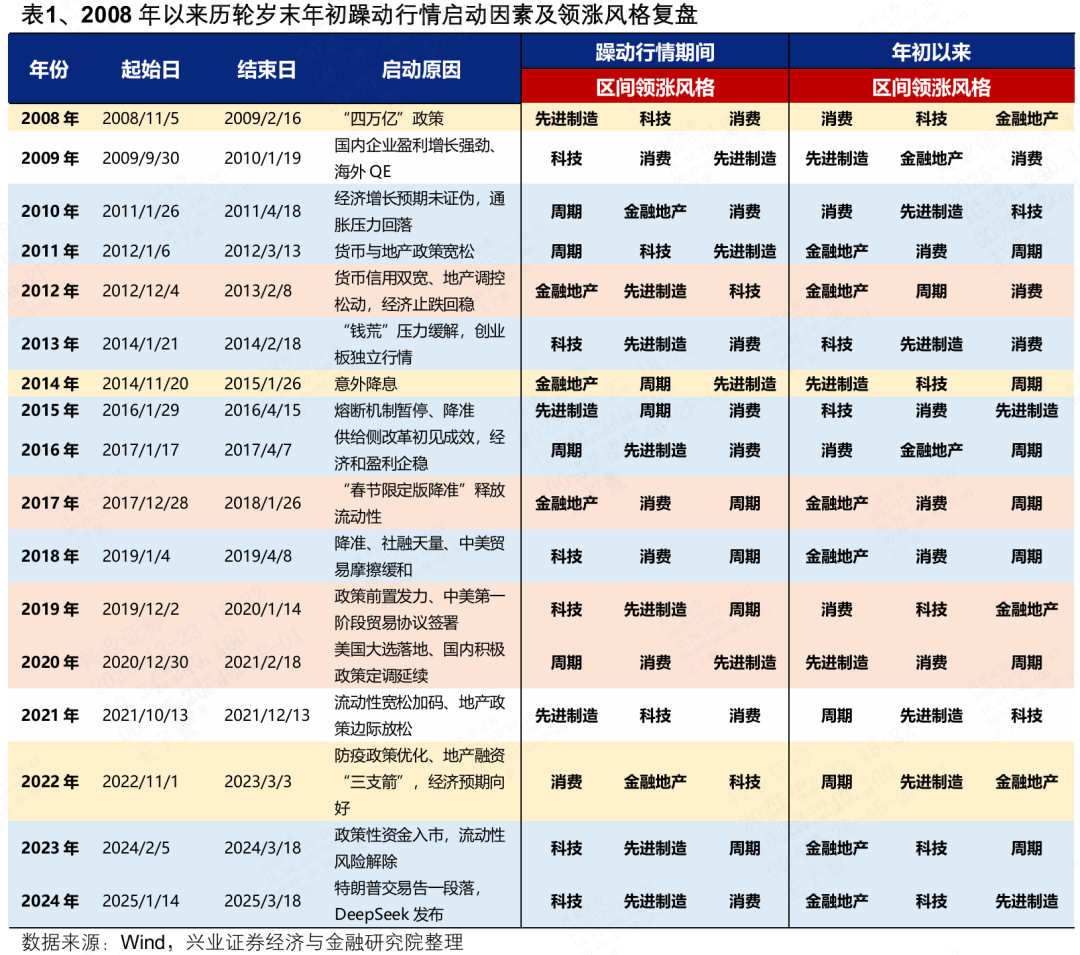
Core Viewpoint - The current bull market is supported by a solid foundation, including an expansionary economic policy tone, improving domestic fundamentals, and ample liquidity in the market [1][5]. Group 1: Economic Indicators and Market Conditions - The economic work conference continues to maintain a positive expansionary tone from last year [5]. - Key data is expected to validate the improvement in domestic fundamentals, with the end of the year and the beginning of the new year serving as critical windows for verifying the upward trend in PPI [5]. - Domestic macro liquidity is abundant, with options for further policy easing such as reserve requirement ratio (RRR) cuts and interest rate reductions [5]. Group 2: Historical Patterns of Bull Market Trends - Historical bull market trends can be categorized into three types based on their initiation timing and catalysts: November starts requiring strong macro policy shifts, December starts following market disturbances, and January-February starts which are common for most bull markets [1][2]. - The analysis of past bull market trends from 2008 onwards shows that even in the absence of strong macro policy shifts, market rallies can still commence following the resolution of prior disturbances [2][9]. Group 3: Potential Catalysts for Market Movement - Key events that may signal the start of a market rally include the resolution of uncertainties that previously suppressed the market, the implementation of easing policies like RRR cuts, and key data that confirms improving fundamentals [8]. - The next potential catalysts for further market excitement include the possibility of RRR cuts and interest rate reductions at the end of the year and early January, as well as key data releases such as PPI, PMI, M1, social financing, and corporate earnings forecasts [8]. Group 4: Market Performance Characteristics - During bull market rallies, the leading sectors typically do not experience significant structural shifts, maintaining a correlation with the performance of sectors from the beginning of the year [9]. - In past bull market rallies, the leading sectors included traditional value stocks and blue-chip companies, with a consistent performance observed across the rallies in 2017, 2019, and 2020 [9].

兴证策略张启尧团队:历史上的牛市躁动行情有何规律?
Xin Lang Cai Jing· 2025-12-23 11:05
Core Viewpoint - The article analyzes the historical patterns of stock market rally initiations since 2008, categorizing them based on their starting times and catalysts, highlighting the significance of macroeconomic policies and market conditions in triggering these rallies [1][3]. Group 1: Historical Rally Patterns - The article identifies three main categories of rally initiation times: 1. January-February starts, which are the most common for historical rallies [1][3]. 2. November starts, which require a clear shift in macroeconomic policy [1][3]. 3. December starts, which occur after strong market performance but face disturbances that, once resolved, lead to a rally [1][3]. Group 2: Key Factors for Rally Initiation - The analysis of the rallies in 2017, 2019, and 2020 reveals that they often began despite lacking strong macroeconomic policy shifts, indicating that market sentiment can drive early rallies [15][20]. - Important factors contributing to the initiation of these rallies include: 1. Positive policy signals from year-end meetings that bolster market sentiment [15][20]. 2. Improvement in economic fundamentals and corporate earnings, with no significant disturbances in economic data or earnings forecasts [15][20]. 3. Loose monetary policy and ample liquidity supporting market growth [15][20]. Group 3: Signals for Rally Initiation - The article outlines three main types of events that can signal the start of a rally: 1. Resolution of prior uncertainties that have suppressed the market [19]. 2. Implementation of easing policies such as rate cuts that can ignite market enthusiasm [19]. 3. Key economic data that confirms improving fundamentals, enhancing investor participation [19]. Group 4: Industry Performance During Rallies - The analysis indicates that during the rallies of 2017, 2019, and 2020, the leading sectors did not experience significant shifts, maintaining a correlation with the performance trends established earlier in the year [20]. - The leading sectors during these rallies included: 1. In 2017, low-valuation value stocks and blue-chip companies dominated the market [20]. 2. In 2019, the TMT sector continued to thrive, with the rise of the new energy industry [20]. 3. In 2020, the focus remained on high-end manufacturing and consumption, with some resource sectors benefiting from favorable monetary policies [20].