物业费下调

Search documents
万万没想到,杭州一物业竟主动降物业费
3 6 Ke· 2026-01-13 02:39
Core Viewpoint - The article discusses the recent trend of property management companies reducing service fees in response to economic pressures and homeowner demands, highlighting the case of Zhongliang Property's fee reduction at the Mu Chen Yuan community in Hangzhou [1][2][10]. Group 1: Fee Reduction Details - Zhongliang Property announced a reduction in the property management fee for the Mu Chen Yuan community from 3.35 yuan/month/㎡ to 2.45 yuan/month/㎡, and parking management fees from 80 yuan/month to 70 yuan/month, resulting in an annual fee reduction of 3.7 million yuan [1][2]. - The fee reduction is framed as a gesture of gratitude and an effort to alleviate the financial burden on homeowners due to the broader economic environment [2][10]. Group 2: Market Trends - Over 100 properties in major cities like Shenzhen, Shanghai, and Wuhan have reduced their management fees by 10% to 40% since last year, indicating a growing trend in the property management sector [2]. - In contrast, in Hangzhou, property management companies are often resistant to fee reductions, with some opting to withdraw from contracts rather than negotiate lower fees [5][6]. Group 3: Conditions for Fee Reductions - Successful fee reductions typically occur under two conditions: when property management contracts are nearing expiration, or when homeowners' committees actively negotiate with property management [3][4]. - For example, the property management fee at Poly Grand View in Xiaoshan was reduced from 3.8 yuan/㎡/month to 3.3 yuan/㎡/month as part of a renewal strategy [3]. Group 4: Economic Context - The article notes that many homeowners are struggling with high property management fees, especially in a market where property values have not appreciated as expected, leading to dissatisfaction among owners who are not occupying their properties [7][8]. - The rising costs of property management fees are attributed to increasing labor costs and expenses related to communal facilities, which have led to a significant increase in fees across the board [8][9]. Group 5: Future Implications - The trend of reducing property management fees may signal a shift in the industry, as companies like Zhongliang Property take proactive steps to maintain customer satisfaction and improve fee collection rates [10][11]. - The introduction of property fee guidelines in various cities suggests a move towards more regulated pricing, which could impact the profitability of property management companies in the long term [9][10].
为什么,越来越多地方物业费开始下调
Hu Xiu· 2025-08-28 02:09
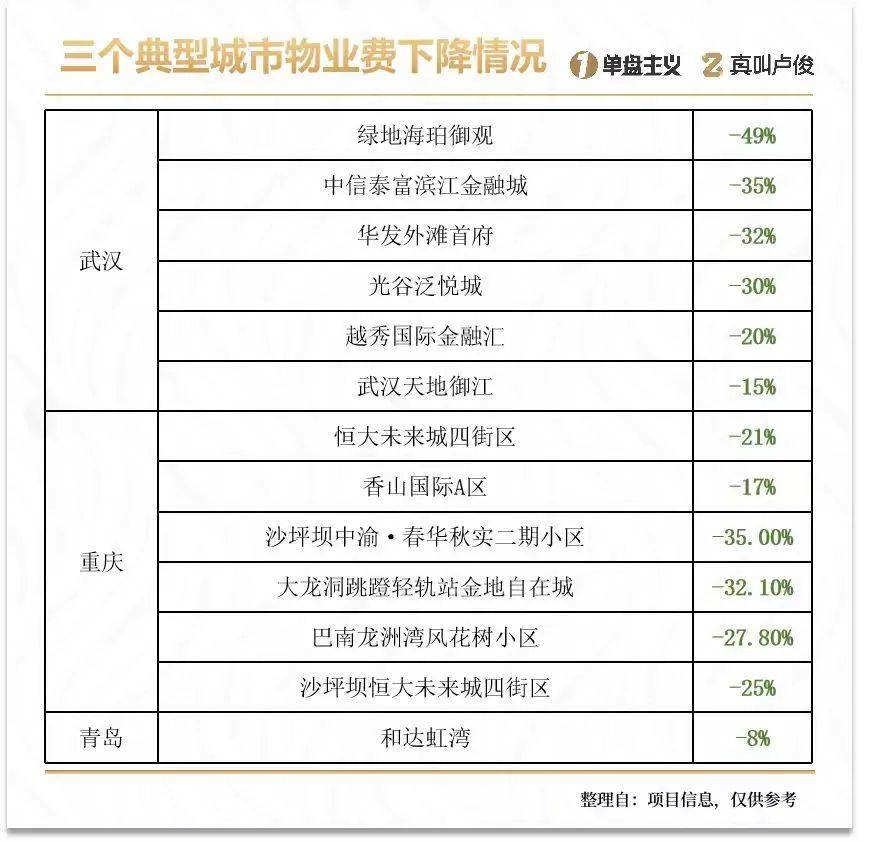
Core Viewpoint - The property management fees are experiencing significant declines across various cities in China, with some areas seeing reductions of up to 49%, indicating a shift in the market dynamics and potential new negotiations between property owners and management companies [1][2][3]. Group 1: Decline in Property Management Fees - Property management fees have decreased notably in cities such as Wuhan, Chongqing, and Qingdao, with specific properties showing reductions of 49% to 8% [1][3]. - For instance, in Wuhan, the property fee for Greenland Haipo Yuguan dropped from 7.6 yuan/sqm/month to 3.84 yuan/sqm/month, marking a substantial decrease [2]. - As of June 2025, the comprehensive index for property service prices in 20 major cities showed a year-on-year decline of 0.11% and a month-on-month decline of 0.08%, with over one-third of these cities experiencing falling fees [10][11]. Group 2: Market Trends and Regulations - The trend of declining property fees is spreading from second- and third-tier cities to first-tier cities, influenced by new regulations allowing homeowners to change property management companies with a certain percentage of agreement [3][25]. - Various provinces and municipalities are implementing regulations to standardize property fee collections, emphasizing transparency and homeowner rights [27][28]. - The decline in fees is not only a response to homeowner dissatisfaction but also a proactive measure by property companies to remain competitive in a challenging market [30][43]. Group 3: Impact on Property Management Companies - Many property management companies are facing declining net profits, with top 500 companies reporting a 2.8% decrease in net profit in 2024, and listed companies experiencing a 23.3% drop [48][50]. - The competitive landscape is leading to a consolidation where stronger companies are likely to survive while weaker ones may exit the market [56][62]. - Property companies are adjusting their service offerings and costs to maintain competitiveness, which may include reducing fees while enhancing service quality [42][70]. Group 4: Homeowner Expectations and Service Quality - Homeowners are primarily dissatisfied with the quality of services provided rather than the fees themselves, indicating that a reduction in fees must be accompanied by adequate service levels to avoid long-term negative impacts on property values [71][72]. - The current trend of fee reductions may be a temporary market adjustment, and there is a risk that if fees drop too low, it could lead to inadequate service provision and deteriorating living conditions [74][78]. - As the market stabilizes, there may be a renewed demand for value-added services, highlighting the importance of quality in property management [78][79].

多个小区物业费下调,10城空置房可以少缴物业费
3 6 Ke· 2025-05-13 01:50
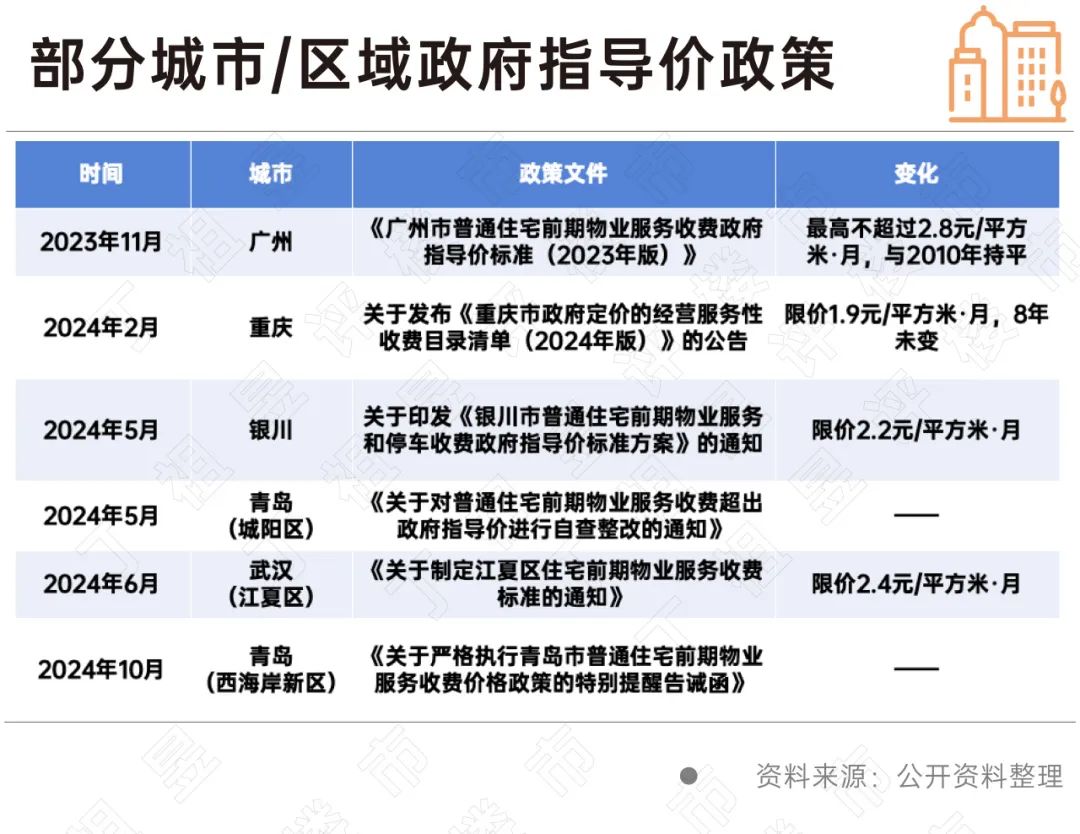
Core Viewpoint - The recent trend of property fee reductions across multiple cities in China has gained significant attention, driven by government guidelines and rising homeowner dissatisfaction with service value [1][2][12]. Group 1: Property Fee Reductions - Over 40 residential communities in Wuhan have announced property fee reductions since 2024, with decreases typically ranging from 10% to 35% [1]. - Specific examples include a villa in Chongqing reducing fees from 4.5 yuan/sqm/month to 2.09 yuan/sqm/month, and a high-end community in Wuhan lowering fees from 7.6 yuan/sqm/month to 3.8 yuan/sqm/month [2]. - The overall percentage of projects reducing fees remains low, with less than 1% of nearly 10,000 projects in four major cities experiencing significant reductions [5]. Group 2: Government Regulations - New regulations in cities like Guangzhou and Chongqing have set property service fee caps, with Guangzhou maintaining a maximum of 2.8 yuan/sqm/month since 2010 [3][4]. - In 2024, Chongqing announced a maximum fee of 1.9 yuan/sqm/month, effective from June 1, 2024 [3]. - Cities such as Yinchuan and Qingdao have implemented self-inspection and compliance measures for property companies exceeding government guidelines [3][4]. Group 3: Discounts for Vacant Properties - Several cities have introduced discounts for vacant properties, with Jiangsu's Zhenjiang allowing a 70% fee payment for homes unoccupied for over six months starting February 2025 [5][6]. - Changsha has implemented a tiered discount system for unoccupied homes, reducing fees to 70% for the first 24 months and 90% thereafter [5][6]. - The trend of offering discounts for vacant properties aims to improve payment willingness among homeowners while ensuring property rights are protected [6]. Group 4: Industry Challenges and Future Outlook - The property management industry is facing declining collection rates, with average collection rates dropping from 92% in 2021 to 80% in 2024 [6][9]. - The ongoing debate over property fees reflects broader issues in the marketization of public services amid rising operational costs and increasing homeowner expectations [12][13]. - The industry is at a critical juncture, requiring property companies to transition from cost controllers to value providers to enhance service quality and homeowner satisfaction [13][14].
你所在的小区物业费调整了吗?
Ren Min Ri Bao Hai Wai Ban· 2025-05-05 22:50
Core Viewpoint - The article discusses the trend of property fee reductions in various cities across China, driven by changes in the real estate market, increased competition among property management companies, and government policies aimed at regulating property service fees [4][6][8]. Group 1: Property Fee Reductions - In cities like Wuhan, property management companies have announced fee reductions, with some areas seeing decreases from 3 yuan/square meter/month to as low as 1.1 yuan/square meter/month, representing a reduction of up to 56% [4][5]. - The average property fee in 20 major cities is projected to be 2.72 yuan/square meter/month in December 2024, with cities like Wuhan and Nanchang experiencing year-on-year declines of 0.72% and 0.47%, respectively [5][6]. - Property fee reductions are primarily concentrated in second and third-tier cities, with reductions ranging from 10% to 40% depending on the city and specific projects [5][6]. Group 2: Factors Driving Fee Reductions - The decline in property fees is attributed to a significant shift in the supply-demand structure of the real estate market, leading homeowners to become more sensitive to property costs and advocate for lower fees through collective bargaining [6][8]. - Increased competition among property management firms has prompted some companies to voluntarily lower fees to improve collection rates and win bids for new projects [6][9]. - Government policies in cities like Qingdao and Chongqing have introduced guidelines for property service fees, aiming to standardize and regulate charges [7][8]. Group 3: Expectations for Property Services - Homeowners express a desire for improved transparency and quality in property services, emphasizing the need for better communication between property management and residents [9][10]. - Property management companies face pressure to maintain service quality while reducing fees, which could lead to increased tensions between homeowners and management if not managed properly [9][10]. - Some property management firms are investing in service quality improvements, such as establishing trust-based management models and enhancing service transparency [10].