
物联网集成

Search documents
大摩中国机器人调研:人形目前缺成熟产品,复合机器人或率先放量
Hua Er Jie Jian Wen· 2025-12-03 10:36
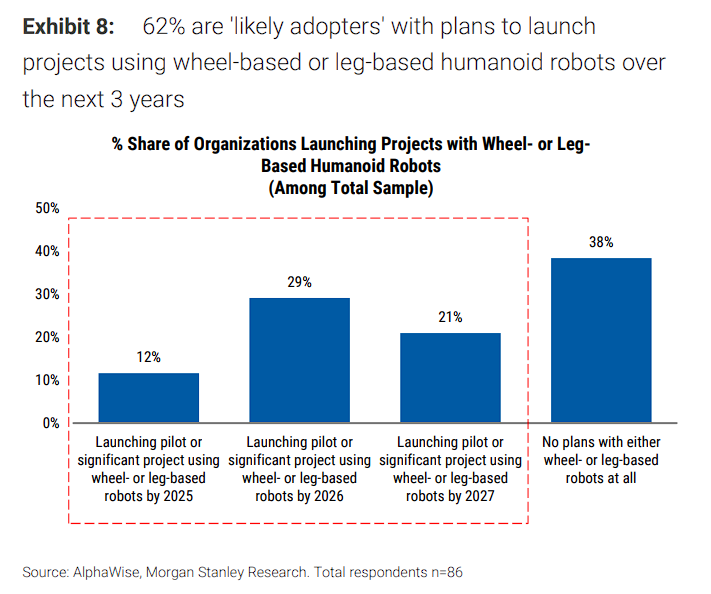
Core Insights - Morgan Stanley's survey reveals a strong interest among Chinese enterprises in deploying humanoid robots, with 62% planning to implement them within three years, indicating significant market potential. However, only 23% of respondents are satisfied with current products, highlighting a critical need for improvements in flexibility, functionality, and pricing [1][4][14]. Deployment Plans - Among 86 surveyed companies, 62% are categorized as "potential adopters," with plans to initiate humanoid robot pilot projects or major deployments within three years. Specifically, 12% plan to invest in 2025, 29% in 2026, and 21% in 2027 [4][3]. - The adoption rate for composite robots (mobile base + robotic arm) is expected to be the fastest, with 21% of companies planning deployment by 2025, increasing to 64% by 2027. In contrast, wheeled humanoid robots will see deployment rates of 8% in 2025, 37% in 2026, and 58% in 2027, while bipedal robots will have rates of 6%, 17%, and 41% respectively [3][7][9]. Product Maturity and Satisfaction - Despite strong market demand, product maturity is a significant constraint on the large-scale application of humanoid robots. Only 23% of respondents express satisfaction with current products, while 53% are neutral and 25% dissatisfied [14][16]. - Satisfaction levels vary by industry, with manufacturing firms showing relatively higher satisfaction compared to industrial and service sectors, which exhibit net dissatisfaction [16]. Performance Expectations - Among potential adopters, only 42%-57% rated various performance indicators as "excellent/good," indicating substantial room for improvement. The most anticipated enhancements include human-robot collaboration (70%), IoT integration (57%), fine manipulation (57%), and self-learning capabilities (49%) [18][24]. - Cost remains a critical barrier, with 92% of respondents believing that the price of humanoid robots must drop below 200,000 RMB (approximately 28,000 USD) for widespread adoption, and 40% identifying the ideal price range as 100,000-200,000 RMB [18]. Market Landscape - Chinese brands dominate the market, with Yushutech being the most engaged integrator, having contact with 60% of potential adopters, followed by Yundongchu (28%), UBTECH (23%), and Midea (17%) [20][22]. - The current brand preferences reflect visibility and media exposure rather than actual performance, as evidenced by Yushutech's high visibility despite lacking manufacturing capabilities [25]. Investment Recommendations - Morgan Stanley maintains a positive long-term outlook for humanoid robots but emphasizes that the market is still in its early stages, with scaling requiring time. The firm suggests prioritizing investments in component suppliers, as these companies are expected to benefit earlier from industry growth [27]. - The anticipated drivers for market interest in 2026 include new product launches by tech giants like Tesla, expanded government subsidies, and IPOs of related companies [27].


声控 LED 腕带产业化机遇:2025-2031年全球市场格局
QYResearch· 2025-10-20 09:23
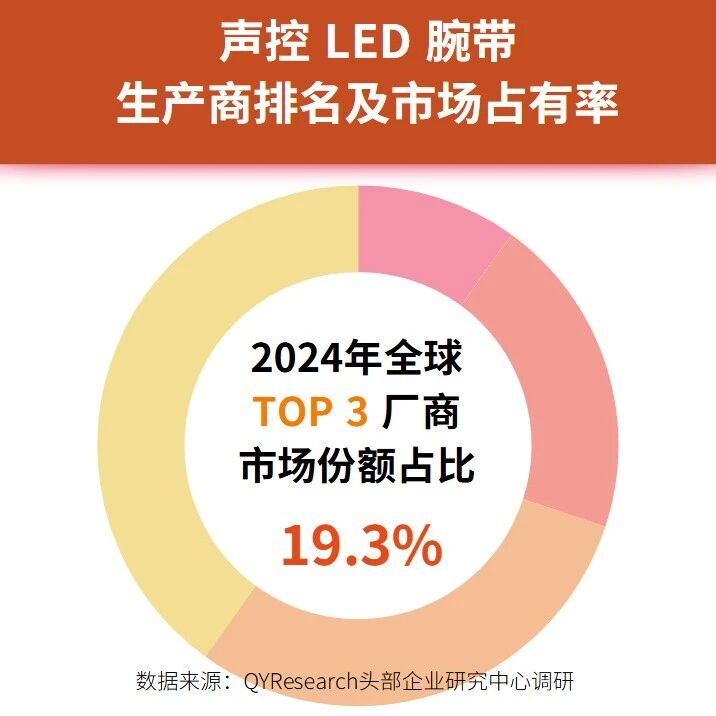
Core Insights - The article discusses the sound-activated LED wristband market, highlighting its expected growth and key players in the industry. The market is projected to reach $13.28 million by 2031, with a compound annual growth rate (CAGR) of 4.5% from 2025 to 2031 [1]. Market Overview - The global sound-activated LED wristband market is experiencing growth, driven by demand in entertainment and fitness sectors [2]. - The top three manufacturers, Nordic wristbands, synometrix, and GFLAI, hold approximately 19.3% of the market share as of 2024 [6]. Industry Chain Analysis - The industry chain includes upstream suppliers of electronic components, materials, and manufacturing equipment, as well as downstream distributors and retail channels [7]. Policy Analysis - Key policies affecting the industry include product safety certifications (CE, FCC, CCC), environmental regulations (RoHS), and incentives for innovation and R&D [8]. Development Trends - The industry is witnessing trends such as integration with IoT, sustainability initiatives, advancements in sensor and LED technology, and increasing demand for personalized services [9]. Opportunities for Growth - Opportunities in the market include the recovery of the entertainment industry post-pandemic, integration with smart wearable devices, B2B customization, and a focus on sustainability [10]. Challenges and Barriers - The industry faces challenges such as intense market competition, technological and standardization issues, supply chain disruptions, and regulatory pressures [11][12].
望变电气: 2025年半年度报告
Zheng Quan Zhi Xing· 2025-08-29 16:18
Core Viewpoint - The report highlights the significant growth in revenue and profit for Chongqing Wangbian Electric (Group) Co., Ltd. in the first half of 2025, driven by strong performance in the power transmission and distribution equipment sector and the oriented silicon steel business. Financial Performance - The company achieved operating revenue of 1.836 billion RMB, an increase of 28.81% compared to the same period last year [3] - Total profit reached 69.79 million RMB, up 75.57% year-on-year [3] - Net profit attributable to shareholders was 546.32 million RMB, reflecting a 57.02% increase [3] - The net cash flow from operating activities was 198.31 million RMB, a significant recovery from a negative cash flow in the previous year [3] Business Segments - The power transmission and distribution equipment segment generated revenue of 1.143 billion RMB, a 46.72% increase year-on-year, primarily due to higher sales of transformers [3] - The oriented silicon steel segment reported revenue of 636 million RMB, a 5.50% increase, driven by a rise in sales volume [3] Industry Context - The power transmission and distribution equipment industry is a strategic and foundational sector for China's economic development, with products widely used in renewable energy, high-end equipment, and new infrastructure [5] - The demand for power equipment is expected to grow significantly due to the ongoing energy transition and the increasing penetration of renewable energy sources [5][6] - The total installed power generation capacity in China reached approximately 3.65 billion kW in the first half of 2025, with solar and wind power showing substantial growth [6][7] Technological Advancements - The company is focusing on high-end, intelligent, and green development, with significant investments in R&D for advanced transformer series and smart power distribution equipment [17] - The oriented silicon steel products have achieved domestic leading quality standards, with a focus on high-grade products that are essential for transformer manufacturing [12][13] Market Position - The company maintains a leading position in the railway traction transformer sector and is expanding its international market presence [8] - It has established long-term strategic partnerships with major clients, including State Grid and China Power Construction, enhancing its competitive edge [8] Future Outlook - The company plans to increase its overseas business share and deepen its market penetration in Europe and the Middle East, aiming for sustainable high-quality growth [17] - The ongoing development of high-performance magnetic materials and smart power systems is expected to further strengthen the company's market position [17]
