
玉米价格上涨

Search documents
看好玉米价格上行
2026-01-29 02:43
Summary of Conference Call on Corn Market Outlook Industry Overview - The conference call focuses on the corn market, particularly in the context of global and Chinese supply and demand dynamics, pricing trends, and investment opportunities within the corn industry [1][3][5]. Key Points and Arguments Global Corn Supply and Demand - The USDA forecasts global corn production for 2024-2025 at 1.23 billion tons, with an increase of approximately 6 million tons expected for 2025-2026. Despite this increase, demand is also rising significantly, leading to a decrease in the global stock-to-use ratio from 24.8% to 22.38%, indicating tighter supply which may support corn prices [1][3][4]. - The demand for corn is expected to remain robust, particularly due to industrial consumption, including ethanol production, which is anticipated to drive prices higher [3][8]. Chinese Corn Market Dynamics - China's corn market is relatively closed, with major production areas in Northeast and Huang-Huai-Hai regions, contributing approximately 70%-80% of national output. Extreme weather in the Huang-Huai-Hai region in 2025 is expected to severely impact yields, while the Northeast region is expected to maintain sufficient supply [5][6]. - Import policies in China have tightened, reducing imports from historical levels of over 20 million tons to a few million tons, aimed at protecting farmers' interests and ensuring food security [5]. Corn Processing Industry - The profitability of China's corn deep processing industry has been poor in recent years but is expected to improve starting in the second half of 2025. This improvement is attributed to the increased use of lower-quality corn for processing, which enhances operational rates and profit margins for processing companies [6][8]. Wheat and Corn Relationship - There exists a substitution relationship between wheat and corn, where high corn prices may lead to increased use of wheat as a feed alternative. Current weather conditions affecting wheat sowing in the Huang-Huai-Hai region may elevate wheat prices, indirectly influencing corn price trends [7][9]. Future Demand for Feed Grains - Global demand for feed grains is expected to steadily increase, supported by the recovery of pig stocks and expansion in poultry farming. This trend is mirrored in China, where the recovery in pig inventory and growth in poultry farming will bolster feed grain demand, particularly for corn [8]. Investment Opportunities Notable Companies in the Corn Industry 1. **Beidahuang**: Benefits from rising land rental expectations due to increased grain prices. The company has over 10 million acres of land, with 10%-20% allocated for corn cultivation. The dividend rate is close to 4%, with strong backing from the major shareholder [10][11]. 2. **COFCO Technology**: Focuses on corn deep processing, primarily producing corn ethanol. Although profitability has been low before 2025, it is expected to improve with rising corn ethanol prices [10][13]. 3. **Kangnong Seed Industry**: Noted for its high-yield and dense variety, Kangnong 8,009, which has received positive reviews. The company reported a more than 60% year-on-year increase in advance payments in the first three quarters of 2025, indicating strong demand from distributors [10][13]. Impact of Rising Corn Prices - Rising corn prices are expected to enhance farmers' income, which may lead to increased land rental prices and a greater willingness to invest in high-quality seeds and agricultural inputs. Companies that maintain a strategy of selling high-quality, high-priced products are likely to perform well in terms of sales and pricing [11]. Additional Insights - The agricultural team at Guotai Junan holds an optimistic view on the agricultural market for 2026 and plans to continue organizing events to share insights on various agricultural products, including rubber [12].
进度加快,价格上涨——玉米市场购销两旺
Xin Hua Wang· 2026-01-06 23:41
Group 1 - The core viewpoint of the articles highlights the significant increase in corn prices in Northeast China due to various factors, including adverse weather conditions in other regions, increased demand for domestic corn, and reduced imports [1][2][3] - The corn purchase progress in Northeast China is faster than in previous years, with prices rising approximately 10% year-on-year [1] - The increase in corn prices has led to improved profitability for farmers in Northeast China, with prices rising from around 2050 yuan per ton to approximately 2230 yuan per ton [2] Group 2 - The overall corn production in China is expected to exceed 300 million tons in 2025, marking a 2.1% increase from 2024, and accounting for 42% of the total grain production [3] - The favorable growing conditions in Northeast China, including higher temperatures and increased rainfall, have contributed to the expected increase in corn production [3] - Corn is a vital crop in China, with significant applications in food, feed, and deep processing industries, and it plays a crucial role in the feed industry, consuming about 65% to 70% of total corn consumption [3][4]
玉米市场购销两旺
Jing Ji Ri Bao· 2026-01-06 22:00
Core Insights - The current autumn grain procurement period is critical, with domestic corn market activity strong and procurement progress faster than usual, particularly in Northeast China where prices have risen significantly [1] - The increase in Northeast corn prices is attributed to several factors, including adverse weather in key production areas, increased procurement efforts by the state, and a substantial reduction in imports [1] Group 1: Price Trends and Market Dynamics - Northeast corn prices have increased by approximately 10% year-on-year, with prices rising from around 2050 yuan per ton to about 2230 yuan per ton [1][2] - The demand for domestic corn has surged due to a significant decrease in imports, with a reported 185 million tons imported in the first 11 months of 2025, a decrease of 86.1% year-on-year [1] - Farmers in Northeast China are holding onto their corn in anticipation of higher prices, indicating a growing sentiment of reluctance to sell [2] Group 2: Regional Production Variations - While Northeast China is experiencing increased corn production and profitability, regions like North China and the Huang-Huai area are facing poor harvests due to adverse weather conditions [2] - The Huang-Huai region has seen corn quality decline due to drought followed by flooding, leading to lower prices for affected crops [2] Group 3: Overall Corn Production and Consumption - China's total corn production is projected to exceed 300 million tons in 2025, marking a 2.1% increase from 2024, and accounting for 42% of the national grain output [3] - The favorable growing conditions in Northeast China, including higher temperatures and increased rainfall, have contributed to this production increase [3] - Corn serves multiple purposes, with approximately 65% to 70% of consumption going to animal feed, and the deep processing sector consuming around 25% to 30% of total corn [3] Group 4: Market Outlook - The current consumption foundation for corn is solid, supported by strong demand in both the feed and deep processing sectors, indicating stable price support [4]
玉米价格打破"黑12月"规律逆势上涨,供需偏紧推动市场高位震荡
Jin Rong Jie· 2025-12-15 02:13
Group 1 - The corn market is experiencing an unusual trend this year, with prices rising contrary to the traditional decline seen in December [1] - Multiple factors contribute to this price increase, including a sharp reduction in imported corn due to global trade tensions and a continuous decline in domestic old grain inventory [1] - The quality issues of new grain, particularly in North China due to persistent rainy weather causing some corn to mold, are key factors driving prices up [1] Group 2 - Demand remains strong, with significant year-on-year growth in the inventory of pigs and poultry, leading to a substantial increase in feed demand that supports prices [1] - Recent corn futures prices have seen a notable correction, as rising prices since October have narrowed profit margins for deep processing enterprises, reducing their purchasing willingness [1] - In late December, it is unlikely that the Northeast region will see the usual large-scale grain sales, as farmers are reluctant to sell and prefer to hold onto their stocks due to premium purchasing policies [2]
新粮上市之际玉米价格“逆势”上涨的背后:市场表现“冷热不均” 后期或存回调可能
Xin Hua Cai Jing· 2025-12-09 14:01
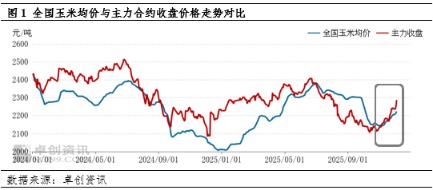
Core Viewpoint - The corn spot prices are showing strong performance due to factors such as farmers' reluctance to sell, rising futures prices, and rigid demand, although there are regional disparities in market performance [1][3]. Group 1: Price Trends - As of December 5, the national average corn price reached 2235.64 yuan/ton, reflecting a month-on-month increase of 4.14% and a year-on-year increase of 9.06% [1]. - The corn futures market has been strong, contributing to bullish market sentiment, with the main contract rising by 7.19% compared to a 4.20% increase in spot prices from November 3 to December 5 [1]. Group 2: Regional Market Performance - There is a noticeable disparity in price increases across different regions, with the Northeast showing a more significant rise in corn prices compared to the relatively stable prices in North China [3]. Group 3: Industry Challenges - Despite rising corn prices, the terminal breeding sector is facing ongoing losses, with average profits for self-bred and self-raised pigs reported at -227.18 yuan/head, a decrease of 14.20 yuan/head week-on-week [5]. - The continuous rise in corn prices is expected to exert pressure on feed prices, further impacting the breeding sector, which has been in a loss position since mid-September [5]. - The market is anticipated to cool down, with potential price corrections expected in mid-December, possibly bringing the national average price below 2220 yuan/ton in the coming month [5].

新粮上市期,东北玉米价格缘何上涨?
Xin Hua Cai Jing· 2025-11-19 07:09
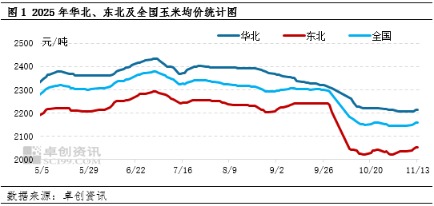
Core Viewpoint - The corn prices in Northeast China are experiencing a slow increase, with the growth rate surpassing that of North China and the national average, primarily due to farmers' reluctance to sell and a slow increase in market supply [1][2][9] Price Trends - As of November 15, the average daily price of corn in Northeast China rose from 2031 CNY/ton to 2051 CNY/ton, an increase of 20 CNY/ton or 0.98%, which is higher than the increases in North China (0.31%) and the national average (0.60%) [2][4] - The price increase is attributed to farmers' reluctance to sell and a slow increase in market supply [2][9] Supply and Demand Dynamics - The average grain selling progress among farmers in Northeast China was 18% as of November 13, which is 2 percentage points faster than the same period last year [4] - The selling pace varies by region, with Liaoning showing a faster pace due to earlier harvests and higher initial market prices, while Jilin and Heilongjiang are slower due to lower temperatures and favorable storage conditions [4][8] - The port of Jinzhou's corn collection volume has decreased significantly compared to last year, indicating a decline in selling willingness among farmers [4][5] Future Price Expectations - The demand from downstream sectors is expected to increase, with traders actively purchasing and building inventories, which will support market prices [8][9] - The overall market price is projected to rise by 40-60 CNY/ton until mid-December, with a potential slight price correction of around 20 CNY/ton in late December due to increased supply [9] Influencing Factors - The sentiment of farmers and traders regarding selling will likely persist, impacting supply levels [8][9] - The end of wheat planting in North China by the end of November may lead to an increase in farmers' willingness to sell, potentially affecting the demand for Northeast corn [8][9]
需求强劲叠加产量下调 芝商所玉米价格攀升至月内高点
Zhi Tong Cai Jing· 2025-08-25 07:00
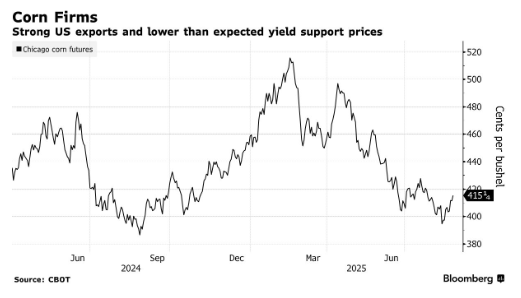
Group 1 - The core viewpoint is that strong market demand and lower-than-expected production forecasts are driving U.S. corn futures prices to their highest levels of the month [1] - U.S. corn export demand remains robust, with net sales increasing by 2.8 million tons for the week ending August 14 [1] Group 2 - Pro Farmer's annual crop survey predicts U.S. corn yield at 182.7 bushels per acre, which, while a record, is still below the USDA's previous estimate of 188.8 bushels per acre [3] - Drought conditions and crop diseases are identified as potential risk factors, which also provide some support for prices [3]
第二轮上涨如期启动,新作预期能否阻碍旧作翘尾?
Dong Zheng Qi Huo· 2025-05-08 04:42
Report Industry Investment Rating - The report gives a "Bullish" rating for corn [6]. Core Viewpoints of the Report - The second-round price increase of corn in the 2024/2025 period has started as expected, and the expectation of new crops is unlikely to prevent the tail-up of old crops [1][3]. - In a normal-yield scenario, the cost of new corn is expected to decline slightly, but there are significant uncertainties related to weather [2]. - The current supply-demand gap of corn has not been filled, and in the medium term, the tight inventory will continue to drive up corn prices [4]. Summary by Relevant Catalogs 1. Gradually Tightening Inventory and the Second-Round Price Increase - The second-round price increase of corn in the 2024/2025 period has started. After the first-round increase, the price entered a wide - range oscillation period. Since mid - April, the price has strengthened again, breaking through the previous resistance level of 2,350 yuan/ton. As of May 7, the closing price of the 07 contract was 2,369 yuan/ton, up about 4% from the annual low of 2,280 yuan/ton [10]. - The expectation that "without large - scale substitution, the real supply gap will emerge in July" may be starting to materialize. Due to a significant decline in imports and a cyclical increase in energy demand, a large amount of substitutes are needed this year. The current wheat situation indicates that large - scale feed substitution will be achieved through the increase in corn prices. Signs of tight inventory are emerging, such as a decline in the inventory of deep - processing enterprises and an improvement in the auction performance of China Grain Reserves Corporation [11]. 2. New Crop Cost and Weather Uncertainties - Sowing: Affected by weather, the sowing of corn in Northeast China has been delayed by 1 - 2 weeks. Although sowing delay is theoretically unfavorable for yield, the overall growing - season weather is more crucial. If the delay is too long, some corn may be replanted with soybeans. Currently, the corn area is not expected to decrease significantly [21]. - Land rent cost: The decline in land rent this year is more moderate than expected and shows regional differentiation. In Heilongjiang, the cost reduction is not obvious, with the northern part remaining basically flat and the central and western parts having a 5% - 10% reduction. In Jilin and Liaoning, the decline is larger than in Heilongjiang but still more moderate year - on - year [2][28]. - Cost in a normal - yield scenario: Taking the median value of the land rent decline in Heilongjiang (-5%) as a reference, in a normal - yield scenario, the new - grain drying cost in Heilongjiang is expected to be about 1,750 yuan/ton, and the port - collection cost is expected to be about 2,010 yuan/ton, a year - on - year decrease of about 60 - 70 yuan/ton. However, if there is a slight reduction in yield (-3%), the cost may remain basically the same year - on - year. The cost of new crops still has uncertainties, and attention should be paid to the weather in the production areas [25]. 3. New Crop Expectations Unlikely to Hinder Old Crop Tail - Up - In Q3 2025, if there is a game between strong reality and weak expectations, this year is expected to be more similar to 2022/2023. Currently, the overall demand is expected to be good, and the phenomenon of a year - on - year sharp decline in imported grains is difficult to reverse. Therefore, in the face of the game between reality and expectations, this year may be more like 2022/2023, where old crops mainly reflect strong reality before the new crops are listed [33][35]. - The repair of trade profits and the likely realization of wheat's indirect support for corn prices. After the first - round price increase, traders have realized good profits. The view that "the minimum purchase price of wheat will indirectly support corn prices" has become a market consensus, and it is likely to be realized this year. Traders may use "wheat price floor - storage cost" as the bottom anchor for corn [36]. 4. Price Outlook and Investment Suggestions - Price outlook: The increase in corn prices has not attracted a large amount of new supply, and the energy demand is relatively rigid. Therefore, the supply - demand gap of corn has not been filled. In the medium term, the tight inventory will continue to drive up corn prices, and the annual high of the 07 contract is expected to reach about 2,450 yuan/ton. In the short term, concerns about import reserve auctions may suppress the upward momentum of futures prices [36][37]. - Investment suggestions: It is recommended to continue to adopt a mid - line strategy of buying on dips for the 07 contract. Attention is also recommended to be paid to the opportunities of 7 - 9 and 7 - 11 positive spreads [38].