现代农业经营体系

Search documents
视频丨今年29省区市将全面开展二轮土地延包试点
Xin Lang Cai Jing· 2026-02-05 14:06
Core Viewpoint - The Chinese government is focusing on stabilizing land contracts and promoting modern agricultural management systems to adapt to the needs of modern agriculture, particularly as the second round of land contracts is set to expire [1][2]. Group 1: Land Contract Stability - The government emphasizes maintaining historical patience and consolidating the rural basic management system while ensuring the foundational role of family farming [1]. - The central policy for this year includes stabilizing land contract relationships, with pilot extensions of the second round of contracts being gradually implemented across 29 provinces, excluding Guizhou and Tibet [1]. Group 2: Agricultural Management Development - The development of moderate-scale operations is identified as a key direction for agricultural modernization, addressing the reality of small landholdings in China [2]. - The government aims to standardize the transfer of land management rights, ensuring it is voluntary and compensated, while protecting the legal rights of both parties involved [2]. Group 3: Quality Development of Agricultural Entities - New agricultural entities are becoming the main force in agricultural development, with a focus on enhancing production capabilities and promoting sustainable practices [2]. - The government plans to improve the quality of farmer cooperatives, eliminating "empty shell" cooperatives and strengthening their role as a bridge between small farmers and larger markets [2].
不能通过行政命令搞整村整乡土地流转,官方解读中央一号文件
Nan Fang Du Shi Bao· 2026-02-04 09:23
Core Viewpoint - The Chinese government emphasizes the need for moderate-scale agricultural operations as a key direction for agricultural modernization, given the country's limited arable land per capita and household [1] Group 1: Agricultural Development Strategy - The government aims to standardize the transfer of land management rights, adhering to principles of voluntary and compensated transactions while protecting the legal rights of both parties involved in the transfer [1] - There is a strong emphasis on developing socialized agricultural services to support smallholder farmers and address critical weaknesses in agricultural production [1] - The government plans to enhance the coverage and depth of agricultural socialized services to integrate small farmers into the modern agricultural development framework [1] Group 2: Operational Framework - The government recognizes the foundational role of family farming while accelerating the establishment of a modern agricultural management system to address the issue of "who will farm" [1]
韩文秀:不能通过下指标、定任务、搞考核等方式硬推土地流转
2 1 Shi Ji Jing Ji Bao Dao· 2026-02-04 04:19
Core Viewpoint - The 2026 Central No. 1 Document emphasizes the acceleration of establishing a modern agricultural management system as a key task, focusing on stabilizing land contracts and promoting appropriate scale operations in agriculture [1][2]. Group 1: Stabilizing Land Contracts - The document outlines a comprehensive second round of land contract extensions for 30 years, with a focus on resolving conflicts and ensuring stability for most farmers' original contracted land [1][2]. - The principle of "big stability, small adjustments" is highlighted, ensuring that the majority of farmers maintain their land while allowing for limited adjustments in special circumstances [2]. - The importance of fair and just procedures in the extension process is emphasized, with a focus on grassroots involvement and tailored solutions for farmers [2]. Group 2: Developing Appropriate Scale Operations - The document recognizes the reality of China's agricultural situation, where the average land per person is limited, and stresses that developing appropriate scale operations is crucial for agricultural modernization [3]. - It advocates for the regulation of land transfer rights, ensuring voluntary and compensated transactions while protecting the rights of both parties involved [3]. - The need for a robust agricultural social service system is highlighted, aiming to integrate small farmers into modern agricultural practices [3]. Group 3: Promoting High-Quality Development of Agricultural Entities - New agricultural entities are becoming the main force in agricultural development, with a focus on enhancing the production and operational capabilities of family farms [5]. - For farmers' cooperatives, the emphasis is on improving quality and eliminating "empty shell" cooperatives to effectively connect small farmers with larger markets [5].

这里的秸秆地何以成为放牧场?
Ren Min Ri Bao· 2025-05-05 07:09
Core Insights - The article highlights the innovative "borrowing grazing" model that addresses the challenges faced by both herders and farmers, promoting resource efficiency and ecological benefits [1][2][3] - It emphasizes the need for reform and innovation in agricultural management to enhance productivity and farmer income, as outlined in the recent "Accelerating the Construction of an Agricultural Power Plan (2024-2035)" [1][2] Group 1: Innovative Agricultural Practices - The "borrowing grazing" model allows herders to find stable feed sources for livestock during winter while providing farmers with rental income and reducing straw disposal costs [1] - Similar innovative practices, such as the "large托管" model in Anhui and the "small fields into large fields" reform in Jiangsu, demonstrate effective resource allocation and enhanced agricultural productivity [2] Group 2: Systematic Support and Management - Successful implementation of the "borrowing grazing" model requires a structured management service system involving provincial, municipal, and county-level coordination to address logistical challenges [3] - The article stresses the importance of a robust agricultural social service system to maximize the benefits of innovative management practices and ensure sustainable agricultural development [3]
政策利好驱动农业股再度强势,新赛股份4连板,关注两条投资主线
Di Yi Cai Jing· 2025-04-09 02:07
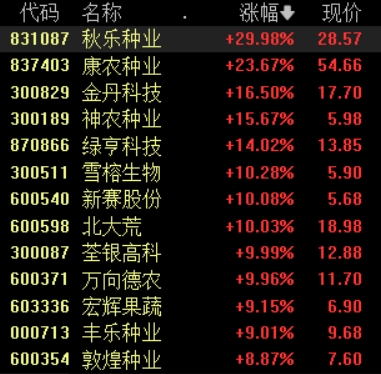
Group 1 - The agricultural sector is experiencing strong performance, with multiple stocks such as XinSai Co., WanXiang DeNong, BeiDaHuang, and QiuLe Seed Industry hitting the daily limit, while others like JinDan Technology and KangNong Seed Industry have risen over 10% [1][2] - Specific stock performance includes QiuLe Seed Industry up by 29.98% to 28.57, KangNong Seed Industry up by 23.67% to 54.66, and JinDan Technology up by 16.50% to 17.70 [2] Group 2 - The Central Committee of the Communist Party and the State Council have issued a plan for building a strong agricultural nation by 2035, aiming for significant progress by 2027 and modernization of rural areas [3] - The plan emphasizes the need for advanced agricultural machinery, highlighting the demand for high-performance and intelligent agricultural equipment, particularly in grain production [3] - The plan also includes upgrading agricultural machinery and promoting the integration of agricultural machinery and agronomy to enhance efficiency and productivity [3] Group 3 - Pacific Securities highlights the defensive attributes of the agricultural sector amid trade tariffs, recommending investment in the planting industry chain related to soybeans and corn, as well as livestock sectors related to pork and poultry [4] - The investment strategy focuses on sectors with strong recovery potential, such as dairy farming and poultry farming, which are experiencing capacity reduction and price reversal expectations [4] - The pet food sector is also identified as a value investment opportunity due to its sustained high demand and overseas production capabilities [4]