
生态战略

Search documents
手机涨价,华为苹果为啥不涨?
36氪· 2026-03-26 10:14
Core Viewpoint - The current price increase in the smartphone industry is a result of a shift from competing on hardware and scale to competing on supply chain, ecosystem, and long-term value [4][67]. Group 1: Price Increase Dynamics - Major brands like Xiaomi, OPPO, vivo, and Honor are signaling price increases for mid-range phones by 300 to 500 yuan and flagship models by 1000 to 2000 yuan [6][7]. - The price of storage chips, particularly DRAM and NAND flash, has surged, with DRAM contract prices increasing by 90% to 95% and NAND flash by 55% to 60% in early 2026 [20]. - The cost of storage chips in a typical mid-range Android phone has risen from approximately 300 yuan to 500-600 yuan, increasing its cost share from 12% to over 20% [20]. Group 2: Factors Behind Price Increases - The demand for storage chips has been drastically altered by the explosive growth of AI servers, which require significantly more memory than standard servers [22][23]. - Major storage manufacturers have redirected over 80% of their advanced production capacity to AI server-specific storage, leading to a severe shortage for mobile devices [24]. - The rising costs of raw materials like copper and aluminum, along with the global AI infrastructure expansion, have further exacerbated the situation [26]. Group 3: Apple and Huawei's Pricing Strategies - Apple has managed to lower the price of the iPhone 17e by 1000 yuan compared to the iPhone 16e, leveraging its massive global procurement scale to negotiate lower prices with suppliers [8][33]. - Apple's self-developed components, such as the C1X baseband, allow it to reduce costs compared to purchasing from third-party suppliers like Qualcomm [36]. - Huawei is not increasing prices due to its self-developed technologies, which help mitigate external cost pressures, and its procurement of domestic components at lower prices [45][49]. Group 4: Market Positioning and Strategy - Huawei aims to enhance its market reputation and user loyalty rather than focusing solely on short-term profits, with a goal of selling 70 million phones in 2026 [50][56]. - Both Apple and Huawei are strategically positioned to maintain or lower prices while other brands are forced to increase them due to weaker supply chain management [57][58]. - The smartphone market is expected to see a significant shift, with lower-end models potentially disappearing or being severely downgraded due to increased component costs [60].



荣耀设计之夜:从海外全球增速第一到AI生态引领,一场全球化突围新战事
Cai Jing Wang· 2026-01-20 11:53
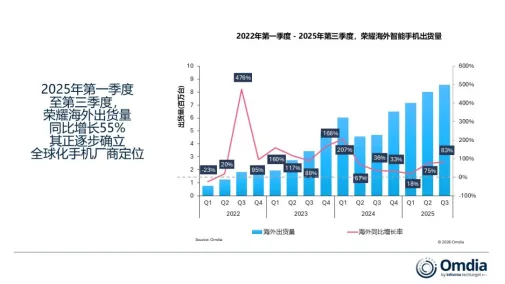
Core Insights - The consumer electronics industry is witnessing a significant transformation, with Honor achieving a historic milestone in overseas market growth, marking a shift from survival to proactive expansion through its "Alpha Strategy" [1][3][12] Group 1: Market Performance - Honor's overseas smartphone shipment volume reached a historic high, with a growth rate of approximately 55% year-on-year in the first three quarters of 2025, positioning it as the top brand in global overseas growth [3][5] - The overseas shipment proportion increased from less than 10% in early 2021 to nearly 50% by Q3 2025, indicating a fundamental shift in Honor's global business structure [3][5] Group 2: Product Strategy - Honor launched three new products during the "Honor Design Night," showcasing its commitment to expanding product, technology, ecosystem, and brand boundaries, leading to significant sales growth and brand elevation [2][12] - The flagship Magic series, including the Magic V5 and Magic8 series, has set industry benchmarks with innovative designs and AI capabilities, contributing to a global shipment of over 71 million units in 2025 [6][7] Group 3: Technological Advancements - Honor's investment in technology is evident, with innovations like the Qinghai Lake battery technology and the Oasis eye protection screen, enhancing user experience and health [8] - The introduction of the world's first "robot phone" and advancements in AI capabilities demonstrate Honor's commitment to leading in AI and robotics [8][10] Group 4: Strategic Expansion - Under new management, Honor is broadening its boundaries by integrating cultural and artistic expressions into its products, exemplified by collaborations with brands like Porsche Design and Jimmy Choo [9][10] - The "1X3XN" ecological strategy aims to transform Honor into a leading AI terminal ecosystem company, enhancing collaboration with partners like BYD and Alibaba [10][11] Group 5: Future Outlook - Honor's strategy for 2026 focuses on three main axes: high-end flagship market expansion, emotional connections with younger consumers, and establishing a brand presence at the intersection of luxury and technology [12][13] - The shift from product-centric competition to an integrated experience encompassing hardware, software, services, and ecosystem collaboration marks a new competitive dimension for Honor [13]
双十一中国智能门锁线上销量:华为无缘前五
Xi Niu Cai Jing· 2025-12-05 09:40
Group 1 - The core point of the article highlights a significant decline in the online sales of smart locks during the 2025 Double Eleven shopping festival, with a total of 1.375 million units sold, representing a year-on-year decrease of 25.8% [2] - The decline in sales is attributed to adjustments in industry subsidy policies leading to consumption pre-spending, reduced promotional intensity, and a high base from the previous year, rather than a loss of interest in the product category itself [6] - Despite the overall market downturn, the smart lock market maintained a sales growth rate of 6.8% in the first three quarters of 2025 [6] Group 2 - The average price of smart locks has been continuously declining, with the online average price during the 2025 Double Eleven period dropping to 1,140 yuan, a decrease of 442 yuan compared to 2023 [6] - Products priced below 1,000 yuan accounted for over 60% of sales, indicating intense price competition in the market [6] - Huawei, despite its presence in the high-end market, failed to enter the top five in sales share during this period, suggesting that its ecosystem strategy may not have effectively translated into sales advantages in a price-driven online promotional market [6] Group 3 - Xiaomi has gained a leading position in sales due to its cost-performance advantage, while traditional lock companies like Kaadas and Dessmann maintain a solid foundation in the high-end market and offline channels [6] - Huawei's focus on mid-to-high-end products limits its coverage in the entry-level market, which is detrimental to expanding its consumer base in a price-sensitive online market [6]
创业公司赚钱的路被Open AI堵死了?
虎嗅APP· 2025-10-26 09:50
Core Insights - OpenAI is aggressively expanding into various AI application domains, including music generation and web browsing, raising concerns among startups about competition and survival [4][5][11]. - The strategic move towards an "AI application store" and the introduction of the AI browser Atlas signifies OpenAI's intent to become a central traffic hub in the AI ecosystem [5][8]. Group 1: OpenAI's Strategy - OpenAI's entry into the music generation space indicates its capability to dominate all AI functionalities, but its strategy focuses on creating an ecosystem rather than integrating every feature into ChatGPT [7]. - The CEO of Jiahe Capital suggests that large-scale consumer applications will attract major model companies, increasing the risk of failure for startups in these areas [7][8]. - OpenAI aims to enhance user retention and engagement by launching more consumer applications, leveraging its existing user base of over 1.1 billion monthly active users [8]. Group 2: Implications for Startups - Startups in vertical AI applications may find it challenging to compete with OpenAI, but those with deep industry knowledge and specialized data may still thrive [12][13]. - Companies like Suno, which recently raised funds and achieved a valuation of $2 billion, demonstrate that specialized knowledge in music generation can provide a competitive edge against larger players [12]. - The success of startups often hinges on their ability to embed deeply within industry workflows and continuously gather proprietary data, which large model companies may struggle to replicate [13]. Group 3: Market Dynamics - The introduction of OpenAI's browser Atlas has raised concerns for existing AI browser startups, as the market appears to favor established giants [16]. - The competitive landscape for AI applications is intensifying, with startups needing to adopt innovative marketing strategies to capture user attention in a crowded market [17]. - The need for AI entrepreneurs to be multifaceted—understanding product development, user engagement, and growth strategies—is becoming increasingly critical in the evolving AI landscape [17].

幸福人寿完成换届 新一任董事长获批
Zhong Guo Jing Ying Bao· 2025-10-08 11:28
Core Viewpoint - The appointment of He Liuyi as the new chairman of Xingfu Life Insurance marks a significant leadership change, potentially leading the company into a new development phase [1][3]. Company Leadership Changes - He Liuyi has been elected as the chairman of the sixth board of directors of Xingfu Life Insurance, following the approval from the Beijing Regulatory Bureau of the National Financial Supervisory Administration [1]. - He Liuyi is the sixth chairman of Xingfu Life, previously serving as the vice president of Jianxin Life Insurance [1][2]. - The recent board restructuring includes the election of eight new directors, indicating a substantial change in the company's governance [2]. Company Performance and Strategy - As of June 30, 2025, Xingfu Life reported total assets of 141.48 billion, a year-on-year increase of 28.64%, and net assets of 8.895 billion, up 27.09% [3]. - The company achieved an annualized financial investment return rate of 6.16% and an annualized comprehensive investment return rate of 5.96% [3]. - Xingfu Life has launched an ecological strategy titled "Happy Life, Happy Companion," focusing on five core areas: health, elderly care, growth protection, wealth enjoyment, and lifestyle enhancement [3].