
电动汽车(EV)

Search documents
金银抢占头条后,铜或成2026年大黑马?
Jin Shi Shu Ju· 2025-12-29 03:55
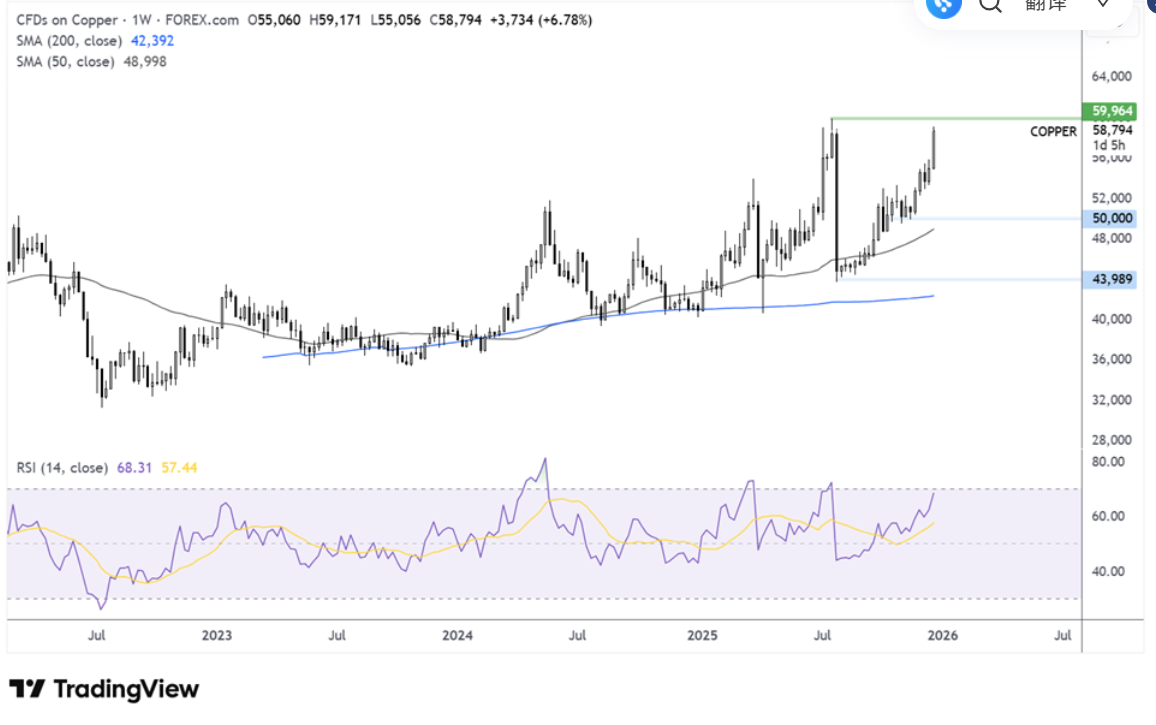
Core Viewpoint - Copper prices are experiencing significant growth, driven by supply constraints and structural demand changes, with expectations for continued upward momentum into 2026 [1][2]. Group 1: Price Trends and Market Dynamics - Copper prices on the New York Mercantile Exchange (Comex) have increased over 30% this year, reaching a five-month high of $5.90 per pound, while prices on the London Metal Exchange (LME) have surpassed $12,000 per ton, marking a 42% increase year-to-date [1]. - The demand for copper is being fueled by the AI and electric vehicle (EV) sectors, with expectations that copper demand in the energy transition sector will double over the next 20 years [1][2]. Group 2: Supply Constraints - Supply disruptions in Chile, Indonesia, and Peru are contributing to a tightening market, with BloombergNEF predicting a potential global copper shortfall of 19 million pounds over the next 25 years if new mines are not developed and recycling rates do not significantly improve [2]. Group 3: Policy and Market Sentiment - The U.S. government's tariff policy has created market volatility, initially excluding refined copper from a 50% tariff, but concerns are growing over potential expansions of this tariff, which could lead to inventory withdrawals from LME for Comex stockpiling [2]. Group 4: Valuation Signals - The copper-to-gold ratio has fallen to a 50-year low, suggesting potential for valuation recovery as copper prices are expected to stabilize after significant increases in gold prices driven by monetary policy and fiscal concerns [2]. Group 5: Technical Analysis - A long-term bullish trend for copper prices has been established, with prices rebounding from a summer low of $4.38 per pound to $5.91 per pound, supported by upward-sloping moving averages [2][3].

GM Cuts Hundreds of Workers as Ford Climbs Most in Three Years
Youtube· 2025-10-24 20:27
Core Insights - The automotive industry is experiencing strong earnings reports from major players like GM and Ford, despite GM's decision to lay off hundreds of workers [1] - Full-size SUVs are driving significant sales for these companies, marking one of the best periods in two decades, although cost issues related to tariffs remain a concern [2] - There is a strategic effort from GM and Ford to express gratitude towards President Trump for tariff relief, while also navigating the competitive landscape against rivals like Stellantis [3][5] Company-Specific Summaries - GM is further along in establishing battery and EV capacity but has faced disappointing sales in the EV segment, leading to cutbacks in investments [7][9] - Ford's reduction in EV investments predates recent policy changes, primarily due to substantial financial losses in that sector [9] - Both companies are adjusting their strategies in response to market conditions and competitive pressures, with Ford potentially benefiting from increased tariffs on competitors' products [5][6]



GM(GM) - 2025 Q2 - Earnings Call Transcript
2025-07-22 13:32
Financial Data and Key Metrics Changes - The company reported record total revenue of $91 billion for the first half of 2025, driven by strong demand and stable vehicle pricing [25] - Adjusted EBIT for Q2 was $3 billion, down $1.4 billion year over year, primarily due to a net tariff impact of $1.1 billion [32][33] - Adjusted automotive free cash flow was $2.8 billion, down $2.5 billion year over year, mainly due to tariff payments and lower dealer inventory levels [33] Business Line Data and Key Metrics Changes - North America revenue reached a record nearly $77 billion for the first half, slightly up year over year [26] - The Chevrolet Equinox gained nearly six points of retail market share year over year, with total sales rising more than 20% compared to the same period last year [12][28] - GM International delivered adjusted EBIT of $200 million in Q2, an increase of $150 million year over year, driven by improved profitability from China equity income [39] Market Data and Key Metrics Changes - GM's U.S. market share reached 17.3% in the first half of the year, marking a 1.2 percentage point increase year over year [28] - The company was the only foreign OEM to gain market share in China, reporting positive equity income and strong performance in new energy vehicles [10][39] - The overall U.S. industry saw a spike in demand due to tariff-related sales pull ahead, with a full-year outlook of 16 million units [10] Company Strategy and Development Direction - The company aims to grow its U.S. manufacturing footprint and domestic supply chain while strengthening its international business [7][19] - GM is focusing on innovation in batteries, software, and autonomous technology, with significant investments in U.S. assembly plants to increase capacity [19][30] - The company is committed to improving EV profitability through advancements in battery technology and vehicle design [47] Management's Comments on Operating Environment and Future Outlook - Management expressed confidence in the company's resilience and ability to adapt to new trade and tax policies [7] - The company anticipates a stable pricing environment and expects to offset at least 30% of the tariff impact through strategic actions [43][45] - Management highlighted the importance of a flexible manufacturing footprint to adjust to changing demand in both ICE and EV markets [21][46] Other Important Information - The company has booked $4 billion of deferred revenue from software services, which will be recognized over time [15] - GM's projected Super Cruise revenue is expected to exceed $200 million in 2025 and double in 2026 [16] - The company is investing in battery joint ventures to enhance its supply chain resilience and reduce costs [22] Q&A Session Summary Question: Can you walk through the accounting for the $600 million related to EVs? - Management explained that the adjustment reflects potential losses on inventory due to market expectations and pricing pressures [50][52] Question: What would be the impact if tariffs with key countries were lower? - Management indicated that lower tariffs would have an immediate positive impact on the company's financials, with ongoing efforts to mitigate tariff impacts [54][56] Question: How do you reconcile pricing assumptions for the second half? - Management noted that fleet pricing normalization is expected, while retail pricing remains stable, supporting their pricing strategy [64][66] Question: What is the strategy for EV profitability given regulatory changes? - Management emphasized a strategic EV portfolio covering various market segments and ongoing efforts to improve EV profitability through cost efficiencies [70][72] Question: How will tariff impacts evolve beyond this year? - Management expects that ongoing investments in U.S. manufacturing will help mitigate tariff costs in the future, although it is too early to predict exact outcomes [80][82]