白酒行业数字化转型

Search documents
十大关键事件,见证宜宾白酒价值跃升
Xin Lang Cai Jing· 2026-01-08 11:37
Core Insights - The article highlights ten key events in Yibin's development as a core area of Chinese liquor, showcasing its achievements in digital transformation, cultural branding, and industry standards, which solidify its status as "China's Liquor Capital" and provide a reference for industry transformation [1][26]. Group 1: Digital Transformation - Yibin's digital transformation sample was selected as the only national-level demonstration in the liquor industry, providing a model for small and medium enterprises to overcome challenges in digitalization [2][4]. - The sample emphasizes the need for collaborative digital transformation across the industry rather than isolated efforts, aiming to enhance efficiency and quality throughout the production chain [4][28]. Group 2: Traditional Advantage and Cluster Effect - Yibin led the initiative for "Sichuan Basin's Strong Aroma Liquor" to be recognized as a national traditional advantage food production area, enhancing the region's brand power and resource allocation [5][7]. - This recognition shifts competition from individual brands to regional clusters, promoting collaboration and resource flow within the Sichuan Basin [7][29]. Group 3: Standardization and Smart Brewing - Yibin established the first national standard for smart brewing, which integrates traditional techniques with modern technology, facilitating industry-wide adoption [3][8]. - The implementation of this standard has led to significant participation from local enterprises, validating its practicality and encouraging a shift towards smart brewing across the industry [8][32]. Group 4: Cultural Branding - Yibin developed the "Five Olds" cultural branding initiative, which translates the region's competitive advantages into recognizable cultural symbols, enhancing brand value in a culture-driven market [9][11]. - The initiative reflects a broader trend in the industry where cultural identity becomes crucial for market acceptance, moving beyond mere consumption to cultural engagement [11][33]. Group 5: Wine and Tourism Integration - Yibin was awarded the title of "World Wine and Tourism Destination," indicating its leadership in integrating cultural experiences with tourism and liquor consumption [12][37]. - This integration redefines the value of wine tourism, transforming it into a platform for cultural engagement and consumer experience, which is vital in the evolving market landscape [37][13]. Group 6: Innovative Exhibition Mechanism - Yibin hosted the 2025 China International Famous Wine Expo, establishing a new model for industry collaboration and resource sharing during a period of market adjustment [14][39]. - The expo serves as a comprehensive platform for showcasing products, sharing industry trends, and facilitating trade, reinforcing Yibin's position as a central hub for industry exchange [39][15]. Group 7: Reverse Investment Strategy - Yibin successfully attracted significant investments during a challenging market period, demonstrating the region's ecological appeal and strategic advantages [16][40]. - The focus on ecological investment rather than individual brand investment reflects a shift in industry dynamics, emphasizing the importance of regional strengths [40][16]. Group 8: Product Innovation - Yibin launched a series of low-alcohol and trendy beverages in response to changing consumer preferences, marking a significant shift in product offerings [17][41]. - This product diversification aims to appeal to younger consumers and adapt to new consumption scenarios, enhancing the region's market image [41][43]. Group 9: Enterprise Cultivation Mechanism - Yibin established a "1134N" enterprise cultivation mechanism to support various tiers of businesses, enhancing the overall industry structure and resilience [18][44]. - This mechanism aims to optimize resource allocation and foster growth across different enterprise scales, contributing to the region's competitive strength [44][47]. Group 10: Education and Talent Development - Yibin deepened its integration of education and industry, establishing partnerships to address talent shortages and align educational outcomes with industry needs [19][48]. - This initiative aims to cultivate a skilled workforce capable of driving innovation and addressing industry challenges, reinforcing the importance of talent in regional competitiveness [48][20].


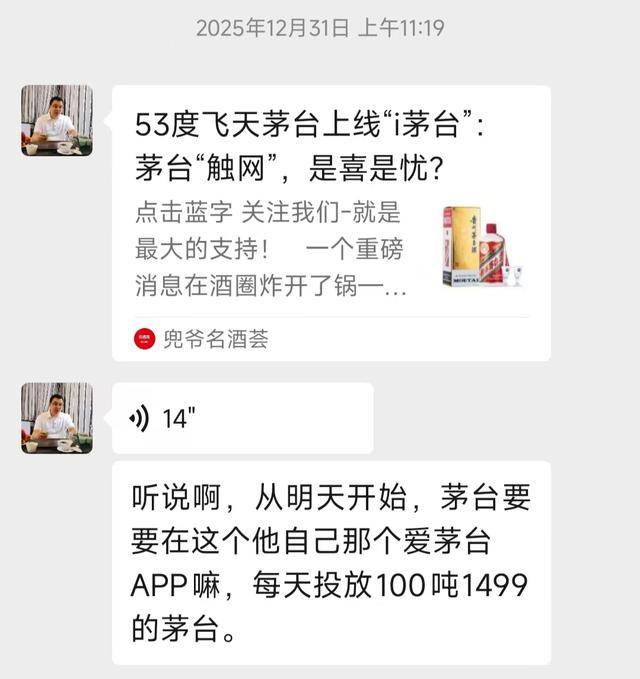
秒空!“i茅台”上线1499元53度飞天,黄牛“末日”?
Sou Hu Cai Jing· 2026-01-02 03:54
Core Viewpoint - The launch of the 1499 yuan official price for the 500ml Flying Moutai on the iMoutai platform marks a significant shift in Moutai's marketing strategy, aiming to regain pricing power and reduce speculation in the market [3][6]. Group 1: Launch and Sales Strategy - Starting January 1, 2026, Moutai will sell the 53-degree 500ml Flying Moutai at an official price of 1499 yuan, with a daily limit of 12 bottles per person [3][4]. - The iMoutai platform has accumulated 67.84 million registered users since its launch in May 2022, with over 17 million monthly active users [4]. - Moutai's direct sales revenue increased from less than 20% in 2021 to approximately 45.89% in the first quarter of 2025, indicating a shift towards direct consumer engagement [4]. Group 2: Market Dynamics and Pricing Power - The previous dual pricing system allowed significant price discrepancies, with wholesale prices around 1169 yuan and market prices exceeding 2500 yuan, creating opportunities for arbitrage [6]. - The market wholesale price of Flying Moutai dropped from 2320 yuan at the beginning of 2025 to 1499 yuan by the end of the year, reflecting a decline of over 30% [6]. - Moutai's reform aims to directly engage consumers and control pricing, potentially increasing company revenue and profit margins by eliminating the middlemen [6]. Group 3: Consumer Impact and Market Reactions - Consumers are expected to benefit from the new pricing strategy, as it ensures authenticity and reduces the need for markups or concerns about counterfeit products [7]. - Moutai's stock price experienced a decline of nearly 3% leading up to the New Year, indicating market uncertainty regarding the effectiveness of the reform [8]. - The company faces challenges in balancing its high-end brand image with expanded market access while stabilizing its distributor network [8].

国有企业杏系品牌管理(山西)有限公司,为清香型白酒赛道注入国企力量!
Sou Hu Cai Jing· 2025-09-06 23:45
Core Viewpoint - The company aims to promote high-quality development in the liquor industry while integrating traditional practices with innovative approaches [1][3]. Group 1: Company Operations - The company operates as a state-owned enterprise under Shanxi Xinghuacun Fenjiu Distillery Co., Ltd., focusing on the national brand operation center for Xinghuacun liquor [1]. - It has established a comprehensive compliance system that adheres to national liquor industry regulations, including product traceability and quality control [3]. - A digital traceability platform has been developed, allowing consumers to check product brewing batches and logistics information in real-time [3]. Group 2: Industry Contribution - The company is actively involved in promoting the cultural value of Qingxiang liquor by organizing forums and releasing consumption trend reports [3]. - It is exploring digital transformation in the liquor industry through a dual-track model of online brand operation and offline experience services, targeting younger consumers [3]. - The "Xinghuacun Liquor Digital Marketing Plan" is expected to drive a 45% year-on-year increase in online sales for 2024, providing replicable practices for traditional liquor enterprises [3]. Group 3: Market Impact - The company has built an operational network covering over 30 provinces and cities nationwide, contributing to the steady increase in market share for Xinghuacun liquor [5]. - By sharing operational experiences and management standards, the company supports the growth of regional liquor distributors [5]. - The company will continue to act as an "industry promoter," focusing on quality, cultural dissemination, and innovative models to contribute to the high-quality development of the liquor industry [5].