
知识工程

Search documents
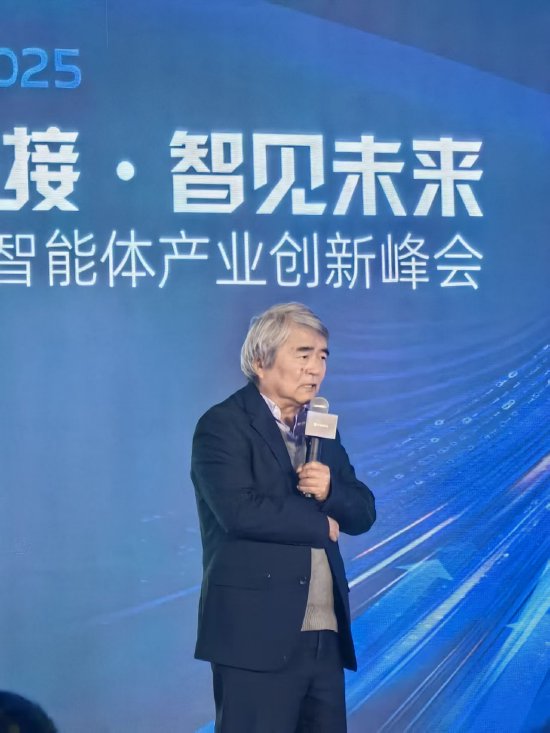
谭建荣院士:智能体是AI最终载体,知识工程乃落地核心路径
Jin Rong Jie· 2025-12-10 08:41
Core Insights - The rapid development of artificial intelligence technology is driving the integration of large models and intelligent agents, becoming a core driver of industrial innovation [1] - The "Super Link · Smart Future" EVOLVE 2025 summit highlighted the collaboration between leading companies in the industry, including Huawei Cloud, Alibaba Cloud, and Baidu Smart Cloud, to launch the "Super Connection" global ecosystem partnership plan [1] Group 1: Key Technologies and Trends - Intelligent agents serve as the carriers of artificial intelligence, which is fundamentally composed of data, algorithms, and computing power [3] - The emergence of generative AI, exemplified by OpenAI's ChatGPT and China's DeepSeek, marks a significant advancement in the field, with generative AI surpassing ordinary human writing capabilities [3] - The relationship between data and models is crucial, where data is seen as unintegrated "loose sand," and the extraction of relationships and patterns forms knowledge, while models represent quantitative knowledge [3] Group 2: Development Roadmap and Applications - The "3+2+2" intelligent agent product matrix was unveiled, which includes various platforms aimed at empowering enterprises to develop and utilize intelligent agents effectively [5] - The Dazhu Large Model Platform 5.0 integrates over 300 enterprise-level intelligent agents across six industries, achieving a 95% success rate in deployment [5] - The products have already served over 2,000 leading clients across more than 180 countries, significantly reducing innovation trial costs in finance by 60% and improving conversion rates in automotive marketing by 55% [5]


谭建荣院士:要重视大模型,但千万别忽视小模型
Xin Lang Cai Jing· 2025-12-09 06:29
Core Insights - The importance of both large and small AI models is emphasized, with a warning that without small models, the implementation of artificial intelligence becomes challenging [2][3] - Knowledge engineering is identified as a core technology for achieving artificial intelligence, alongside models, computing power, and algorithms [4] Group 1 - The need to focus on large models while not neglecting small models is highlighted, indicating a balanced approach is necessary for AI development [2][3] - Knowledge is categorized into qualitative and quantitative types, with models representing quantitative knowledge [4] - Large models require significant computing power for training on diverse data, underscoring the necessity of substantial computational resources behind big data and models [4]
游戏研发中的 AI 转型:网易多 Agent 系统与知识工程实践
AI前线· 2025-11-13 05:25
Core Insights - The article discusses the implementation of large models in game development, highlighting the challenges and advancements in AI coding tools, particularly in the context of complex game projects [2][3][4]. Group 1: AI Tools in Game Development - Numerous AI coding tools have emerged recently, but their participation in game project coding remains limited due to the complexity and flexibility of game business [2][4]. - A large-scale internal survey revealed that game developers spend more time on code understanding rather than code writing, indicating a need for better tools to facilitate this understanding [4][6]. Group 2: Challenges in Game Development - Three main challenges were identified: lack of clear technical documentation (30%), the complexity of game development pipelines compared to traditional web development, and slow testing and debugging processes [6][8]. - The game development process often leads to accumulated technical debt due to rushed timelines, which complicates the coding and debugging phases [6][8]. Group 3: Knowledge Engineering in Game Development - The company has developed a game development knowledge engineering system to improve code understanding and collaboration among different roles such as planning, art, and development [13][14]. - The knowledge system integrates structured and unstructured data, allowing for efficient retrieval and application of knowledge within the game development context [14][19]. Group 4: AI-Driven Code Generation and Review - A dual-end system was created to enhance code understanding, generation, and quality review, focusing on integrating AI capabilities into the existing development environment [8][11]. - AI-generated code accounted for 30% of the total code produced, with the system contributing approximately 5 million lines of code monthly across various projects [41][44]. Group 5: AI Code Review Process - The company has implemented a combination of traditional static code analysis and AI-driven code review to ensure quality control throughout the development process [44][45]. - The AI review process aims to identify low-level errors that could lead to significant operational issues, enhancing the overall quality of the code produced [45][46]. Group 6: Future Directions and Team Collaboration - The focus is on creating a cohesive team AI agent system that facilitates collaboration across different roles in game development, aiming to enhance efficiency and knowledge sharing [55][56]. - The upcoming AICon event will explore further applications of AI in business growth and development efficiency, featuring insights from industry experts [2][56].


蚂蚁数科Agentar入选2025国际标准金融应用卓越案例
Zhong Guo Jing Ji Wang· 2025-10-30 07:48
Core Insights - Ant Group and Ningbo Bank's collaboration on the "Agentar Knowledge Engineering KBase" has been recognized as an exemplary case for international financial applications, showcasing its potential to enhance business intelligence in the financial sector [1] - The financial industry faces challenges related to "knowledge silos," where critical information is dispersed across different systems, leading to inefficiencies in service and consultation experiences [1] - The Agentar platform integrates knowledge processing management, logical reasoning engines, and intelligent application scenarios to provide a robust decision-making system for financial institutions [1] Technology and Implementation - The platform manages multi-source heterogeneous data throughout its lifecycle and features capabilities such as intelligent Q&A, knowledge processing, multi-route recall, and knowledge management [2] - A significant technological breakthrough is the knowledge-enhanced generation engine, which utilizes a collaborative mechanism of "planning-retrieval-reasoning" to improve knowledge quality through bidirectional indexing of knowledge graphs and raw text [2] - The system has transitioned from "fuzzy matching" to "precise reasoning," increasing reasoning depth from traditional 1-hop to 3-5 hops, enabling AI to understand financial knowledge and exhibit human-like logical reasoning [2] Performance Metrics - The solution has been implemented across various internal scenarios at Ningbo Bank, including market analysis, product interpretation, dialogue practice, and report writing [2] - Evaluation results indicate that the accuracy of complex Q&A has improved from 68% to 91%, with response times reaching the millisecond level [2] - Content recommendation accuracy has increased by 35%, and recall rates have improved by 40%, leading to a significant enhancement in business efficiency [2] Future Directions - Ant Group and Ningbo Bank plan to deepen their collaboration by expanding the technology to a broader range of financial business scenarios [2] - The partnership aims to actively participate in industry standardization efforts, promoting the regulated and large-scale application of knowledge engineering and large model technologies in the financial sector [2]