金融数智化转型

Search documents
向新而行,以质致远,平安消费金融荣获“卓越成长价值奖”
Sou Hu Cai Jing· 2026-02-10 16:14
Group 1 - The core theme of the 2025 financial summit is "Moving towards newness and achieving quality for the long term," highlighting the importance of digital transformation in the consumer finance sector [1] - Ping An Consumer Finance received the "2025 Outstanding Growth Value Award" for its impressive performance in financial practices and service promotion [1] Group 2 - Financial digital transformation is essential for survival and competitiveness, requiring the integration of AI, big data, and cloud computing into business processes [3] - Ping An Consumer Finance has accumulated over 240 intellectual property rights in the field of financial technology and has provided services to over 10 million customers across more than 2,500 cities, with nearly 80% of clients from lower-tier cities [3] Group 3 - The company is enhancing customer service through AI technology, achieving a coverage of 90% in consultation scenarios and maintaining a human connection rate of over 97% [4] - Ping An Consumer Finance aims to continue integrating technology with financial services, focusing on value-driven approaches as it moves forward [4]


神州控股:神州信息预期2025年归母净利润约4600万元至6900万元 同比扭亏为盈
Zhi Tong Cai Jing· 2026-01-30 09:17
Core Viewpoint - Shenzhou Holdings (00861) announced that its indirect non-wholly owned subsidiary, Shenzhou Digital (000034), expects to achieve a net profit attributable to shareholders of Shenzhou Digital ranging from RMB 46 million to RMB 69 million for the year ending December 31, 2025, a significant turnaround from a loss of approximately RMB 524 million in 2024 [1] Financial Performance - Shenzhou Digital anticipates a return to profitability, primarily due to proactive market expansion and a year-on-year increase in operating revenue [1] - The improvement in profit is also attributed to enhanced management of receivables, resulting in an overall better collection situation and a year-on-year decrease in impairment losses on receivables [1] - Additionally, preliminary estimates indicate a significant reduction in goodwill impairment losses compared to the same period last year [1] Strategic Direction - Moving forward, Shenzhou Digital will firmly advance its fintech strategy, focusing on technology research and development as the core driver [1] - The company aims to accelerate the deep transformation of its "AI for Process" initiative, leveraging AI technology to empower its financial solution system comprehensively [1] - The goal is to achieve high-quality, efficient, and refined development, striving to become a leading partner in the financial digital transformation industry [1]

ETF及指数产品网格策略周报-20260127
HWABAO SECURITIES· 2026-01-27 09:06
Group 1 - The report outlines the grid trading strategy as a method of profiting from price fluctuations without predicting market trends, making it suitable for volatile markets [4][12] - Characteristics of suitable grid trading targets include being exchange-traded, having stable long-term trends, low transaction costs, good liquidity, and high volatility, with equity ETFs being identified as appropriate candidates [4][12] - The report highlights two key ETFs for grid trading: the Financial Technology ETF (159851.SZ) and the Medical ETF (512170.SH), emphasizing their potential benefits from market trends and innovations [4][13][16] Group 2 - The Financial Technology ETF is positioned to benefit from capital market reforms and the digital transformation of finance, with advancements in AI and blockchain driving efficiency and innovation in the sector [4][13] - The Medical ETF is catalyzed by the recent Nipah virus outbreak in India, which serves as a short-term driver, while the long-term growth is supported by the acceleration of innovative drug exports from China, showcasing the country's significant presence in the global pharmaceutical market [5][16] - The report suggests that investors can enhance returns by diversifying their grid trading strategies across different ETFs, combining various types and investment scopes to optimize risk management and capital utilization [16][19]
从国有大行到省农商行,钉钉成了金融机构的“AI标配”
Sou Hu Cai Jing· 2026-01-23 10:26
Group 1 - The "AI Era: 'Yu' See the Future of Financial Intelligence" summit was held in Zhengzhou, focusing on the deep integration of AI and finance, attended by nearly 200 financial executives and experts [1] - China's financial industry is currently at the forefront of global digitalization, with DingTalk being a popular digital collaboration platform among major banks [1][2] - Over half of the joint-stock banks and provincial rural commercial banks have chosen DingTalk as their strategic partner for digital transformation [1] Group 2 - The summit highlighted the shift in the financial industry's digital transformation from "process-driven" to "model-driven" due to the maturity of large model technologies [2] - DingTalk's financial industry general manager emphasized the importance of AI assistants for every financial professional, enabling efficient responses to complex financial tasks [5] - The CIO of Henan Rural Commercial Bank shared how they utilized DingTalk to enhance collaboration and efficiency, significantly reducing the time needed for meeting minutes [6] Group 3 - The future of financial talent is expected to be a combination of finance, technology, and AI expertise, as discussed by a representative from Shanghai Jiao Tong University [6] - DingTalk's AI implementation in finance aims to create "AI super organizations," where AI assistants will be integrated into core functions like risk control and customer service [8] - The successful hosting of the summit signals a clear message that Chinese financial institutions are accelerating their transition to intelligent and agile "future organizations" with the support of digital platforms like DingTalk [8]

人民银行副行长邹澜:数据是数字经济时代的“点金密钥”
Bei Jing Shang Bao· 2026-01-14 02:34
Core Viewpoint - The People's Bank of China emphasizes that data is the "golden key" in the digital economy era, highlighting significant advancements in the financial sector since the 14th Five-Year Plan, particularly in data infrastructure, governance, and security [1][2] Group 1: Data Infrastructure Development - Financial institutions have established enterprise-level data platforms, enhancing their data capabilities and integrating big data technologies to support decision-making across all business processes [1] - This transformation enables deeper customer insights, product innovation, and risk management, effectively empowering the entire value chain [1] Group 2: Data Governance Improvement - The financial sector has seen a gradual unification of enterprise-level data standards, driven by policy guidance and industry practices, leading to improved data quality [1] - The governance model has shifted from passive response to proactive value creation, marking a leap in development [1] Group 3: Security and Compliance Enhancement - Financial institutions have implemented a tiered and classified security management mechanism covering the entire data lifecycle, effectively mitigating risks of data misuse and leakage [1] - Technologies such as privacy computing have been adopted to facilitate secure, efficient, and compliant data collaboration and joint modeling [1] Group 4: Future Directions - The financial industry aims to deepen the market-oriented reform of data elements, accelerating the release of data value [2] - The focus will be on leveraging technology and institutional innovation to strengthen data security and advance the digital transformation of finance, providing robust support for building a modern financial system [2]
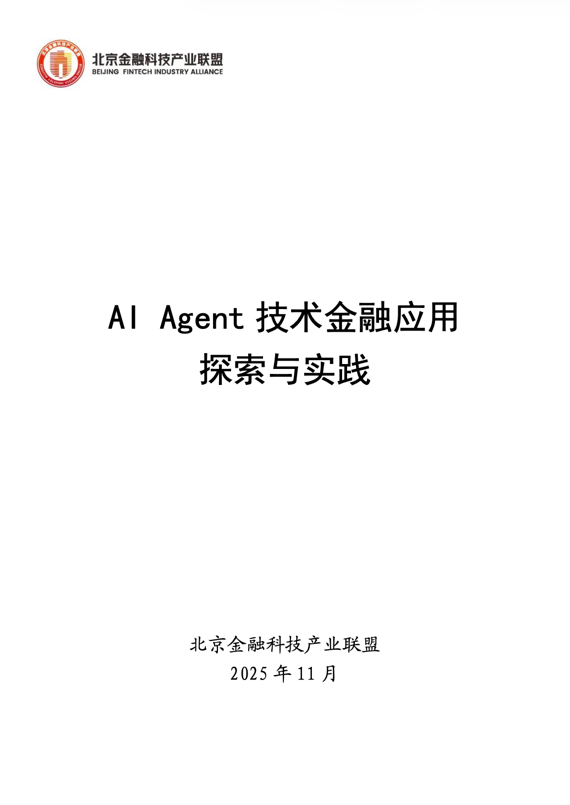
神州信息参编,《AI Agent技术金融应用探索与实践》正式发布
Xin Lang Cai Jing· 2026-01-09 09:00
Core Insights - The report titled "Exploration and Practice of AI Agent Technology in Financial Applications" was collaboratively developed by leading financial institutions and technology companies, including Postal Savings Bank, Shenzhou Information, China UnionPay, and others, and has been recognized as an "Excellent Topic" by the Beijing Financial Technology Industry Alliance for 2025 [1][5] - The financial industry is accelerating its digital transformation driven by new information technologies represented by large AI models, with AI Agents serving as a crucial application paradigm for facilitating the flow of financial data elements and realizing business value [1][5] Summary by Sections AI Agent Components and Technologies - The report discusses the core components, key technological forms, and construction paths of AI Agents, analyzing critical technologies in financial scenarios from theoretical and architectural perspectives [2][6] - It addresses typical application scenarios in banking, securities, and insurance, focusing on the industry's demands for massive data processing, precise risk assessment, and personalized service customization [2][6] Design Considerations and Framework - A design reference for the financial AI Agent architecture is provided, analyzing core components, technology selection, data flow, and interaction modes, while ensuring effective integration into business processes and compliance with strict regulatory requirements [2][6] - The report emphasizes the importance of enhancing service efficiency and customer experience through the effective deployment of AI Agents [2][6] Future Outlook and Recommendations - The application of AI Agents in the financial industry is described as a systematic project that requires consideration of technical feasibility, business value, compliance requirements, security risks, and user experience [4][8] - The report offers insights into technological development trends and industry application expansion, aiming to assist financial institutions in designing advanced and practical AI-native systems to maintain competitive advantages during digital transformation [4][8] - Shenzhou Information, as a leading partner in financial digital transformation, promotes the "AI for Process" concept and has launched a series of "AIGC+" financial solutions to significantly enhance banks' R&D efficiency, data utilization, and AI model iteration speed [4][8]
金融机构“追”着要AI应用方案 行业数字化改造向核心环节渗透
Shang Hai Zheng Quan Bao· 2026-01-08 16:49
Group 1 - Digital finance is a crucial part of the financial sector, linking technological innovation, business upgrades, and national strategy through bidding processes, reshaping service systems, business models, and competitive landscapes [2][5] - The shift in financial institutions' outsourcing bids from merely "finding people to work" to "ecosystem co-construction" reflects a transition from "heavy construction" to "heavy operation" in digital transformation [6][2] - The demand for AI applications is surging, leading to increased computing power needs, particularly for distributed and cloud-native core system upgrades [3][5] Group 2 - Huakun Zhenyu, a core hardware supplier for state-owned banks, expects its financial sector revenue to exceed 6 billion yuan in 2025, with a year-on-year growth rate of over 50% [4] - Recent bidding projects from major banks indicate a trend towards long-term, value-focused technology procurement, emphasizing "technology empowering business" rather than just hardware and software purchases [5][4] - The competitive landscape is intensifying as financial institutions increasingly seek to collaborate on digital finance initiatives, with a notable rise in project bids and the need for targeted solutions [7][8] Group 3 - The financial industry is experiencing a shift towards distributed core systems, with significant projects being launched by various banks, indicating a rapid upgrade cycle in the asset management sector [4][5] - AI technology is becoming a core component in various financial IT solutions, with smaller institutions also beginning to adopt AI applications, reflecting a trend of scaling up from larger institutions [5][4] - The financial sector's technology investments are expected to peak and slightly decline by 2026, amidst a complex landscape of overheating computing investments and the absence of standout AI applications [8][7]

李伟:积极稳妥、安全有序推进人工智能金融应用
Jin Rong Shi Bao· 2026-01-05 01:27
Core Insights - Artificial intelligence (AI) is recognized as a crucial engine for high-quality development across various industries, particularly in the financial sector, where it is expected to enhance digital transformation and governance [1][2]. Group 1: AI in Financial Sector - The "14th Five-Year Plan" is concluding, and the "15th Five-Year Plan" is being formulated, marking a significant year for the integration of AI and finance, aiming for collaborative innovation and deep integration [1]. - Financial institutions are actively promoting the application of AI in various areas such as office assistance, intelligent customer service, credit risk control, and compliance review, achieving positive results [1]. Group 2: Support for AI Development - The development of AI applications in finance is supported by a robust industrial system, with significant reductions in the cost and barriers to entry for large model applications, alongside advancements in intelligent computing chips [2]. - Challenges in AI applications include the need for enhanced ethical governance, risks of model homogeneity, inherent flaws in algorithm architectures, and data governance and security issues [2]. Group 3: Strategic Recommendations - Strengthening overall planning is essential, with a focus on integrating AI applications into the financial technology development plan for the "15th Five-Year Plan" [3]. - Establishing a sound risk control system is necessary, including the development of safety standards for AI applications in finance and enhancing ethical governance [3]. - Improving application levels by focusing on key areas such as credit financing, risk control, and marketing services, while exploring AI-driven service models [3]. - Supporting industry development through collaboration between financial institutions and AI companies, enhancing the competitiveness and safety of foundational AI models and intelligent computing devices [3].
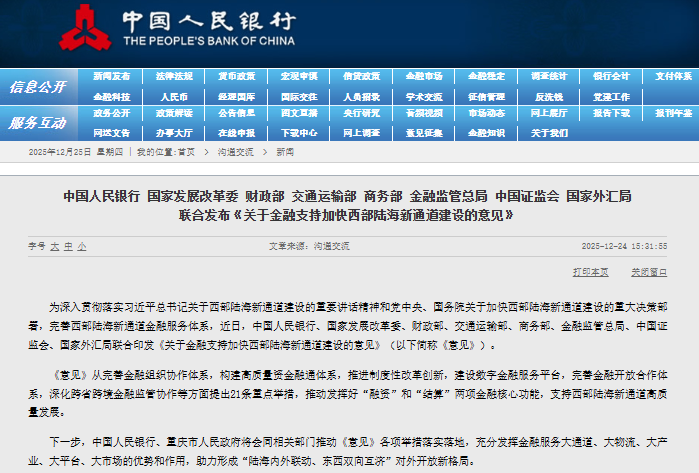
中国人民银行:金融支持加快西部陆海新通道建设 推动各项举措落地落实
智通财经网· 2025-12-25 12:39
Core Viewpoint - The People's Bank of China (PBOC) is set to enhance financial services for the Western Land-Sea New Corridor, aiming to establish a new pattern of open economy that integrates land and sea, and promotes mutual benefits between the east and west [1][4]. Group 1: Policy Announcement - The PBOC, along with seven other national departments, has jointly issued the first national financial policy document to support the construction of the Western Land-Sea New Corridor [2][7]. - The policy document outlines 21 key measures focusing on improving financial services for infrastructure, logistics, trade, and industry along the corridor [4][10]. Group 2: Financial Support Mechanisms - The policy emphasizes the development of tailored financial products to meet diverse financing needs across different stages of development [10]. - It aims to enhance cross-border financial cooperation and facilitate the integration of domestic and international financial markets [11][24]. Group 3: Regional Development and Collaboration - The Western Land-Sea New Corridor connects 12 western provinces and regions, facilitating trade with 127 countries and regions through 583 ports [6][7]. - The policy encourages regional collaboration and the establishment of a unified financial service framework to support cross-border trade and investment [33][34]. Group 4: Implementation and Future Plans - The PBOC plans to work with relevant departments to ensure the effective implementation of the policy measures, enhancing the financial service capabilities of the corridor [4][35]. - Future efforts will focus on building a digital financial service platform and improving the efficiency of cross-border financing and settlement [29][37].
央行等八部门联合发布“21条”金融举措,力挺西部陆海新通道建设
Huan Qiu Wang· 2025-12-25 07:00
Core Viewpoint - The People's Bank of China and eight other departments have jointly issued the "Opinions on Financial Support for Accelerating the Construction of the Western Land-Sea New Corridor," introducing 21 key measures across six areas to enhance financial support for the corridor's development [1][4][7] Group 1: Financial Resource Coordination - The "Opinions" propose substantial incentives for financial institutions to establish specialized service mechanisms, focusing on joint credit and syndicate loan businesses for cross-regional operations [4] - A special fund will be established in Chongqing to support infrastructure and industrial park construction along the corridor, with efforts to attract support from international financial organizations like the Asian Development Bank [4] - The policy encourages the use of diversified financing channels, including corporate credit bonds and Real Estate Investment Trusts (REITs), to increase credit support for logistics and small to medium-sized trade enterprises [4] Group 2: Cross-Border Financial Services and RMB Usage - The "Opinions" detail measures to facilitate cross-border trade settlement and support banks in handling compliant cross-border fund settlements for quality enterprises [5] - There will be pilot programs for integrated currency pools for multinational companies in certain regions, simplifying foreign exchange registration procedures [5] - The policy emphasizes strengthening bilateral currency cooperation with Southeast and Central Asian countries and expanding the use of the digital RMB in cross-border applications [5] Group 3: Digital Financial Transformation and International Cooperation - The establishment of the "Central Bank Western Land-Sea Intelligent Financial Integration" platform aims to provide a comprehensive financial service system, enhancing information sharing between government, banks, and enterprises [6] - The policy supports participation in multilateral central bank digital currency bridge projects to facilitate cross-border payments with countries like Thailand and the UAE [7] - The initiative aims to improve service capabilities for cross-border e-commerce through digital service platforms [7]