碳中和目标

Search documents
用数据见证变化 用政策法规引领美丽中国建设
Yang Shi Wang· 2026-02-25 06:35
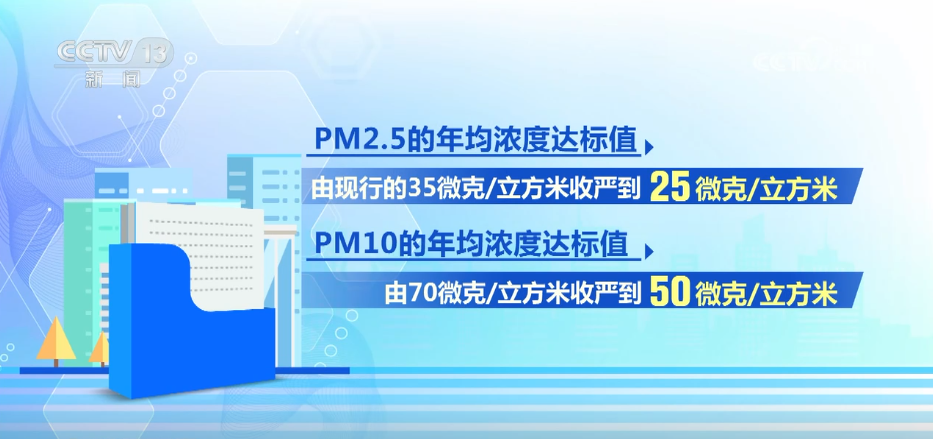
Core Viewpoint - The Ministry of Ecology and Environment has initiated a new round of revisions to the "Ambient Air Quality Standards" to further improve air quality in China, with the new standards officially released on February 24 [1] Group 1: New Standards Implementation - The annual average concentration limit for PM2.5 is tightened from 35 micrograms per cubic meter to 25 micrograms per cubic meter [3] - The annual average concentration limit for PM10 is reduced from 70 micrograms per cubic meter to 50 micrograms per cubic meter [3] - The annual average concentration limit for sulfur dioxide is lowered from 60 micrograms per cubic meter to 20 micrograms per cubic meter [3] - The annual average concentration limit for nitrogen dioxide is decreased from 40 micrograms per cubic meter to 30 micrograms per cubic meter [3] Group 2: Phased Implementation - The new standards will be implemented in two phases: the first phase from March 1, 2026, to December 31, 2030, with PM2.5 set at 30 micrograms per cubic meter and PM10 at 60 micrograms per cubic meter [5] - The second phase will commence on January 1, 2031, enforcing the revised limits nationwide [5] Group 3: Historical Context and Achievements - Since 2013, air pollution control has achieved significant milestones, with approximately 70% of cities meeting the current standards [3] - Over the past decade, the average PM2.5 concentration has decreased by 36%, and the number of heavily polluted days has reduced by 68% [9] - China's GDP has increased by 63% and the number of vehicles has grown by 111% during the same period, indicating that stricter standards have positively influenced high-quality economic development [9] Group 4: Future Goals and Comparisons - By 2035, the average PM2.5 concentration is expected to drop below 25 micrograms per cubic meter, aligning with the goals of a beautiful China [11] - The World Health Organization recommends a guideline of 5 micrograms per cubic meter, while the U.S. standard for 2024 is set at 9 micrograms per cubic meter, and the EU at 10 micrograms per cubic meter [13] - Experts suggest that achieving the new PM2.5 limit of 25 micrograms per cubic meter is a realistic target that requires concerted efforts from local authorities [13] Group 5: Long-term Vision - Achieving air quality standards is a gradual process, especially for a large country like China with significant energy and industrial structures [15] - The transition to a low-carbon energy structure is expected to fundamentally change energy consumption, with non-fossil energy sources projected to account for 72% of primary energy consumption by 2050 [15] - By 2050, PM2.5 levels could potentially drop below 10 micrograms per cubic meter, reaching the recommended levels set by the World Health Organization [15]

中国可以不买美国芯片,但西方不能没有中国稀土
Sou Hu Cai Jing· 2025-11-28 00:43
Core Viewpoint - The article discusses China's strategic importance in the global rare earth market, emphasizing that Western countries, particularly the U.S. and Japan, have become increasingly dependent on Chinese rare earth supplies despite efforts to reduce this reliance [1][2][4]. Group 1: U.S. Dependency on Chinese Rare Earths - As of 2025, U.S. dependency on Chinese rare earths has increased from 90% in 2010 to 97%, highlighting a significant failure in efforts to diversify sources [4][6]. - U.S. officials, including Florida Congressman Carlos Gimenez, have expressed skepticism about the ability to compete with China in the rare earth sector [2][4]. - The only U.S. rare earth mine, Mountain Pass, still requires processing in China, indicating a lack of domestic capabilities [4][6]. Group 2: Japan's Attempts and Challenges - Japan invested 100 billion yen and 46 billion yen in overseas rare earth projects to reduce reliance on China after the 2010 supply disruption [4][6]. - Despite these efforts, Japan only recently managed to import a small amount of rare earths from outside China, with heavy reliance on Chinese sources for critical elements [6][8]. - The need for rare earths in industries such as automotive and clean energy remains a significant challenge for Japan [6][8]. Group 3: Importance of Rare Earths in Modern Technology - Rare earths are essential for various high-tech applications, including electric vehicles, wind turbines, and robotics, with specific examples provided such as the use of neodymium in electric motors [6][8][9]. - The absence of rare earths would severely hinder the performance of electric vehicles and clean energy technologies, undermining Western goals for carbon neutrality [8][9]. - The military sector is also heavily reliant on rare earths, with 78% of U.S. military weapon systems depending on Chinese supplies [11]. Group 4: China's Competitive Advantage - China's unique capability in rare earth purification and separation technology gives it a significant edge over Western countries, which struggle to replicate these processes [13][15]. - The ability to produce high-purity rare earths (4N and above) is crucial for advanced technology applications, and China's expertise in this area is unmatched [15][17]. - The article concludes that global rare earth production ultimately requires processing in China, solidifying its dominant position in the market [17].


当极端高温遇上减排博弈:欧盟这步棋,能否走活全球气候困局?
Sou Hu Cai Jing· 2025-07-03 03:11
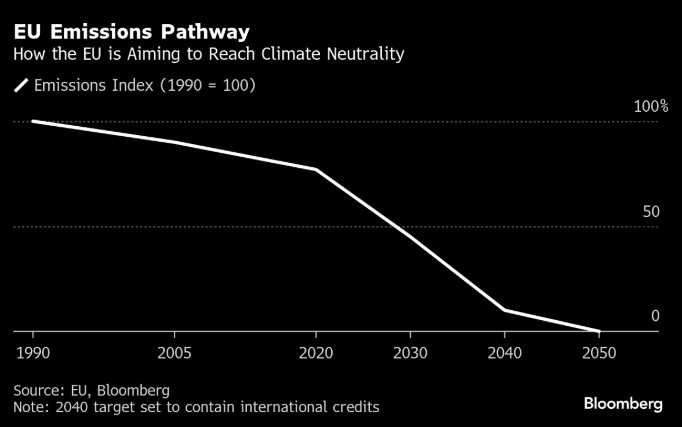
Group 1 - The European Commission has proposed a legislative plan to reduce greenhouse gas emissions by 90% by 2040 compared to 1990 levels, marking a critical milestone towards the 2050 carbon neutrality goal [1][3] - The proposal allows member states to use an international carbon offset mechanism to fulfill up to 3% of their reduction targets starting in 2036, which has sparked disagreements among member countries and criticism from environmental organizations [3][4] - The proposal reflects a balance between ambitious climate goals and practical implementation, as highlighted by the EU Climate Commissioner Wopke Hoekstra [3][4] Group 2 - There are significant divisions among member states regarding the feasibility of the 2040 target, with some leaders linking decarbonization to industrial competitiveness, while others express concerns about the impact on heavy industries [4] - The European Parliament is also divided, with the largest party, the European People's Party, caught between climate activists and industrial protectionists, facing pressure from other political groups [4] - The new carbon offset mechanism has been criticized for potentially undermining local fossil fuel phase-out efforts, as funds may be directed towards overseas projects [5][6] Group 3 - The EU plans to submit an updated Nationally Determined Contribution (NDC) by September and aims to demonstrate leadership at the upcoming COP30 climate conference in Brazil [6] - The proposed reduction curve from 2030 to 2040 is expected to achieve a reduction of approximately 72.5%, contingent on unanimous agreement from member states [6] - The EU's ability to reconcile internal divisions is crucial for maintaining its image as a climate leader, especially in light of global trust issues following the U.S. withdrawal from the Paris Agreement [6]