空气质量标准修订

Search documents
空气质量标准收紧,从“达标”变“不达标”,这66城该咋办
Nan Fang Du Shi Bao· 2026-02-27 08:09
Core Viewpoint - The Ministry of Ecology and Environment announced the revision of the Ambient Air Quality Standards, marking the second revision since 2012, with new standards to be implemented on March 1, 2023, which will tighten air quality evaluation criteria [1]. Group 1: Impact of New Standards - The revised standards will affect air quality evaluation results, potentially causing cities that previously met standards to fall below them, and days previously classified as good may now be considered lightly polluted [1]. - By 2025, if evaluated under the transitional limit of 30 µg/m³ for PM2.5, the number of cities meeting the standard will decrease from 271 to 205, and the proportion of good air quality days will drop from 88.1% to 83.6% [1]. - Under the second phase limit of 25 µg/m³ for PM2.5, the number of compliant cities will further decline to 140, with good air quality days falling to 78.3% [1]. Group 2: Differentiated Strategies for Cities - The Ministry will implement differentiated strategies based on the concentration levels of PM2.5 in different cities, focusing on structural, engineering, and management reductions to address pollution issues [2]. - Cities with PM2.5 levels above 35 µg/m³, accounting for about 20%, will need to continue efforts to reduce emissions, while those between 26-35 µg/m³, making up about 40%, must utilize the transition period to analyze pollution causes and enhance reduction efforts [2]. Group 3: Goals and Support Mechanisms - The Ministry plans to set specific air quality improvement targets for each city based on their pollution levels and reduction potential, emphasizing the importance of local efforts in improving air quality [3]. - Support will be directed towards cities with higher PM2.5 concentrations and strong improvement intentions, focusing on funding, technical support, and capacity building [3]. - Cities will be encouraged to develop tailored strategies for air quality improvement, implementing measures to ensure sustained progress and enhance public satisfaction with air quality [3].
用数据见证变化 用政策法规引领美丽中国建设
Yang Shi Wang· 2026-02-25 06:35
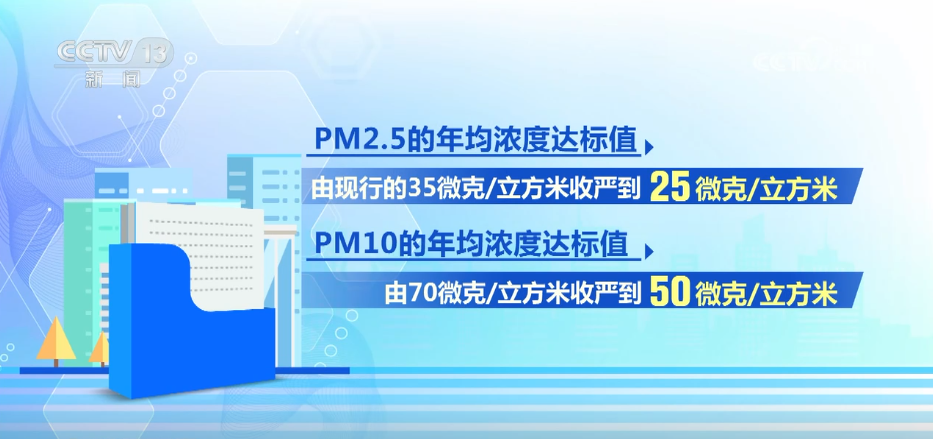
Core Viewpoint - The Ministry of Ecology and Environment has initiated a new round of revisions to the "Ambient Air Quality Standards" to further improve air quality in China, with the new standards officially released on February 24 [1] Group 1: New Standards Implementation - The annual average concentration limit for PM2.5 is tightened from 35 micrograms per cubic meter to 25 micrograms per cubic meter [3] - The annual average concentration limit for PM10 is reduced from 70 micrograms per cubic meter to 50 micrograms per cubic meter [3] - The annual average concentration limit for sulfur dioxide is lowered from 60 micrograms per cubic meter to 20 micrograms per cubic meter [3] - The annual average concentration limit for nitrogen dioxide is decreased from 40 micrograms per cubic meter to 30 micrograms per cubic meter [3] Group 2: Phased Implementation - The new standards will be implemented in two phases: the first phase from March 1, 2026, to December 31, 2030, with PM2.5 set at 30 micrograms per cubic meter and PM10 at 60 micrograms per cubic meter [5] - The second phase will commence on January 1, 2031, enforcing the revised limits nationwide [5] Group 3: Historical Context and Achievements - Since 2013, air pollution control has achieved significant milestones, with approximately 70% of cities meeting the current standards [3] - Over the past decade, the average PM2.5 concentration has decreased by 36%, and the number of heavily polluted days has reduced by 68% [9] - China's GDP has increased by 63% and the number of vehicles has grown by 111% during the same period, indicating that stricter standards have positively influenced high-quality economic development [9] Group 4: Future Goals and Comparisons - By 2035, the average PM2.5 concentration is expected to drop below 25 micrograms per cubic meter, aligning with the goals of a beautiful China [11] - The World Health Organization recommends a guideline of 5 micrograms per cubic meter, while the U.S. standard for 2024 is set at 9 micrograms per cubic meter, and the EU at 10 micrograms per cubic meter [13] - Experts suggest that achieving the new PM2.5 limit of 25 micrograms per cubic meter is a realistic target that requires concerted efforts from local authorities [13] Group 5: Long-term Vision - Achieving air quality standards is a gradual process, especially for a large country like China with significant energy and industrial structures [15] - The transition to a low-carbon energy structure is expected to fundamentally change energy consumption, with non-fossil energy sources projected to account for 72% of primary energy consumption by 2050 [15] - By 2050, PM2.5 levels could potentially drop below 10 micrograms per cubic meter, reaching the recommended levels set by the World Health Organization [15]

新版空气质量标准3月1日起实施,“收严限值”外还有哪些新变化
Xin Lang Cai Jing· 2026-02-25 04:34
Core Viewpoint - The new air quality standards in China, effective from March 1, 2026, aim to significantly improve air quality and public health, with a cost-benefit ratio of nearly 1:10 for pollution control investments [1][2]. Group 1: New Standards and Regulations - The Ministry of Ecology and Environment and the State Administration for Market Regulation have jointly released the revised "Ambient Air Quality Standards" (GB 3095—2026) and accompanying technical specifications [1]. - The revised standards tighten the concentration limits for particulate matter and its precursors, adjusting the annual average PM2.5 limit to 10 micrograms per cubic meter and the daily average to 25 micrograms per cubic meter [1][2]. - The standards also include stricter limits for PM10, SO2, and NO2, aligning with the latest WHO guidelines [1]. Group 2: Implementation and Impact - The implementation of the new standards is expected to lead to a reduction of over 7 billion tons of CO2 emissions from 2026 to 2035 through various pollution reduction measures [1]. - The revised standards will likely result in a decrease in the proportion of cities meeting air quality standards, but this does not indicate a deterioration in air quality; rather, it reflects the increased stringency of the new limits [2]. - The updates to the standards include adjustments to environmental functional areas and the incorporation of recent monitoring standards, enhancing the scientific and objective evaluation of air quality [2].
修订后的空气质量标准即将亮相 污染物浓度限值有所收严
Yang Shi Wang· 2025-12-27 06:30
Group 1 - The revised air quality standards have tightened the concentration limits for PM2.5, sulfur dioxide, and nitrogen dioxide, with the annual PM2.5 limit reduced from 35 micrograms per cubic meter to 25 micrograms per cubic meter [3] - The implementation of the new standards will be phased to minimize the impact on economic and social development, ensuring a smooth transition [3] - The tightening of standards is expected to promote the development of new energy vehicles and clean energy, facilitating a green and low-carbon transformation in industries, energy, and transportation [3] Group 2 - The ecological environment department emphasizes that the new standards should not simply replicate the strictest international levels, but must consider factors such as spatial layout, industrial structure, and resource endowment [3] - The current coal-dominated energy structure in China is expected to change slowly in the short term, and the country aims to reach a level of development comparable to that of medium-developed countries by 2035, where PM2.5 limits are also around 25 micrograms per cubic meter [3]
我国空气质量标准修订符合国情、体现决心
Xin Lang Cai Jing· 2025-12-26 13:54
Core Viewpoint - The Ministry of Ecology and Environment of China has released a draft for revised air quality standards, tightening the limits for PM2.5 and PM10 concentrations to better protect public health while considering national conditions [1][2]. Group 1: Air Quality Standards - The proposed secondary limits for PM2.5 annual and daily concentrations are tightened from 35 and 75 micrograms per cubic meter to 25 and 50 micrograms per cubic meter, respectively [1]. - The secondary limits for PM10 annual and daily concentrations are also tightened from 70 and 150 micrograms per cubic meter to 50 and 100 micrograms per cubic meter [1]. - The limits for sulfur dioxide and nitrogen dioxide are also being tightened due to their health impacts and their role in the secondary formation of PM2.5 [1]. Group 2: Comparison with International Standards - Other countries and regions, such as the United States, have also revised their PM2.5 limits, with the U.S. EPA tightening the annual average from 12 micrograms per cubic meter to 9 micrograms per cubic meter by 2024 [1]. - Despite these international standards, the proposed limits in China are still considered relatively lenient compared to the strictest global standards [1]. Group 3: National Context and Development - China's reliance on coal and its status as a manufacturing powerhouse, contributing nearly 30% to global manufacturing value, necessitate higher emissions of air pollutants [2]. - The expected economic development trajectory suggests that by 2035, China will reach a level comparable to that of medium-developed countries, which typically have PM2.5 limits around 25 micrograms per cubic meter [2]. - The revision of standards reflects China's commitment to improving environmental quality and public health while aligning with its development goals [2].
空气质量标准修订收严PM2.5浓度限值,生态环境部解读
Xin Jing Bao· 2025-12-26 13:12
Core Viewpoint - The Ministry of Ecology and Environment has released a draft for revised air quality standards, tightening limits on pollutants such as PM2.5, PM10, SO2, and NO2, which may impact economic and social development, but the overall benefits for public health and economic growth are emphasized [1][4]. Group 1: Air Quality Improvement - Over the past decade, the average PM2.5 concentration in China has decreased by 36%, with heavy pollution days reduced by 68%, while GDP has increased by 63% and the number of vehicles has grown by 111% [2]. - The revised standards aim to transition from total pollutant emission control to air quality improvement, from single pollutant control to multi-pollutant management, and from local to regional pollution control [2][4]. Group 2: Implementation Phases - The revised air quality standards will be implemented in two phases: the first phase (2026-2030) will set PM2.5 annual and daily limits at 30 µg/m³ and 60 µg/m³, respectively; the second phase (from 2031) will further tighten these limits to 25 µg/m³ and 50 µg/m³ [3]. - The phased approach is designed to minimize the impact on economic and social stability while ensuring a smooth transition to stricter standards [3]. Group 3: Long-term Benefits - Stricter standards are expected to further reduce PM2.5 levels, improve air quality, decrease the incidence of cardiovascular and respiratory diseases, and enhance public health and well-being [4]. - The revisions are anticipated to foster the development of new production capacities in electric vehicles and clean energy, promote advanced processes in industries such as metallurgy and petrochemicals, and drive a green and low-carbon transition in various sectors [4]. Group 4: National Context - The formulation of air quality standards must consider national conditions and not simply adopt the strictest international levels; it should reflect China's unique energy structure and economic development stage [5][6]. - China's reliance on coal and its status as a manufacturing powerhouse necessitate a balanced approach to pollution control, with PM2.5 limits expected to align with those of developed countries as the economy matures [6].
空气质量标准调后与发达国家仍有差距?生态环境部:不能照抄
Nan Fang Du Shi Bao· 2025-12-26 08:12
Core Viewpoint - The Ministry of Ecology and Environment emphasizes the need to develop air quality standards that consider national conditions while protecting public health, rather than simply adopting international standards [1][2] Group 1: Air Quality Standards - The Ministry of Ecology and Environment is revising PM2.5 concentration limits, taking into account the country's specific circumstances and development stage [1] - The U.S. Environmental Protection Agency plans to tighten the PM2.5 annual average from 12 micrograms per cubic meter to 9 micrograms per cubic meter by 2024, while China's secondary limit remains relatively lenient [1] - The revised standards will consider factors such as spatial layout, industrial structure, resource endowment, environmental capacity, and governance capabilities to ensure they are scientific, reasonable, and achievable [1] Group 2: National Context - China's energy structure, primarily reliant on coal, is expected to change slowly, and as a major manufacturing country, it contributes significantly to air pollution emissions [1] - By 2035, China is projected to reach the level of a moderately developed country, with PM2.5 limits in developed countries at similar economic stages around 25 micrograms per cubic meter [1] - The standard revision reflects China's confidence and determination to lead continuous improvements in environmental quality, supporting the goal of building a beautiful China [2]
空气质量标准修订符合中国国情(答问九)
Xin Lang Cai Jing· 2025-12-26 05:40
Group 1 - The revised air quality standards in China still lag behind those of developed countries like the US and EU, indicating a need for standards that reflect national conditions rather than simply adopting the strictest international levels [1] - The US EPA plans to tighten the PM2.5 annual average from 12 micrograms per cubic meter to 9 micrograms per cubic meter by 2024, while China's secondary limit remains relatively lenient [1] - The revision of standards should consider factors such as spatial layout, industrial structure, resource endowment, environmental capacity, and governance capabilities to ensure they are scientific, reasonable, and achievable [1] Group 2 - China's reliance on coal as a primary energy source is expected to persist in the short term, contributing to higher emissions of air pollutants due to its status as a manufacturing powerhouse, accounting for nearly 30% of global manufacturing value added [2] - By 2035, China is projected to reach a level comparable to that of middle-income developed countries, where PM2.5 limits are around 25 micrograms per cubic meter, aligning with the country's current economic and social development stage [2] - The standard revision reflects China's confidence and determination to lead continuous improvements in environmental quality, supporting the goal of building a beautiful China and better protecting public health [2]
我国空气质量标准“升级”
Zhong Guo Qing Nian Bao· 2025-12-17 02:16
Core Points - The Ministry of Ecology and Environment has released a draft for the revision of the "Ambient Air Quality Standards" and related technical specifications, focusing on tightening the concentration limits for PM2.5, PM10, sulfur dioxide, and nitrogen dioxide [1][2] - The revised standards propose to lower the secondary limits for PM2.5 from 35 and 75 micrograms per cubic meter to 25 and 50 micrograms per cubic meter, and for PM10 from 70 and 150 micrograms per cubic meter to 50 and 100 micrograms per cubic meter [1] - The implementation of the revised standards will occur in two phases: the first phase from 2026 to 2030 with transitional limits, and the second phase starting in 2031 with full enforcement of the new limits [1] Summary by Sections Revision Details - The draft proposes stricter limits for PM2.5 and PM10, as well as for sulfur dioxide and nitrogen dioxide, to enhance public health protection [1] - The new PM2.5 annual and daily secondary limits will be 30 and 60 micrograms per cubic meter during the transitional phase [1] Impact on Air Quality Assessment - The revision may lead to changes in air quality evaluation results for certain cities and regions, potentially shifting from compliant to non-compliant status under the new standards [2] - This change does not indicate a deterioration in air quality but reflects a commitment to improving air quality under higher standards [2]
3项空气质量标准征求意见,收严PM2.5等浓度限值
第一财经· 2025-12-16 08:47
Core Viewpoint - The article discusses the recent revisions to China's air quality standards, emphasizing the need to tighten limits on pollutants like PM2.5, SO2, and NO2 to improve public health and align with international standards [3][4][5]. Group 1: Air Quality Standards Revision - The Ministry of Ecology and Environment has proposed stricter limits for PM2.5, reducing the annual average concentration limit from 35 micrograms per cubic meter to 25 micrograms per cubic meter [6][7]. - The revised standards aim to support the "Beautiful China" initiative, which targets a national average PM2.5 concentration below 25 micrograms per cubic meter by 2035 [5][6]. - The new standards will also tighten limits for SO2 and NO2, with SO2's annual average limit set to 20 micrograms per cubic meter and NO2's to 30 micrograms per cubic meter [8]. Group 2: Health and Environmental Impact - The article highlights that PM2.5 is the most significant air pollutant affecting human health, necessitating stricter regulations based on WHO's updated guidelines [4][5]. - Experts indicate that the ongoing improvement in air quality requires updated standards to maximize health benefits and address changing pollution characteristics [6][7]. - The revisions are expected to lead to changes in air quality assessment results for some cities, potentially reclassifying them from compliant to non-compliant under the new standards [9]. Group 3: Economic Implications - Implementing stricter air quality standards may exert short-term pressure on the economy, particularly on high-pollution industries [10]. - However, the article suggests that these changes could drive industrial upgrades, reduce output from high-pollution sectors, and promote a transition to cleaner energy sources [10]. - The health benefits of stricter regulations are expected to increase significantly as enforcement intensifies, leading to long-term positive outcomes for public health [10].