
碳排放管控

Search documents
化工板块爆发,碳排放管控利好化工中长期价值,石化ETF(159731)持续吸金
Mei Ri Jing Ji Xin Wen· 2026-02-06 05:46
Core Viewpoint - The petrochemical ETF (159731) has seen a significant increase of 2.32%, with notable gains in holdings such as Zhejiang Longsheng, Huafeng Chemical, and Rongsheng Petrochemical, indicating strong capital inflow and investor interest [1] Group 1: Market Performance - The petrochemical ETF (159731) has recorded a total net inflow of 1.437 billion yuan over the past 20 trading days, showcasing a clear trend of capital accumulation [1] - The basic chemical industry accounts for 60.02% of the Shenwan primary industry distribution, while the oil and petrochemical sector represents 32.43%, indicating a strong potential for profit recovery in downstream chemical products [1] Group 2: Industry Trends - From 2022 to 2025, Europe is set to shut down a total of 37 million tons of chemical production capacity, which constitutes approximately 9% of the total chemical production capacity in Europe, reflecting a significant reduction in investment trends within the European chemical industry [1] - The introduction of new climate and circular economy regulations by the EU in 2026 is expected to further increase compliance costs and weaken competitiveness in the already struggling European chemical sector, creating a dilemma between emission reduction targets and economic development [1] - According to Zhongjin Company, the difficulty in adding new production capacity due to stricter carbon emission controls will lead to a decline in the growth rate of the chemical industry, but a medium to long-term improvement in industry conditions is anticipated [1]
争当石油工程行业“碳路先锋”
Qi Lu Wan Bao· 2025-11-16 16:19
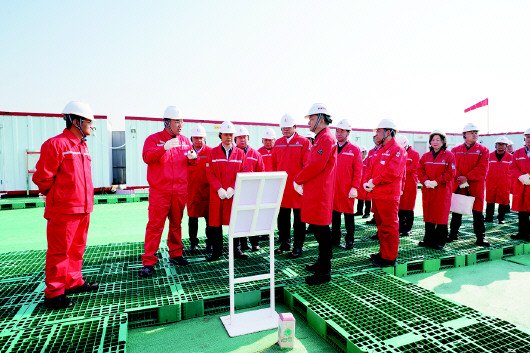
Core Viewpoint - The company is pioneering carbon footprint accounting in the oil engineering sector, aiming to establish a comprehensive carbon accounting system to facilitate green and low-carbon development [2][3][4]. Group 1: Carbon Footprint Accounting - The company initiated carbon accounting in July 2024, focusing on drilling and testing oil as pilot industries [2]. - A carbon emission calculation model was developed, covering over 30 factors throughout the entire lifecycle of drilling and testing oil [2][3]. - The company received the first domestic carbon footprint certification for oil engineering from the Quality Certification Center [3]. Group 2: Green Low-Carbon Initiatives - The establishment of a green low-carbon office and related research centers has created a system for ongoing management of carbon emissions [4]. - The company has set annual carbon emission targets for its teams, linking performance to evaluations [4]. - A carbon management platform was created to collect and monitor carbon emission data from 3,000 construction wells [4]. Group 3: Logistics and Supply Chain Optimization - The company has implemented a "one-stop" supply system to reduce carbon emissions from logistics by eliminating intermediate steps [5]. - The transition to more efficient and environmentally friendly transportation methods has significantly decreased carbon emissions [5]. Group 4: Energy Efficiency and Technology Adoption - The company has introduced hybrid power systems to reduce reliance on diesel generators, significantly lowering carbon emissions [6][7]. - The use of flexible electricity consumption strategies is expected to reduce carbon emissions by approximately 1,050 tons annually [8]. Group 5: Renewable Energy Integration - The company has established photovoltaic power stations to reduce energy consumption and costs, achieving significant savings in standard coal [9]. - Plans are in place to convert selected facilities into "zero-carbon" zones by relying entirely on solar and storage energy [9]. Group 6: Performance Metrics and Future Goals - The company has achieved a 42.2% reduction in carbon emissions per unit of output and a 48.1% decrease in comprehensive energy consumption compared to the previous five-year plan [9]. - Future initiatives include the implementation of 34 additional green projects to ensure continuous progress in carbon reduction [5].

建材ETF(159745)涨超1.2%,水泥行业供需矛盾有所缓和
Mei Ri Jing Ji Xin Wen· 2025-10-31 07:17
Group 1 - The core viewpoint is that the cement industry is expected to see a slight recovery in average prices and profit margins in 2025, despite ongoing demand decline due to the real estate sector not stabilizing and limited infrastructure support [1] - Cement production from January to September 2025 is projected to decrease by 5.20% year-on-year, with the average price in September dropping by 39.46 yuan per ton [1] - The industry is showing signs of profitability recovery due to normalized peak-shifting production and collaborative production limits, alongside policy-driven capacity replacement and carbon emission controls [1] Group 2 - The Building Materials ETF (159745) tracks the construction materials index (931009), which includes listed companies involved in cement, glass, ceramics, and other building materials, reflecting the overall performance of these securities [1] - The construction materials index exhibits strong cyclical characteristics and is closely related to the development of the real estate and infrastructure sectors, serving as an important indicator for observing market trends in China's building materials industry [1]