产能置换

Search documents
金隅冀东(000401) - 000401金隅冀东投资者关系管理信息20260331
2026-03-31 13:38
Group 1: Market Outlook and Demand - The outlook for cement demand in 2026 is supported by increased infrastructure investment from special bonds and long-term treasury bonds, despite being in a downward trend [2] - National policies since 2025 aimed at capacity reduction and stable growth have laid a solid foundation for supply-demand improvement [2] - Cement prices are expected to fluctuate throughout 2026, with recovery dependent on supply-side adjustments and policy effectiveness [3] Group 2: Production and Capacity Management - The company is actively monitoring and enforcing production limits in the Beijing-Tianjin-Hebei region, with differentiated measures for various levels of overproduction [4] - As of Q1 2026, the company has completed announcements for the replacement of 34 production lines, involving 16 lines being phased out and 18 new lines being introduced [5] Group 3: Strategic Integration and Expansion - The company continues to pursue a strategic layout of "one core, one body, two wings," focusing on mergers and acquisitions to enhance market competitiveness [4] - Recent acquisitions, such as the purchase of Shuangyashan Cement, have filled regional gaps and strengthened market positions [4] Group 4: Carbon Management and Sustainability - The company has established a comprehensive carbon management system, achieving a CO2 emission rate of less than 0.7812 tons per ton of clinker in 2025 [6] - All cement kiln enterprises are now included in the national carbon market, with expectations for carbon revenue based on existing technology and emission reduction effectiveness [6] Group 5: Industry Chain Extension and International Business - The company is developing an integrated "cement+" industry system, focusing on aggregates, ready-mixed concrete, and mortar to enhance resilience and resource utilization [6] - The Mamba company in Northern South Africa has an annual clinker capacity of 870,000 tons and cement capacity of 1 million tons, generating over 100 million RMB in profit [6]

海螺水泥(600585):底部业绩稳定,分红率小幅提升
GF SECURITIES· 2026-03-31 11:49
Investment Rating - The investment rating for the company is "Buy-A/Buy-H" with a current price of 23.42 CNY and a reasonable value of 30.16 CNY for A-shares and 30.09 HKD for H-shares [4]. Core Views - The company reported a net profit attributable to shareholders of 8.1 billion CNY in 2025, representing a year-on-year increase of 5.4%. The net profit for Q4 was 1.81 billion CNY, down 27.6% year-on-year and 6.6% quarter-on-quarter [8][9]. - The company benefits from a decline in coal prices, leading to a slight increase in profitability for cement, while aggregate and concrete gross profits decreased by 2.4% [10]. - Capital expenditures are expected to decrease, with a cash dividend of 4.486 billion CNY in 2025, reflecting a slight increase in the dividend payout ratio to 55% [13]. - The company is projected to have a net profit of 9.1 billion CNY in 2026, with corresponding P/E ratios of 13.5, 11.0, and 9.5 for 2026, 2027, and 2028 respectively [14]. Summary by Sections Financial Performance - Revenue for 2025 was 82.532 billion CNY, with a growth rate of -9.3%. EBITDA was 17.534 billion CNY, and net profit attributable to shareholders was 8.113 billion CNY, with a growth rate of 5.4% [2][18]. - The company’s earnings per share (EPS) for 2025 was 1.53 CNY, with a projected increase to 1.71 CNY in 2026 [18]. Business Segments - Cement and clinker sales volume in 2025 was 265 million tons, down 1.13% year-on-year, with an average price of 230 CNY per ton, a decrease of 16 CNY year-on-year [10]. - Aggregate revenue was 4.2 billion CNY, down 10% year-on-year, while concrete revenue increased by 20% to 3.2 billion CNY, with a gross profit margin of 12.4% [10]. Capital Expenditure and Dividends - Capital expenditure for 2025 was 11 billion CNY, with a planned increase to 11.8 billion CNY in 2026, significantly lower than the levels from 2021 to 2024 [13]. - The company’s cash dividend for 2025 was 4.486 billion CNY, with a payout ratio of 55%, indicating a slight increase from the previous year [13]. Profitability Outlook - The company is expected to maintain a net profit of approximately 30 CNY per ton in 2024-2025, with a potential improvement in profitability in 2026 due to supply-side adjustments [13][14].
48亿元!这家化企拟实施纯碱装置提质改造工程
Zhong Guo Hua Gong Bao· 2026-02-26 09:11
Core Viewpoint - Shandong Haihua plans to invest 4.837 billion yuan in a project aimed at upgrading its soda ash production facility to enhance efficiency and environmental sustainability, with a construction period of 24 months [1] Group 1: Project Details - The existing soda ash production line, which has been in operation for over 30 years, is outdated and has high energy consumption, necessitating an upgrade [1] - The project will replace the old 1.2 million tons per year Solvay (ammonium carbonate) soda ash capacity with a new capacity of 1 million tons per year, following a 1.2:1 capacity replacement ratio [1] - The new setup includes a 400,000 tons per year ammonia synthesis unit and a 1 million tons per year combined soda ash unit, producing 400,000 tons of light soda ash, 600,000 tons of heavy soda ash, and 1.03 million tons of ammonium chloride as a byproduct [1] Group 2: Environmental Goals - The project focuses on green and low-carbon energy transformation, aiming to establish a green low-carbon technology system through "green electricity substitution" and "direct supply cost reduction" [1] - This initiative is aligned with national industrial policies and supports the company's goals for carbon peak and carbon neutrality, promoting a green low-carbon transition for the enterprise [1]

山东海化(000822.SZ):拟投资实施基于资源和能源综合利用的纯碱装置提质增效节能环保改造工程
Ge Long Hui A P P· 2026-02-25 10:20
Core Viewpoint - Shandong Haohua plans to invest 4.837 billion yuan to upgrade its traditional chemical industry, focusing on green and low-carbon sustainable development [1] Group 1: Investment and Project Details - The company will implement a project titled "Energy and Resource Comprehensive Utilization-based Soda Ash Quality Improvement and Energy-saving Environmental Protection Renovation" [1] - The ammonia-soda transformation project is planned to have an annual production capacity of 1 million tons, replacing the existing 1.2 million tons Solvay (ammonia-soda method) capacity, with a capacity replacement ratio of 1.2:1 [1] - The project aligns with national industrial policies by adopting a reduction replacement strategy [1] Group 2: Environmental Goals - The core objective of the project is to achieve energy green and low-carbon transformation [1] - The project aims to establish a green low-carbon technology system through dual pathways of "green electricity substitution" and "direct supply cost reduction" [1] - It is designed to facilitate the company's early layout for carbon peak and carbon neutrality, promoting a green low-carbon transformation of the enterprise [1] Group 3: Production Capacity - The project includes the construction of a new 400,000 tons/year ammonia facility [1] - It will also establish a new 1 million tons/year soda ash facility, producing 400,000 tons of light soda ash, 600,000 tons of heavy soda ash, and generating 1.03 million tons of ammonium chloride as a byproduct [1]
港股异动 | 中国建材(03323)再涨超10% 资产减值属单次 反内卷下行业盈利能力有望温和回升
智通财经网· 2026-02-11 03:42
Group 1 - China National Building Material (CNBM) shares rose over 10%, reaching HKD 6.28 with a trading volume of HKD 5.41 billion [1] - CNBM issued a profit warning, expecting a shareholder loss of up to approximately HKD 4 billion in 2025, primarily due to asset impairment related to cement capacity replacement, estimated between HKD 6 billion to HKD 8.3 billion [1] - Bank of America Securities reported that the loss magnitude exceeds their expectations, indicating that the anticipated dividend yield of around 5% for 2025 may face risks [1] Group 2 - China’s cement industry is actively implementing strict production regulations according to designed capacity, reducing actual clinker capacity from 2.1 billion tons to 1.6 billion tons, which is expected to improve industry capacity utilization [1] - Despite supply-demand mismatches, higher capacity utilization is likely to facilitate staggered production, leading to a potential increase in net profit per ton for the industry, thereby enhancing overall industry profitability [1]
建材行业2025年年报业绩前瞻:周期建材分化,消费建材个股修复
Shenwan Hongyuan Securities· 2026-02-10 10:31
Investment Rating - The report rates the construction materials industry as "Overweight," indicating an expectation for the industry to outperform the overall market [2][12]. Core Insights - Domestic cement prices are expected to show a trend of high prices followed by a decline, with an average price of 372.8 RMB/ton in 2025, a decrease of 12.6 RMB/ton year-on-year. Cement production is projected to decline by 7.2% in 2025, with a gradual recovery in profitability anticipated in 2026 due to supply-side improvements [4]. - The glass sector continues to face pressure, with the average price of flat glass expected to drop to 1323.3 RMB/ton in 2025, a significant decrease of 383.4 RMB/ton year-on-year. The industry is entering a period of accelerated cold repairs, which may enhance profitability in the future [4]. - The fiberglass yarn market remains relatively stable, with an expected average price of 3866 RMB/ton in 2025, reflecting a year-on-year increase of 174 RMB/ton. The demand for specialty electronic fabrics is anticipated to grow rapidly, contributing positively to the sector's performance [4]. - Consumer building materials are expected to show strong performance, with companies like Sanke Tree and Han Gao Group maintaining excellent revenue and profit due to strong channel development and brand advantages [4]. Summary by Sections Cement Industry - The average cement price in 2025 is projected at 372.8 RMB/ton, down 12.6 RMB/ton from the previous year. The first quarter's average price is expected to be 400.8 RMB/ton, declining to 358.0 RMB/ton by the fourth quarter. Cement production is expected to decrease by 7.2% in 2025, with a recovery in profitability anticipated in 2026 due to supply-side improvements [4]. Glass Industry - The average price of flat glass is expected to be 1323.3 RMB/ton in 2025, a decrease of 383.4 RMB/ton year-on-year. The industry is entering a cold repair cycle, with daily melting capacity dropping below 150,000 tons. This may lead to improved profitability in the future [4]. Fiberglass Sector - The average price of fiberglass yarn is projected to be 3866 RMB/ton in 2025, an increase of 174 RMB/ton year-on-year. The demand for specialty electronic fabrics is expected to accelerate, contributing positively to the sector's performance [4]. Consumer Building Materials - Companies such as Sanke Tree and Han Gao Group are expected to perform strongly due to their robust channel development and brand advantages. Other companies in the sector are also expected to maintain good operational quality, with potential for significant performance recovery in 2026 [4]. Investment Recommendations - The report suggests focusing on companies with improving quarterly reports and those benefiting from supply-side adjustments. Recommended companies include Conch Cement, Huaxin Cement, and Tianshan Shares in the cement sector, as well as China Jushi and Zhongcai Technology in the fiberglass sector. In consumer building materials, companies like Dongfang Yuhong and Kezhong Shares are highlighted for their strong performance [4].



中国钢铁行业展望:在压力中寻找新平衡
Zhong Cheng Xin Guo Ji· 2026-02-09 08:47
Investment Rating - The report maintains a stable but weakened investment rating for the Chinese steel industry, indicating a neutral overall credit impact despite ongoing challenges [4][6]. Core Insights - The Chinese steel industry is expected to stabilize at the bottom and show signs of fragile recovery in 2026, driven by structural upgrades and cost relief, while facing supply-demand contradictions and price pressures [4][6]. - The overall credit quality of the industry is projected to weaken in the next 12 to 18 months but will remain above a "negative" status level [4][6]. - The competitive landscape of the steel industry has entered a new phase focused on quality improvement and efficiency, with a notable recovery in operational performance since 2025 [6][22]. Industry Fundamentals Analysis - The steel industry is experiencing a mix of factors, including persistent overcapacity, demand pressure, and price suppression, leading to a stabilization at the bottom and a fragile recovery [7][8]. - The real estate sector continues to face challenges, with significant declines in investment and construction metrics, but policy support is expected to mitigate negative impacts on the steel industry [8][15]. - Infrastructure investment is projected to stabilize and support steel demand, with government measures aimed at increasing investment in key areas [8][15]. Industry Credit Analysis - The competitive landscape has shifted towards quality enhancement, with major players like China Baowu Steel Group and Ansteel Group leading consolidation efforts [34][35]. - The industry is characterized by a high level of financial leverage and weak debt repayment indicators, but no significant credit adjustments have been observed [34][39]. - The credit risk landscape is expected to remain controllable, although individual companies with persistent losses and weak financial management may face heightened credit risk exposure [34][39]. Investment Spending Analysis - The steel industry has entered a phase of investment contraction and structural optimization, with a focus on green and low-emission projects [31][32]. - Investment in the industry is expected to remain constrained due to ongoing financial pressures and the need for compliance with environmental regulations [31][32]. - The transition towards high-end product development and technological upgrades is anticipated to dominate capital expenditures in the coming years [31][32].
钢铁行业2025年信用回顾与2026年展望
新世纪评级· 2026-02-09 08:30
Industry Overview - The steel industry has seen a stable competitive landscape since 2025, with large-scale capacity replacement nearing completion[1] - The overall steel production capacity remains stable, while rolling steel capacity has expanded with the launch of advanced production lines[1] Market Dynamics - In 2025, the overall demand from downstream sectors remains weak, leading to a slight decline in sales volume and revenue for sample steel companies[2] - Despite a decrease in sales, the significant drop in raw material prices has helped control costs, leading to a recovery in profit levels[2] Financial Performance - The total liabilities of sample steel companies have continued to increase, but some have managed to reduce rigid debt due to improved cash flow and reduced capital expenditures[3] - In the first three quarters of 2025, the steel industry issued 144 bonds involving 28 entities, with the majority rated AAA, indicating stable credit quality[3] Future Outlook - For 2026, fiscal and monetary policies are expected to support demand in sectors like automotive and machinery, potentially stabilizing or slightly improving the steel market[4] - The global iron ore supply is expected to remain loose, with insufficient downstream demand to support iron ore prices, which may further alleviate cost pressures for the steel industry[4] Policy Environment - The steel industry is now subject to stricter capacity replacement policies aimed at promoting low-carbon development and optimizing industry structure[2] - The new capacity replacement measures introduced in October 2025 impose stricter requirements, which will impact the supply side of the steel industry[2] Production and Export Trends - In 2025, the production of crude steel and steel products is expected to show a mixed trend, with construction steel output shrinking while industrial and special steel output may grow[4] - The export volume of crude steel and steel products increased by 13.08% and 6.50% respectively in the first 11 months of 2025, as domestic demand remains insufficient[8]
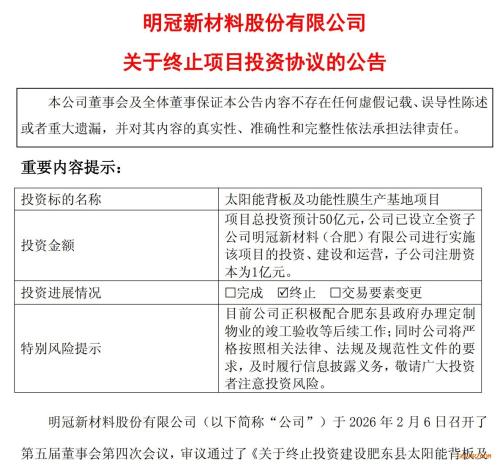
签约3年后终止!明冠新材砍掉50亿元光伏项目后,能否借2.9亿元特种功能膜项目扭亏?
Mei Ri Jing Ji Xin Wen· 2026-02-09 04:32
Core Viewpoint - The company, Mingguan New Materials, has made a significant strategic adjustment by terminating a 5 billion yuan investment in a solar backplane and functional film production project in Hefei, reflecting the severe compression of survival space in the photovoltaic backplane sector and the pressure of expected losses exceeding 1 billion yuan in 2025 [1][6]. Group 1: Project Termination - The company signed an investment cooperation agreement in January 2023 to invest 5 billion yuan in the Hefei project, which was planned to produce 300 million square meters of solar backplanes and 200 million square meters of functional films [2]. - On February 6, 2026, the board of directors approved the termination of the Hefei project due to intensified price competition in the photovoltaic industry and anticipated widespread losses in 2024 and 2025 [3][5]. Group 2: Financial Implications - The company has already invested approximately 1.6341 million yuan in the Hefei project, with an additional 871,600 yuan pending payment, and has agreed with the Hefei government to mutually release responsibilities [4]. - The company forecasts a net loss of 1.25 billion to 1.6 billion yuan for 2025, with a further loss of 1.35 billion to 1.7 billion yuan when excluding non-recurring gains and losses [6][9]. Group 3: New Project Development - The company plans to invest 290 million yuan in a new project for special functional films in Yichun, shifting from the heavy investment in Hefei to a lighter, more technology-driven approach [1][5]. - The new project aims to produce 350 million square meters of new battery packaging special functional films, utilizing existing facilities to significantly reduce investment costs and construction time [5].


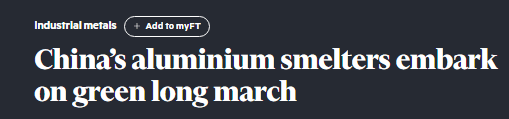
全球媒体聚焦︱英媒:中国铝冶炼厂开启绿色征程
Sou Hu Cai Jing· 2026-02-09 02:16
Core Viewpoint - The Chinese aluminum industry is transitioning towards green and low-carbon development, with significant production capacity being relocated from traditional coal-based regions to areas rich in renewable energy [1][2]. Group 1: Industry Transition - China's aluminum production is projected to reach 43.8 million tons in 2024, accounting for approximately 60% of global output [2]. - Due to large-scale capacity transfers, 13 million tons of electrolytic aluminum capacity now comes from regions like Yunnan, Sichuan, Xinjiang, and Inner Mongolia, representing about 30% of the national total [2]. - New aluminum smelting plants in these regions utilize clean energy and have lower development costs [2]. Group 2: Environmental Impact - The multi-year, multi-billion dollar relocation project is aiding one of the world's most polluting industries in achieving decarbonization [4]. - Successful decarbonization in the aluminum sector could serve as a model for implementing stricter production limits and capacity replacements in other industries [4]. Group 3: Regional Development - Yunnan province, known for its clear skies, is becoming a focal point for the future development of the aluminum industry, with numerous smelting plants concentrated in industrial parks [5]. - The region is equipped with a large high-voltage power grid that transmits electricity from local hydropower stations, complemented by solar panels and wind turbines [5]. Group 4: Corporate Initiatives - A major private aluminum company in Shandong plans to establish its second smelting plant in Yunnan, aiming for an annual output of 4 million tons, equivalent to the total annual output of North America's aluminum industry [7]. - The company's report indicates that this relocation, along with investments in solar and wind projects in Shandong and Yunnan, will reduce its carbon emissions by approximately two-thirds [7]. - The mayor of Wenshan, Le Jiawen, stated that the Chinese aluminum industry is undergoing a profound and systematic transformation, shifting competition from scale and cost to a focus on green and low-carbon advantages [7].