种族问题

Search documents
1.6公里,美国没走出来
Xin Lang Cai Jing· 2026-01-21 12:20
Core Viewpoint - The recent police shooting of 37-year-old American citizen Rainey Nicole Good in Minneapolis has reignited large-scale protests, highlighting systemic violence and deep-rooted social fractures in the U.S. [1][2][4] Group 1: Systemic Issues - The distance of 1.6 kilometers between the sites of George Floyd's death and Good's shooting symbolizes the cyclical nature of systemic violence in American society [4] - The events surrounding Floyd's death have exposed entrenched racism within U.S. institutions, with structural racism persisting across law enforcement, housing, education, healthcare, and employment [5][6] - The violence associated with immigration enforcement has become more frequent, raising concerns about the safety and dignity of citizens in the current political climate [7][9] Group 2: Political Dynamics - The U.S. political system has shown a failure to unify public opinion and seek reform in response to Good's shooting, instead becoming polarized and mired in partisan conflict [10][11] - Both major political parties have engaged in intense political attacks regarding the incident, focusing on narrative control rather than meaningful reform of law enforcement practices [11][13] - The ongoing political strife has led to the public's trust in law enforcement and political institutions eroding, as evidenced by a significant decline in reported gun violence incidents following the Floyd case [16][18] Group 3: Social Trust and Consensus - The repeated tragedies of Floyd and Good have deepened societal rifts and eroded trust in law enforcement agencies, leading to a crisis of confidence in the political system and the American Dream [15][16] - A survey indicated that 69% of respondents believe the American Dream is either unattainable or has become increasingly difficult to achieve, marking a record high in pessimism over the past 15 years [16] - The ongoing trust crisis is accompanied by a growing divide in societal values, threatening the foundation of community consensus [18][19]


作为唯一的超级大国,美国的7寸在何处?其中一个就是美元
Sou Hu Cai Jing· 2026-01-20 06:45
Group 1 - The article discusses the concept of identifying the critical vulnerabilities of a powerful entity, using the United States as an example, highlighting its military and economic dominance [1] - The U.S. military strength is emphasized, with 1.4 million active-duty personnel and global command structures, allowing rapid deployment in case of conflict [1] - The U.S. dollar's historical significance is outlined, detailing its establishment as the dominant global currency through the Bretton Woods system in 1944, linking it to gold [1] Group 2 - The article notes the challenges to the dollar's dominance, with various countries seeking alternatives, such as the Euro and initiatives like China's Belt and Road [3] - The internal social issues in the U.S., particularly racial discrimination, are highlighted as a significant vulnerability, affecting social stability and the country's global image [3] - The persistence of racial tensions and incidents of violence in the U.S. are cited as ongoing challenges that undermine national cohesion and contribute to uncertainty about the country's future [3]

《疯狂动物城》,越看越恐怖
半佛仙人· 2025-12-07 04:12
Core Viewpoint - The article discusses the underlying themes and hidden narratives in the movie "Zootopia," particularly focusing on the character of Chief Bogo and the societal dynamics within the animal city, suggesting a deeper commentary on social issues and identity politics [5][16]. Group 1: Character Analysis - Chief Bogo is portrayed as a key figure who is aware of the truth behind the missing carnivores but chooses to delay action, indicating a manipulative nature [6][7]. - Judy Hopps, the protagonist, is depicted as a tool used by the political system to gain votes, highlighting the theme of being a pawn in a larger game [10][11]. Group 2: Societal Commentary - The film presents a complex view of societal divisions, particularly between herbivores and carnivores, while masking deeper issues related to size and power dynamics among different animal types [15][16]. - The narrative suggests that the apparent harmony in "Zootopia" is superficial, with underlying tensions that reflect real-world social issues, such as racial and identity politics [16]. Group 3: Evolution of Themes - The article notes a shift in the film's themes over the years, with earlier messages about inclusivity and potential being overshadowed by current societal challenges and corporate diversity initiatives that may not be effective [16]. - The commentary reflects on how the film's humor and satire have become more conservative in the context of contemporary societal changes [16].

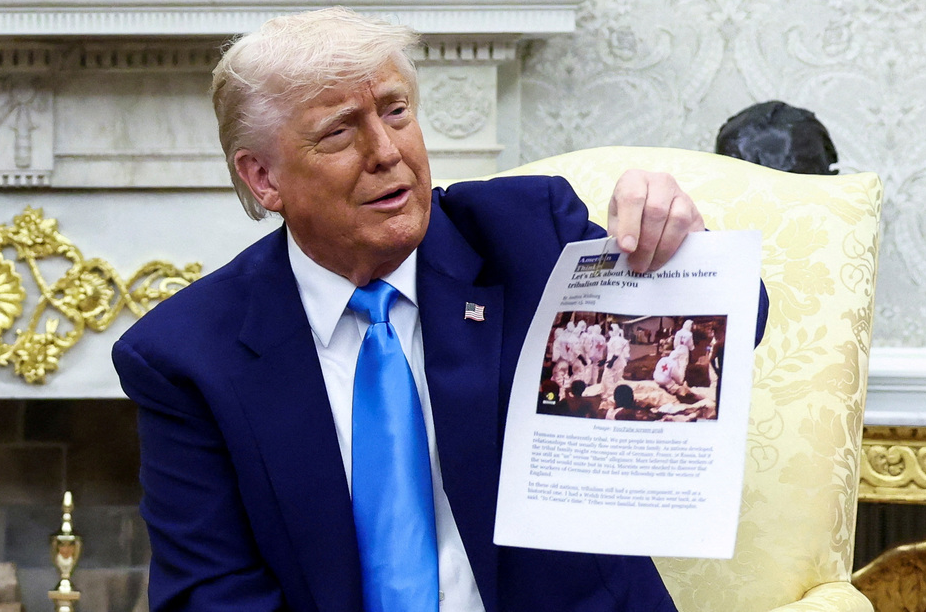
特朗普“伏击”南非总统亮出“白人遇害”图,涉事方路透社“辟谣”:图片内容与其说法无关
Huan Qiu Wang· 2025-05-23 02:26
Core Points - The article discusses a controversial claim made by U.S. President Trump regarding alleged "racial slaughter" of white farmers in South Africa during a meeting with South African President Ramaphosa [1][4] - Trump presented a paper with a photo purportedly showing a buried white farmer, which was later identified as an unrelated image from a conflict in the Democratic Republic of Congo [1][3] Group 1 - Trump accused South Africa of a "racial slaughter" against white farmers, using a photo as evidence during a meeting with Ramaphosa [1][4] - The image presented by Trump was actually a screenshot from a video taken in Goma, Congo, during an attack by the M23 rebel group, not related to South Africa [3] - Ramaphosa denied Trump's claims, stating that violence affects all races in South Africa, with black individuals being the most impacted [4] Group 2 - The article from the conservative magazine "American Thinker," which Trump referenced, discusses pressures faced by white individuals in South Africa but does not support Trump's specific claims [3] - The journalist who captured the original video expressed shock at Trump's misrepresentation of the content, emphasizing the inaccuracy of linking the image to South Africa [3]