租金收益

Search documents
前11个月一线城市二手房累计成交51.9万套
Mei Ri Jing Ji Xin Wen· 2025-12-10 03:33
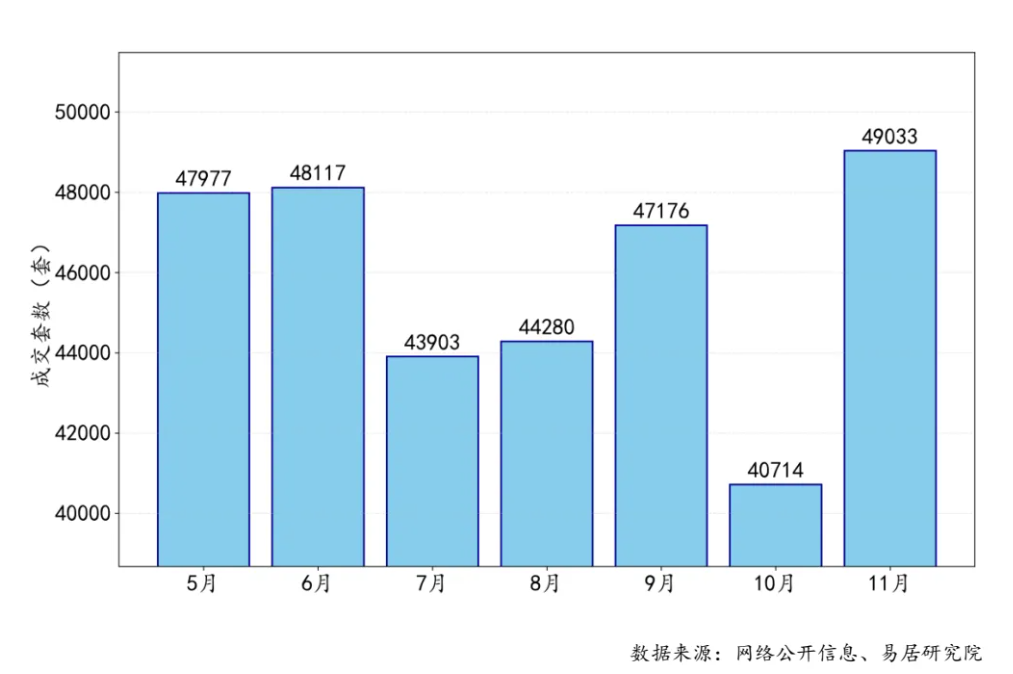
Core Insights - The second-hand housing market in four first-tier cities has shown significant recovery, with cumulative transactions reaching 519,000 units by November, surpassing the same period in 2024 for the first time in four years [1] - Analysts predict that this positive trend may continue into 2026, supported by expected monetary policy easing such as interest rate cuts [1][4] - The market is experiencing a substantial release of demand, with a smooth replacement chain observed among homeowners selling old properties to buy new ones [1][4] Market Performance - In November 2025, the monthly transaction volume for second-hand residential properties in first-tier cities reached 49,033 units, a 20% increase from October, even exceeding the peak season of September [4] - The overall market sentiment remains positive, with some sellers adjusting prices to attract buyers, although many buyers are still looking for bargains [4][5] Price Trends - The average prices for second-hand homes in major cities have shown a decline, with Beijing at 64,984 yuan/sqm (down 6.08% year-on-year), Shanghai at 56,708 yuan/sqm (down 5.56%), and Guangzhou at 34,163 yuan/sqm (down 7.60%) [7][9] - The trend of "price for volume" has become a consensus in the second-hand housing market, indicating a shift in strategy among sellers [6][9] Rental Market Dynamics - The rental yield from second-hand properties has become attractive, with some properties offering better returns compared to bank savings [9] - The analysis suggests that as the market adjusts, landlords may shift from renting to selling, especially if new housing needs arise [9]

投资房产!他们全款买房为收租
3 6 Ke· 2025-10-20 02:30
Core Insights - The article discusses the investment strategy of an individual named Zhang Qiang, who is considering purchasing a small apartment in Beijing for rental income rather than capital appreciation [1][7] - The current real estate market is characterized by opportunities for stable rental yields, particularly in core urban areas, despite ongoing market volatility [3][6] Investment Strategy - Zhang Qiang is focusing on properties with lower total prices and higher rental yields, specifically targeting small units within the city’s five-ring area [3][5] - He aims for a rental yield of around 4%, which is more attractive compared to larger units that typically offer lower yields due to higher total prices [5][7] Market Dynamics - The demand for small units is increasing, with over 60% of transactions in the market being for properties under 70 square meters, while larger units are less sought after [5][6] - The article highlights that many buyers, including institutional investors, are actively seeking undervalued properties, indicating a competitive market for desirable listings [5][6] Rental Income Focus - Zhang Qiang's investment approach has shifted from relying on property value appreciation to prioritizing monthly rental income as a financial safety net [7][8] - The article emphasizes that the current investment landscape favors properties with high rental yields, especially in light of inflation concerns and low returns from traditional savings [7][8] Professional Investment Considerations - Institutional investors are beginning to show interest in residential properties due to declining commercial real estate returns, although they are still in the early stages of market assessment [6][8] - The article notes that professional investors utilize more complex calculations for return on investment, factoring in various costs such as maintenance and vacancy losses, which can affect overall yield assessments [8]
投资房产!他们全款买房为收租
经济观察报· 2025-10-19 07:30
Core Viewpoint - The article discusses the investment strategy of an individual named Zhang Qiang, who is considering purchasing a property in Beijing for rental income rather than capital appreciation, reflecting a shift in investment focus in the real estate market [5][17]. Group 1: Investment Motivation - Zhang Qiang was inspired to invest in real estate after a friend's successful purchase of a small apartment for 1.2 million yuan, generating a monthly rental income of approximately 4,000 yuan [5][8]. - The current market conditions have prompted Zhang Qiang to seek stable rental income as a passive income source, especially given the volatility in other investment avenues like stocks and funds [7][10]. Group 2: Property Selection Criteria - Zhang Qiang is focusing on properties within the Fifth Ring Road of Beijing, prioritizing locations with good transportation links, specifically within two kilometers of a subway station [10][11]. - He aims to find properties with lower total prices and higher rental yields, indicating a preference for small units over larger ones due to better rental return rates [13][17]. Group 3: Market Dynamics - The article highlights a trend where small unit properties are increasingly sought after, with over 60% of transactions in the market being for units under 70 square meters [13]. - There is a noted scarcity of high-quality, low-priced properties, as many sellers are reluctant to lower prices unless they are in urgent need of cash [14][15]. Group 4: Investment Returns - Zhang Qiang's target property, if purchased for 1.2 million yuan, could yield an annual rental return of approximately 4%, which is a significant consideration for his investment strategy [11][19]. - The article contrasts the simplistic return calculations of individual investors with the more complex models used by institutional investors, which account for various costs and potential losses [18][19].