
秸秆资源化利用

Search documents
贵阳去年农作物秸秆 回收利用逾六万吨
Xin Lang Cai Jing· 2026-02-13 19:33
Core Insights - Guiyang is focusing on the resource utilization of straw, exploring market-oriented paths to convert agricultural waste into green development resources. By 2025, the city aims to mobilize social funds of 18.87 million yuan and achieve a straw recovery of 60,600 tons, representing a year-on-year increase of 8.6% [1][2]. Group 1 - The city has organized the public release of straw purchasing information from 76 agricultural enterprises, cooperatives, and large farming households, effectively addressing the "last mile" issue of straw utilization [1]. - Guiyang's agricultural and rural affairs bureau is implementing a dual approach of "promoting use while prohibiting" to coordinate straw supply and demand, utilizing an information platform to facilitate production and sales connections [1][2]. - The city has promoted nearly 90,000 tons of straw purchasing information across various media platforms, covering multiple crop types, which has effectively resolved bottlenecks in straw utilization [1][2]. Group 2 - The city is enhancing the storage and utilization chain by focusing on the comprehensive utilization of straw, which includes five categories: fertilizer, feed, substrate, fuel, and raw material [2]. - Seven districts and counties in Guiyang have achieved full coverage of straw storage networks, promoting grassroots participation in market transactions [2]. - Various enterprises are actively engaging in different aspects of straw utilization, with companies like Guizhou Southern Dairy and Guizhou Dali Shun Agriculture consuming 54,300 tons of straw for feed, while others focus on substrate and fertilizer production [2].
昔日“大麻烦”今成“香饽饽”,看秸秆如何从“田间废料”蝶变“产业黄金”
Yang Zi Wan Bao Wang· 2025-12-31 13:32
Core Viewpoint - The article highlights the transformation of agricultural waste, specifically straw, into valuable resources through a systematic collection and processing approach in Dayi Town, Yangzhou, promoting a sustainable agricultural model [1][3]. Group 1: Straw Collection and Utilization - Straw collection, known as "straw leaving the field," involves gathering post-harvest straw for resource utilization, reducing pollution and enhancing resource value [1][2]. - The process includes using specialized machinery such as raking, bundling, and grabbing machines to efficiently collect and prepare straw for transport [2]. - The collected straw is processed into various products, including biomass fuel, organic fertilizers, and mushroom cultivation substrates, creating a closed-loop green agricultural system [2][3]. Group 2: Economic and Environmental Impact - The initiative is supported by a model that integrates government, enterprises, and farmers, aiming to build a straw collection and storage system that balances social, economic, and ecological benefits [3]. - The program is projected to handle 8,000 acres of farmland and 3,200 tons of straw annually, generating an estimated annual output value of 600,000 yuan for farmers and local communities [3]. - The approach not only provides economic benefits to farmers and reduces production costs for enterprises but also contributes to ecological protection and sustainable agricultural development [3].
“工厂”建在田边 肥料产自田间 宁波创新采用秸秆“原位堆腐制肥”模式
Feng Huang Wang Cai Jing· 2025-11-27 11:16
Core Insights - The implementation of "in-situ composting" technology for straw management in Jiangbei District provides a new solution for the resource utilization of straw [1][2] - The process involves stacking straw bales, applying urea and microbial agents, and covering them with black film for about 40 days to produce organic fertilizer [1] - The technology significantly reduces the cost of straw treatment by 30% to 50% compared to traditional methods, while also decreasing the need for chemical fertilizers [1] Group 1 - The new composting model requires only 10 square meters of land to process straw from 50 acres of farmland, making it operationally simple and cost-effective [1] - The internal structure of the composting reactor includes ventilation pipes and digital temperature monitoring, allowing for efficient fermentation and real-time data tracking [1] - The economic benefits of this technology are highlighted, with potential earnings of 1.4 million yuan if applied to just 1% of the available straw resources in Ningbo [2] Group 2 - The use of scientifically composted organic fertilizer not only mitigates air pollution from straw burning but also enhances soil organic matter and reduces chemical fertilizer usage [2] - In 2022, Ningbo collected 710,000 tons of straw, with 460,000 tons (65%) being utilized as fertilizer, indicating significant room for improvement in straw utilization rates [2] - The initiative aligns with agricultural carbon peak goals, promoting a green cycle in agricultural production while lowering costs [2]
秸秆换钾肥,这里的经验值得借鉴
Zhong Guo Huan Jing Bao· 2025-11-26 03:14
Core Viewpoint - The article highlights the issue of biomass burning in rural areas of southern hilly regions, where villagers burn various plant materials due to lack of storage and to obtain potassium-rich soil for gardens. This practice, while seemingly minor at individual points, collectively impacts air quality and poses challenges for local authorities [1]. Group 1: Biomass Burning Practices - Villagers collect and burn biomass such as weeds and vines, which leads to air quality concerns due to widespread and numerous burning points [1]. - The primary reasons for this practice include the lack of storage options for biomass and the desire to obtain potassium-rich soil for gardening [1]. Group 2: Local Government Response - Local officials are seeking to transition from dispersed burning to centralized processing to mitigate smoke emissions from individual households [1]. - Some regions have allocated agricultural funds to purchase potassium fertilizer, which is then distributed to villagers in exchange for the biomass they would otherwise burn [1]. Group 3: Waste Management and Agricultural Practices - Collected biomass is transported to specialized incineration facilities for centralized burning, allowing villagers to collect wood ash in return [1]. - The article suggests that the management of straw burning can learn from the strategies used to control the burning of garden soil materials, emphasizing the need for improved resource utilization in agriculture [1].
内蒙古兴安盟:科学应对寒潮 确保牲畜安全越冬
Xin Hua She· 2025-11-07 09:40
Core Viewpoint - The arrival of a cold wave in Inner Mongolia's Xing'an League poses challenges to the livestock industry, prompting local measures to ensure livestock safety during winter [1] Group 1: Livestock Industry Challenges - Xing'an League is a significant livestock region with a livestock population of 13.65 million [1] - The cold wave necessitates proactive measures for feed storage to safeguard livestock during winter [1] Group 2: Local Initiatives - Local farmers are utilizing over 100 agricultural machines to efficiently process corn straw into compact bales before snowfall [1] - The area has 260,000 acres of corn fields, capable of producing 104,000 tons of straw, which is being repurposed into high-quality feed through large-scale processing [1] Group 3: Economic Benefits - Each household can save over 2,000 yuan annually on feed costs through the resource utilization of straw, addressing both straw management and wintering challenges for livestock [1] - The Xing'an League's agricultural and animal husbandry bureau reports that 5.6 million tons of artificial feed and 2.1 million tons of natural grass have been stored, laying a solid foundation for the stable development of the livestock industry [1]
广西大学学子突破农业废弃物转化“卡脖子”技术, 8亿吨“生态包袱”变身“致富黄金”
Zhong Guo Chan Ye Jing Ji Xin Xi Wang· 2025-08-15 10:34
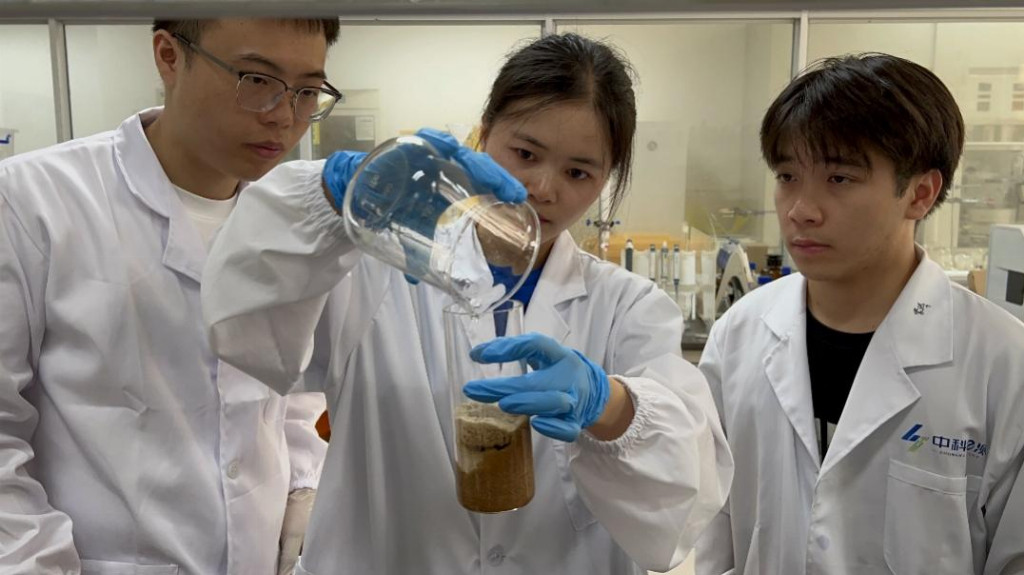
Core Insights - The article highlights the innovative transformation of agricultural waste, specifically straw, into valuable resources through scientific research and community engagement [1][4][5]. Group 1: Technological Breakthroughs - The research team from Guangxi University developed a three-component deep eutectic solvent biomimetic catalytic system, achieving significant advancements in straw resource utilization [2][4]. - Key breakthroughs include: 1. Extraction rate increased from 50% to 90%, enabling efficient composting within 24 hours [2][4]. 2. Humic acid content exceeds industry standards by 150%, enhancing nutrient availability [4]. 3. Fertilizer efficiency improved by 27%, allowing for tailored formulations based on soil quality [4]. Group 2: Economic Impact - The innovative "straw-for-fertilizer" model allows farmers to exchange waste straw for high-quality fertilizer, turning waste into resources and increasing income [5]. - For example, a farmer in Baise saved 200 yuan per acre on straw disposal and earned an additional 602 yuan from fertilizer [5]. - In Hechi, the introduction of new fertilizers led to a total income increase of 320,000 yuan for the village [5]. Group 3: Community Engagement and Social Change - The project emphasizes the importance of understanding rural life through direct engagement with farmers, leading to practical solutions that benefit the community [2][8]. - The youth team members express a commitment to using technology to improve farmers' lives, reflecting a deep connection to the land and its people [8][9].

苏州全市秸秆综合利用率99.9%,走在全国前列
Su Zhou Ri Bao· 2025-08-08 23:39
Group 1 - The core viewpoint is that Suzhou has successfully implemented innovative straw resource utilization methods, achieving a straw comprehensive utilization rate of 99.9% and livestock manure resource utilization rate of 96.4%, leading the nation in these metrics [1][2] - The traditional methods of straw disposal, such as burning, have been detrimental to air quality and soil health, prompting the need for more sustainable practices [1] - Longyun Village has developed a cooperative farming model that utilizes scientific techniques to convert straw into organic fertilizer, enhancing rice growth and improving soil quality [1] Group 2 - Donglin Village in Taicang has upgraded its straw utilization to a "3.0 version," producing 30,000 tons of fermented straw feed annually, which is sold for 500 yuan per ton across various regions [2] - The transformation of straw from a waste product to a profitable resource has contributed to the economic development of local villages, showcasing a successful model of ecological circular agriculture [2] - Donglin Village was recognized as a "Zero Carbon Village Demonstration Village" by the Ministry of Agriculture and Rural Affairs and the United Nations Development Programme, highlighting its commitment to sustainable practices [2]