
农业资源综合利用

Search documents
“秸”尽所能,江西这个传统农业大区实现生态、经济双赢
Zhong Guo Xin Wen Wang· 2026-02-04 10:06
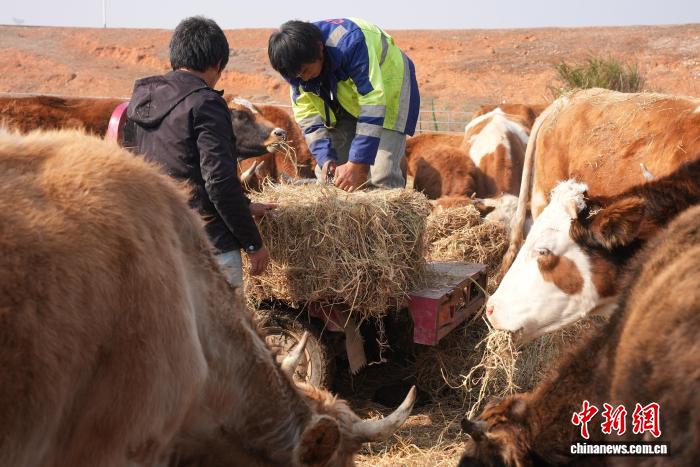
Core Viewpoint - The article highlights the effective utilization of agricultural straw in Jiangxi Province, particularly in Nanchang, where local cooperatives and companies are transforming waste straw into valuable feed and other products, thereby reducing costs and promoting environmental sustainability [1][5]. Group 1: Company Initiatives - The Haoyou Planting and Breeding Cooperative is processing rice straw into feed blocks, addressing the issue of winter feed shortages for cattle and reducing costs by approximately 300,000 yuan annually for raising over 150 cattle [1][3]. - Jiangxi Hengrang Ecological Agricultural Technology Co., Ltd. is focused on high-value utilization of straw, developing biodegradable rice seedling trays that increase seedling survival rates and yield by nearly 300 jin per mu for double-crop rice [4]. - The company is also working on a soil conditioner derived from straw, aimed at improving soil quality and addressing issues like soil acidification and heavy metal pollution [4]. Group 2: Industry Trends - Nanchang's New District is leveraging straw resource abundance by implementing a "government guidance + market operation" model to develop straw collection and processing enterprises, achieving over 95% utilization rate of straw in the region by 2025 [5]. - The district has established five agricultural enterprises as key players in straw comprehensive utilization, promoting local fertilizer and feed applications [5].

创新推进秸秆综合利用
Xin Lang Cai Jing· 2026-02-03 19:46
Core Viewpoint - The initiative in Datong County focuses on the clean utilization of straw, aiming to reduce coal consumption by approximately 3,000 tons annually, curb burning pollution, and support carbon neutrality goals while enhancing soil organic matter through feed utilization [1][2] Group 1: Project Implementation - The project will commence in 2025, establishing a comprehensive utilization demonstration base for crop straw, transforming agricultural waste into a resource that promotes income growth and ecological protection [1] - Datong County aims to increase the comprehensive utilization rate of straw to over 90%, creating a dual-track utilization system of "fuel and feed" [2] Group 2: Production Capacity and Technology - A biomass pellet fuel production base with an annual capacity of about 5,000 tons has been established in Xujiazai Village, and a pellet feed production base with a capacity of approximately 4,500 tons in Dalong Village [2] - The project employs advanced domestic technology and automated equipment, ensuring a pellet formation rate of over 95% and significantly improving feed nutritional conversion rates [2] Group 3: Economic Impact - The stable straw purchase mechanism is expected to cover seven surrounding towns, facilitating the removal of straw from 2,000 hectares and directly increasing farmers' income by 1.2 million yuan [2] - The initiative also creates job opportunities in collection, transportation, and processing, benefiting local communities, especially impoverished households, with an average annual income increase of over 15,000 yuan per person [2]
促进农业经济循环发展税收优惠(一至四)
蓝色柳林财税室· 2026-01-26 09:31
Core Viewpoint - The article discusses the tax incentives provided by the government to promote the recycling and utilization of renewable resources, which are crucial for rural revitalization and agricultural economic development. Group 1: Tax Incentives for Biomass and Renewable Resources - From March 1, 2022, a 100% VAT refund policy is implemented for products made from specific renewable resources such as kitchen waste, animal manure, and agricultural residues [4] - Taxpayers must obtain VAT invoices for the recycled resources purchased domestically to qualify for the refund policy [5] - The sales revenue from products that do not meet the invoice requirements will not be eligible for the VAT refund [5][12] Group 2: Conditions for Enjoying Tax Benefits - Taxpayers must maintain a record of the recycled resources acquired, including supplier details, resource type, quantity, price, and whether VAT invoices were obtained [6] - The products sold must not fall under the categories of eliminated or restricted projects as per the industrial structure adjustment guidance [6] - The products must not be classified as high pollution or high environmental risk according to the environmental protection catalog [6] Group 3: Specific Tax Refund Policies - A 90% VAT refund policy applies to products made from agricultural residues such as straw and corn cobs [11] - A 70% VAT refund policy is available for biodiesel and industrial-grade mixed oil produced from waste animal and plant oils [18] - A 50% VAT refund policy is applicable for paper pulp and paper produced from agricultural straw [26] Group 4: Compliance and Regulatory Requirements - Taxpayers must not have received administrative penalties for violating environmental protection laws in the six months prior to applying for the tax refund [8] - Taxpayers must provide a written declaration to the tax authority confirming compliance with the relevant technical standards and conditions [8][14] - The raw materials used in the products must consist of at least 70% from the specified renewable resources [15][39]
秸秆“翻身记”
Xin Lang Cai Jing· 2026-01-10 23:42
Core Viewpoint - The transformation of straw from an ecological burden into an industrial asset is driving economic growth and sustainability in Longyan, Fujian Province, showcasing a successful model of agricultural innovation and resource utilization [1][2][3]. Group 1: Economic Impact - Farmers like Gong Hongyuan are now earning approximately 1,800 yuan per acre from straw sales, which contributes to an annual income increase of about 15,000 yuan, representing nearly 10% of the income from one acre of rice [3]. - The local agricultural model has shifted from burning straw to utilizing it for feed production, with the purchase price for straw set at around 600 yuan per ton, significantly lower than the average cost of 1,400 yuan for purchased feed [4][6]. Group 2: Policy Support - The government has allocated 7.22 million yuan in special funds for 2024-2025 to support straw utilization, including subsidies for purchasing key equipment and for the construction of storage and transportation facilities [5]. - Local policies provide financial incentives for farmers to adopt straw recycling practices, with subsidies ranging from 60 to 80 yuan per acre for straw utilization in fertilizer and feed production [5]. Group 3: Sustainable Practices - The introduction of a "straw-feed-fertilizer" cycle is being promoted, with local farmers benefiting from reduced feed costs and improved soil quality through straw incorporation [7][8]. - The establishment of a local resource processing and consumption loop is being reinforced, ensuring that the feed produced from straw is utilized by local livestock farmers, thus stabilizing the market and reducing dependency on external supplies [7].
昔日“大麻烦”今成“香饽饽”,看秸秆如何从“田间废料”蝶变“产业黄金”
Yang Zi Wan Bao Wang· 2025-12-31 13:32
Core Viewpoint - The article highlights the transformation of agricultural waste, specifically straw, into valuable resources through a systematic collection and processing approach in Dayi Town, Yangzhou, promoting a sustainable agricultural model [1][3]. Group 1: Straw Collection and Utilization - Straw collection, known as "straw leaving the field," involves gathering post-harvest straw for resource utilization, reducing pollution and enhancing resource value [1][2]. - The process includes using specialized machinery such as raking, bundling, and grabbing machines to efficiently collect and prepare straw for transport [2]. - The collected straw is processed into various products, including biomass fuel, organic fertilizers, and mushroom cultivation substrates, creating a closed-loop green agricultural system [2][3]. Group 2: Economic and Environmental Impact - The initiative is supported by a model that integrates government, enterprises, and farmers, aiming to build a straw collection and storage system that balances social, economic, and ecological benefits [3]. - The program is projected to handle 8,000 acres of farmland and 3,200 tons of straw annually, generating an estimated annual output value of 600,000 yuan for farmers and local communities [3]. - The approach not only provides economic benefits to farmers and reduces production costs for enterprises but also contributes to ecological protection and sustainable agricultural development [3].
打造“五个一”秸秆利用新格局
He Nan Ri Bao· 2025-06-18 23:31
Core Viewpoint - Henan Province is focusing on the comprehensive utilization of straw resources, aiming to enhance agricultural sustainability and reduce carbon emissions through innovative practices and collaborative efforts among various sectors [1][2][3] Group 1: Straw Resource Utilization - Henan Province generates approximately 100 million tons of straw annually, ranking second in the country [1] - In 2024, the province's straw collection potential is estimated at 78.96 million tons, with wheat, corn, peanuts, and rice straw accounting for 96.48% of the total [1] - The total straw utilization in the province is projected to be 74.51 million tons, maintaining a comprehensive utilization rate above 93%, with fertilizer and feed utilization accounting for 74.4% and 21.3% respectively [1] Group 2: Development Strategies - The province is implementing a "one area, one belt, one network, one alliance, one road" strategy to enhance straw utilization [2][3] - "One area" refers to the establishment of high-standard farmland demonstration zones that integrate various agricultural practices and technologies [2] - "One belt" focuses on developing a straw-to-feed industry belt in key livestock regions, enhancing the straw feed storage system and supporting technology upgrades [2] - "One network" aims to create a standardized straw collection and storage network across the province, ensuring comprehensive coverage [2] - "One alliance" involves forming a straw utilization industry alliance to facilitate collaboration and information sharing among government, enterprises, and other stakeholders [2] - "One road" emphasizes the development of high-value straw utilization pathways, including edible fungi substrates and eco-friendly materials [3]