菌棒

Search documents
长顺税务:春风拂暖“生产忙” 税惠滴灌“小菌棒”
Sou Hu Cai Jing· 2026-02-28 01:06
Core Viewpoint - The article highlights the proactive measures taken by the tax authorities in Longshun County to support local agricultural enterprises, specifically Guizhou Tianrenyi Agricultural Technology Development Co., Ltd, in overcoming tax-related challenges and enhancing production efficiency during the spring season [1][2]. Group 1: Tax Support Initiatives - Longshun County Tax Bureau organized visits to enterprises to deliver policies, assess needs, and resolve issues, thereby facilitating a faster recovery and production ramp-up for businesses [1]. - The tax authorities provided on-site guidance regarding the sales of self-produced agricultural products, issuance of invoices, and tax incentives for key employment groups [1][2]. Group 2: Policy Interpretation and Guidance - Tax officials explained the continuation of the VAT exemption policy for agricultural producers selling self-produced primary agricultural products, effective from January 1, 2026, specifically for enterprises engaged in mushroom cultivation and sales [1][2]. - Detailed explanations were provided regarding the distinction between primary and deep processing of edible fungi products, emphasizing the need for compliance with VAT regulations for purchased agricultural products that are processed and sold [2]. Group 3: Operational Support for Enterprises - The tax bureau assisted the company in understanding how to properly issue invoices for purchasing agricultural products from farmers and accurately calculate input tax deductions, thereby helping to standardize tax handling and reduce tax-related risks [2]. - The tax authorities indicated that agricultural products used for deep processing would no longer qualify for the additional deduction policy, advising the company to be mindful of these changes in their accounting practices [2].
昔日“大麻烦”今成“香饽饽”,看秸秆如何从“田间废料”蝶变“产业黄金”
Yang Zi Wan Bao Wang· 2025-12-31 13:32
Core Viewpoint - The article highlights the transformation of agricultural waste, specifically straw, into valuable resources through a systematic collection and processing approach in Dayi Town, Yangzhou, promoting a sustainable agricultural model [1][3]. Group 1: Straw Collection and Utilization - Straw collection, known as "straw leaving the field," involves gathering post-harvest straw for resource utilization, reducing pollution and enhancing resource value [1][2]. - The process includes using specialized machinery such as raking, bundling, and grabbing machines to efficiently collect and prepare straw for transport [2]. - The collected straw is processed into various products, including biomass fuel, organic fertilizers, and mushroom cultivation substrates, creating a closed-loop green agricultural system [2][3]. Group 2: Economic and Environmental Impact - The initiative is supported by a model that integrates government, enterprises, and farmers, aiming to build a straw collection and storage system that balances social, economic, and ecological benefits [3]. - The program is projected to handle 8,000 acres of farmland and 3,200 tons of straw annually, generating an estimated annual output value of 600,000 yuan for farmers and local communities [3]. - The approach not only provides economic benefits to farmers and reduces production costs for enterprises but also contributes to ecological protection and sustainable agricultural development [3].
不掉队 赶上来|从过渡期到常态化 帮扶产业如何后劲更足
Ren Min Ri Bao· 2025-12-25 02:27
Core Viewpoint - The Central Economic Work Conference has outlined eight key tasks for economic work in the coming year, emphasizing the importance of maintaining and expanding the achievements of poverty alleviation while promoting rural revitalization [1] Group 1: Consolidation of Achievements - The development of supportive industries is crucial for enhancing the endogenous development capacity of poverty-stricken areas and continuously improving income-generating abilities [1] - In 2024, the coffee production in Xinzhai Village is expected to reach 4,300 tons, generating an agricultural output value of 170 million yuan, with per capita disposable income exceeding 40,000 yuan [3] Group 2: Upgrading Industries - In Huichang County, the focus has shifted to beef cattle breeding, leveraging local resources and transportation advantages to establish a comprehensive beef cattle industry chain [5][6] - The implementation of a "leading enterprise + cooperative + base + farmer" model has integrated over 200 farmers into the industry system, resulting in an annual income increase of over 5,000 yuan per farmer [6] Group 3: Revitalizing Idle Assets - In Xiji County, the transformation of an idle production facility into a modern mushroom production base has created over 100 job opportunities, with an average annual income of over 45,000 yuan for villagers [8] - The collaboration with a professional company has revitalized the production base, leading to an annual output value of over 14 million yuan [8] Group 4: Adjusting Strategies - In Leimei Village, the transition from unsuccessful black goat farming to the successful cultivation of orchid flowers has resulted in sales exceeding 150 million yuan and collective dividends of over 2.78 million yuan [10] - The establishment of a research and training base has attracted over 10,000 visitors and hosted numerous training activities, contributing to the village's economic development [10]
从过渡期到常态化 帮扶产业如何后劲更足
Ren Min Ri Bao· 2025-12-25 01:52
Core Insights - The central economic work conference has outlined eight key tasks for the upcoming year, emphasizing the importance of addressing "livelihood issues" and maintaining focus on rural revitalization and poverty alleviation efforts [1] Group 1: Poverty Alleviation and Rural Revitalization - The transition period for consolidating and expanding poverty alleviation achievements into rural revitalization is crucial, with a focus on the "three rural issues" [1] - The development of supportive industries is essential for enhancing the endogenous development capacity of impoverished areas and continuously improving income generation capabilities [1] - The "Four Batches" strategy for supportive industries aims to strengthen, upgrade, revitalize, and adjust existing industries to promote sustainable development [1] Group 2: Case Studies of Successful Initiatives - In Yunnan's Xinzhai Village, the introduction of coffee cultivation has transformed the local economy, with coffee bean prices reaching approximately 60 yuan per kilogram due to standardized farming practices [3][4] - In Jiangxi's Chitangxia Village, the establishment of a beef cattle industry has integrated over 200 farmers into a cooperative model, resulting in an annual income increase of over 5,000 yuan per farmer [6][7] - Ningxia's Murong Village has revitalized a previously idle production facility by partnering with a professional company, leading to an annual production capacity of over 600 million mushroom sticks and generating significant local employment [8][9] - Hainan's Lemei Village shifted from unsuccessful goat farming to successful orchid cultivation, achieving sales exceeding 15 million yuan and collective dividends of over 2.78 million yuan [10][11]
特色“产业链”变成“共富链” 浙江庆元食用菌产业实现跃迁
Zhong Guo Jin Rong Xin Xi Wang· 2025-12-18 12:23
Core Insights - The article highlights the efforts of Postal Savings Bank in supporting the edible mushroom industry in Qingyuan County, providing a total of 280 million yuan in credit support by the end of October 2025 [1] - Qingyuan County is recognized as the origin of artificial mushroom cultivation, with a robust industry chain that has significantly contributed to local farmers' income, achieving an industry chain output value of 5.8 billion yuan in 2024 [1] Group 1: Financial Support and Services - Postal Savings Bank has developed a comprehensive financial service system to address financing difficulties in the edible mushroom industry, transforming the "industrial chain" into a "common prosperity chain" [1] - The bank introduced the "Mushroom Loan" product, providing 3 million yuan in credit to Qingyuan County Jingchuang Edible Mushroom Technology Co., which has become a leading enterprise in the region [2] - The bank actively collaborates with the Qingyuan County Edible Mushroom Association to enhance financial service coverage, conducting targeted outreach to over 2,600 mushroom growers who cultivate more than 20,000 mushroom sticks [2] Group 2: Industry Development and Achievements - Qingyuan County's edible mushroom industry has developed a complete supply chain from spawn production to cultivation, processing, and sales, benefiting thousands of local farmers [1] - Zhejiang Baixing Food Co., a well-known deep processing and sales enterprise in the region, has been exporting products to countries like the USA, Australia, and Japan for 28 years [3] - The partnership between Postal Savings Bank and local enterprises has strengthened over time, with credit limits increasing from 5 million yuan during the pandemic to 30 million yuan by 2024 [4]


小蘑菇撑起致富伞
Ren Min Ri Bao· 2025-09-11 22:21
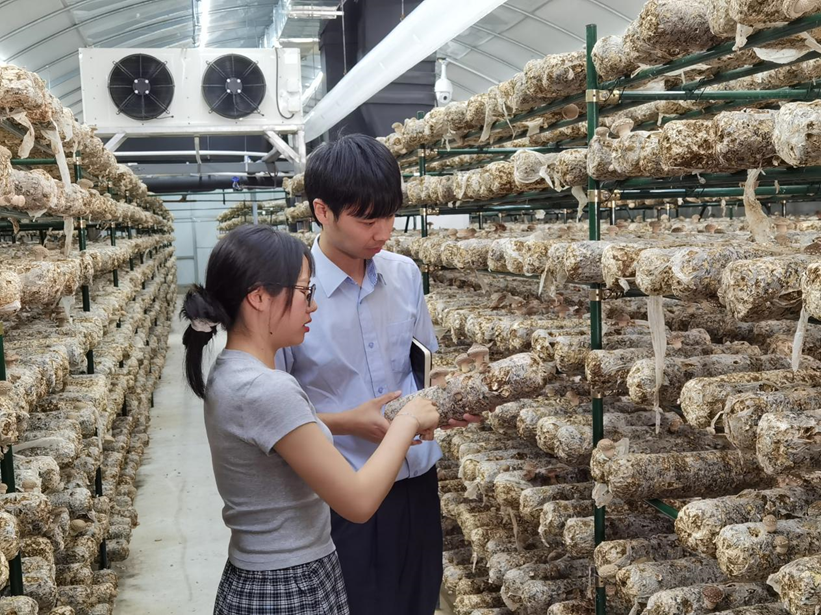
Core Viewpoint - The "Lujingqing" edible mushroom ecological technology demonstration park in Shule County, Kashgar, Xinjiang, has successfully utilized advanced planting techniques and management models to boost local income through mushroom cultivation [1]. Group 1: Company Operations - The demonstration park currently produces 50,000 mushroom sticks daily and generated 360 tons of dried edible mushrooms last year, with a revenue exceeding 20 million yuan [1]. - The park has created job opportunities for over 300 local residents, providing stable employment and contributing to the local economy [1]. Group 2: Community Impact - Local residents benefit from land leasing to the company, receiving rental fees, and can invest in the cooperative by purchasing mushroom sticks, which leads to year-end dividends [1]. - The park emphasizes the importance of community engagement by prioritizing employment for nearby villagers and encouraging them to develop backyard economies using mushroom sticks [1].
废旧物资变“废”为“宝”有新招 循环经济发展空间广阔
Yang Shi Wang· 2025-08-02 09:47
Core Viewpoint - The article highlights the significant benefits of the circular economy in various regions of China, particularly in Qingdao, where innovative technologies are being applied to transform waste into valuable resources [1] Group 1: Circular Economy Initiatives - Qingdao is actively exploring resource utilization to minimize the environmental impact of solid waste through market-oriented efforts [1] - A new "sludge drying and reduction" equipment has been installed in an automotive manufacturing plant to handle wet sludge waste generated during production [3] - The automotive company has developed a solvent salt separation technology to reduce hazardous waste by over 90% through chemical reactions [5] Group 2: Waste Reduction Achievements - The automotive company has invested 230 million yuan in 21 transformation projects, resulting in a 17% reduction in general industrial solid waste and a nearly 34% decrease in hazardous waste this year [8] - The company has saved 25 million yuan in solid waste treatment costs and reduced carbon dioxide emissions by 37,000 tons, achieving both environmental and economic benefits [8] Group 3: Household Appliance Recycling - In a recycling factory in Laixi, Qingdao, old household appliances like refrigerators and air conditioners are disassembled and recycled, achieving a 95% recovery rate [10] - The factory operates six customized intelligent disassembly lines, capable of dismantling 2 million appliances annually and generating approximately 30,000 tons of recycled materials [10] Group 4: Agricultural Waste Utilization - Qingdao has found new ways to address agricultural solid waste by converting discarded fruit wood into substrate materials for mushroom production, repurposing over 60,000 tons annually [13] - A mushroom production enterprise utilizes automated processes to transform waste wood into mushroom cultivation bags, showcasing a successful model of resource efficiency [15] Group 5: Future Developments - The local government plans to expand green recycling models to include remanufacturing of appliance parts, scrapping of old vehicles, and precious metal extraction, promoting large-scale, standardized, and clean development in the recycling industry [12][16]