
窄基ETF

Search documents
慢牛稳了?这届基民学会了低买高卖!
Sou Hu Cai Jing· 2025-12-01 09:10
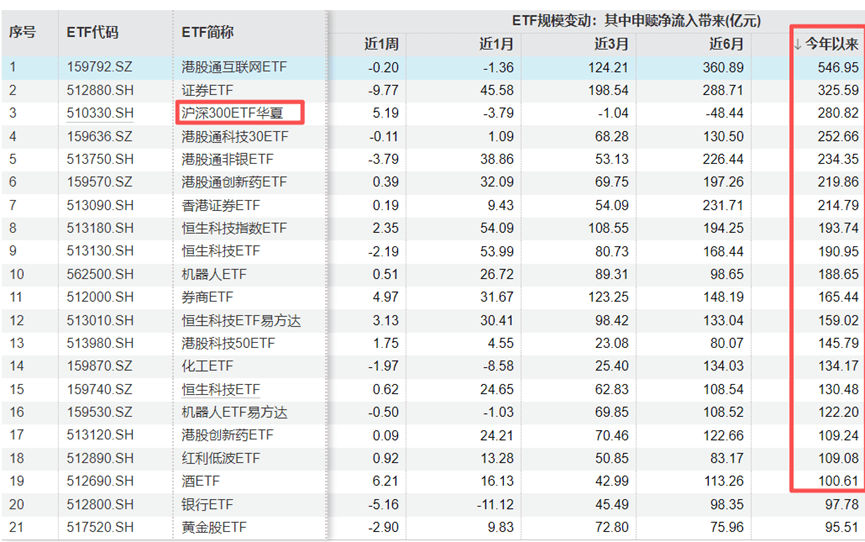
Group 1 - The current bull market is characterized by a "slow bull" sentiment, where the timing of retail investors entering the market affects the duration of the bull run [1] - Retail investors are increasingly favoring narrow-based ETFs over broad-based ETFs, indicating a shift towards more aggressive investment strategies [1][2] - Among the 19 ETFs with over 10 billion yuan in net inflows this year, only the CSI 300 is a broad-based ETF, while the remaining 18 are narrow-based ETFs [2] Group 2 - The Hong Kong Internet ETF and Securities ETF have seen significant net inflows of 546.95 billion yuan and 325.59 billion yuan, respectively, making them the top two performers [4] - The performance of narrow-based ETFs is further supported by the strong inflows into industry-themed ETFs, which dominate the accumulation rankings [6][7] - The CSI 500 index has experienced the largest net outflow this year, exceeding 960 billion yuan, attributed to previous overinflation and underperformance [10] Group 3 - The trend of net outflows from broad-based ETFs is evident, with only a few industry-specific indices appearing in the top outflow rankings [8][9] - The net outflow from the ChiNext and Sci-Tech 50 indices is viewed as a positive signal, indicating a shift in investor sentiment [11] - Retail investors have shown a tendency to exit the market after recovering their investments, particularly in the Sci-Tech 50 index [12][14] Group 4 - The majority of net inflows into ETFs are concentrated in narrow-based funds, with a notable preference for sectors like innovative drugs and robotics [15][17] - The Hong Kong Technology ETF has seen net subscriptions close to 100 billion yuan, with significant inflows during market dips, reflecting a strong accumulation sentiment [18] - The overall market sentiment suggests that as long as there are willing buyers, the bull market is likely to continue, despite potential risks [22]

从“广撒网”转向“精聚焦” 资金加速涌入窄基ETF
Zheng Quan Shi Bao· 2025-11-30 18:17
Core Insights - The first batch of 7 ETFs tracking the CSI Sci-Tech Innovation and Entrepreneurship Artificial Intelligence Index has officially launched, with some ETFs selling out on the first day, indicating strong investor interest in industry-themed ETFs [1][2] - There is a notable shift in investor preference from broad-based strategies to focused investments, reflecting a structural divergence in the A-share market where emerging industries outperform traditional blue-chip stocks [1][3] - The total scale of narrow-based ETFs has surpassed 1.6 trillion yuan, showing a doubling growth compared to the beginning of the year, while broad-based ETFs have seen less than 10% growth [1][2] Narrow-based ETF Growth - The narrow-based ETF market has seen explosive growth this year, with numerous industry-themed ETFs in the application process, including those focused on robotics, semiconductors, and innovative pharmaceuticals [2][3] - Investor enthusiasm for narrow-based ETFs is evident, with 18 ETFs attracting over 10 billion yuan in net inflows, all of which are narrow-based, highlighting a preference for targeted investment strategies [2][3] - The significant inflows into narrow-based ETFs, such as the Hong Kong Stock Connect Internet ETF and Securities ETF, which received 55.3 billion yuan and 33.4 billion yuan respectively, further emphasize this trend [2] Divergence in ETF Performance - In contrast to the popularity of narrow-based ETFs, broad-based ETFs have faced significant outflows, with the top three experiencing net outflows of 46 billion yuan, 29 billion yuan, and 14.9 billion yuan respectively [3][4] - A total of 27 ETFs have seen net outflows exceeding 5 billion yuan this year, with 21 of these being broad-based ETFs, indicating a strong preference for narrow-based options [3][4] - The structural characteristics of the market have led to a concentration of capital in high-growth sectors, while broad-based ETFs lack the appeal of specific industry attributes, resulting in diminished attractiveness [3][5] Investment Strategy Shift - Investors are transitioning from broad-based ETFs, which provide a "fuzzy allocation," to narrow-based ETFs that allow for precise selection based on specific industry trends, such as AI and renewable energy [5][6] - The shift is driven by the significant disparity in performance across different sectors, with narrow-based ETFs offering the potential for higher returns by capturing structural opportunities [5][6] - The lower investment threshold of narrow-based ETFs also helps investors avoid individual stock risks, aligning with their needs for timing and sector rotation [5][6] Market Dynamics and Risks - The current trend towards narrow-based ETFs reflects a structural shift in the A-share market, with sectors related to high-quality economic development, such as AI and semiconductors, becoming focal points for investment [6][7] - The high turnover rates of narrow-based ETFs contribute to increased volatility, with concentrated capital inflows potentially leading to inflated valuations and heightened risks of "crowded trades" [7][8] - Investors are advised to remain cautious, as the performance of narrow-based ETFs is highly sensitive to industry conditions, and significant capital withdrawals can lead to sharp declines in corresponding sectors [8][9]
一日售罄!这类ETF突然爆发,投资者为何痴迷?
Sou Hu Cai Jing· 2025-11-30 09:54
Core Insights - The public fund industry is experiencing a surge in the issuance of industry-themed ETFs, with the first batch of seven ETFs tracking the CSI Innovation and Entrepreneurship Artificial Intelligence Index launched on November 28, selling out on the first day [1][2] - Investors are increasingly favoring narrow-based ETFs over broad-based ETFs due to the structural characteristics of the A-share market, where emerging industries are performing well while traditional blue-chip stocks lag behind [1][4] Group 1: Market Trends - The total scale of narrow-based ETFs in the stock market has surpassed 1.6 trillion yuan, with a growth rate of 100%, significantly outpacing the less than 10% growth of broad-based ETFs [1][3] - In 2025, 34 ETFs exceeded 10 billion yuan in scale, with only 2 being broad-based, highlighting the preference for narrow-based ETFs [3] - The net inflow of funds into narrow-based ETFs has been substantial, with 18 ETFs attracting over 10 billion yuan each, while broad-based ETFs have seen significant net outflows [3][4] Group 2: Investor Behavior - Investors are shifting from "broad allocation" to "precise selection," focusing on specific high-growth sectors such as AI and new energy, reflecting a more refined investment strategy [5][6] - The preference for narrow-based ETFs is driven by the significant disparity in performance across different industries, with narrow-based ETFs allowing for targeted exposure to high-growth areas [6][7] - The low investment threshold of narrow-based ETFs makes them attractive for investors looking to avoid individual stock risks while capitalizing on industry trends [6][7] Group 3: Risks and Volatility - Narrow-based ETFs are characterized by higher volatility compared to broad-based ETFs, which may lead to significant losses during industry corrections [8][10] - The high turnover rates of narrow-based ETFs indicate a trend of frequent trading among investors, which can contribute to inflated valuations and increased market volatility [9] - Investors are advised to maintain a balanced approach, potentially using a core-satellite strategy that combines broad-based ETFs with narrow-based ETFs to mitigate risks [10]