证券ETF

Search documents
ETF生态周报:ETF市场整体综合面板-20260317
HWABAO SECURITIES· 2026-03-17 11:03
1. Report Industry Investment Rating No relevant content provided. 2. Core Viewpoints of the Report - The overall trend in the ETF market last week was that domestic equities generally declined, with high - valuation broad - based indices under pressure. Bonds provided a hedge, and sectors with defensive or resource attributes such as electricity were relatively dominant. There was a clear migration of funds from equity broad - based ETFs to gold, fixed - income, and some thematic ETFs, showing an obvious defensive tendency [22][23][33]. 3. Summary According to the Directory 3.1 Scale: Total Expansion and Structural Stratification (Market/Product/Institution) 3.1.1 Product Scale - As of March 13, 2026, the total number of ETFs in the whole market was 1,456, with a total scale of 52,528.30 billion yuan and 33,707.47 billion shares. Stock - type ETFs were the main force in terms of scale, with 1,131 funds, a scale of 30,551.01 billion yuan, and 21,147.17 billion shares. Compared with the previous week, the overall share increased by 400 million, but the scale decreased by 50.2 billion yuan. The number of stock - type ETFs remained unchanged, the share increased by 1.6 billion, but the scale decreased by 33.1 billion yuan [15][16]. 3.1.2 Institution Scale - Last week, the top 20 fund companies managed a total net asset value of 23 trillion yuan, accounting for 62% of the whole market, indicating significant industry concentration. E Fund and China Asset Management led in total scale with a more balanced structure. Tianhong was more focused on the money - market type. The scale fluctuations last week mainly came from the stock - type and ETF segments, with a "reduction" trend in the equity and ETF segments of the market, and more incremental funds concentrated in a few medium - sized institutions [18][19][20]. 3.2 Performance: Differentiated Gains and Losses and Valuation Positions 3.2.1 Major ETFs - Last week, the domestic equity market was generally weak, with broad - based indices generally retreating. The valuation quantiles of medium - and small - cap indices were at relatively high levels, indicating weakening market risk appetite. Structurally, there were obvious differences. The power ETF rose by 3.88%, showing defensive attributes, while the securities ETF fell by 1.68% due to systematic market adjustments rather than high valuations. Bonds strengthened slightly, and cross - border (QDII) ETFs were also weak, with the Hang Seng Tech Index ETF relatively resistant to decline and at a low historical valuation quantile [22][23]. 3.2.2 CITIC First - level Industry Index - Last week, industry performance showed obvious differentiation. Most industries had relatively high valuation quantiles but different trends. Strong industries were concentrated in the high - valuation range, while low - valuation sectors were generally weak [28]. 3.2.3 Representative ETF Products - As of March 13, 2026, in terms of scale, the Huatai - Peregrine SSE 300 ETF ranked first with 205.803 billion yuan. In terms of trading activity, bond - type ETFs were prominent, and in terms of valuation, some ETFs such as the military - leading ETF and the dividend ETF were at historical high levels, while the Hang Seng Tech ETF and the pharmaceutical ETF were at historical low levels, which were attractive for long - term investors [29]. 3.3 Funds: Sector Liquidity and Net Inflow Structure 3.3.1 Overall Market Overview: Scale and Net Redemption - As of March 13, 2026, the total scale of the whole - market ETFs reached 5.25 trillion yuan, slightly shrinking by 0.77 trillion yuan compared with the beginning of the year. The number of listed ETFs increased to 1,452, an increase of 52 compared with the beginning of the year. Stock - type ETFs were still the main force in scale, but their scale decreased by 0.78 trillion yuan compared with the beginning of the year. Commodity - type ETFs performed the best, with a significant increase of 109.841 billion yuan compared with the beginning of the year [36]. 3.3.2 Major Category of Funds: Stocks/Bonds/Commodities/Cross - border - Last week, funds generally showed a defensive tendency. Broad - based ETFs continued to have net outflows, while industry - thematic ETFs and commodity ETFs had net inflows. The SGE Gold 9999 had the largest net inflow, indicating a strong demand for hedging [4][32]. 3.3.3 Internal Equity: Broad - based vs. Industry/Theme vs. Strategy - As of March 13, 2026, the funds of major broad - based ETFs were generally weak, with continuous net outflows. Thematic ETFs and cyclical manufacturing ETFs were the main directions of fund inflows, while broad - based ETFs continued to be under pressure, indicating an obvious migration of existing funds from broad - based to thematic and cyclical directions [49]. 3.3.4 Top 20 Stock - type ETF Redemption Net Inflows - Last week, power and hedging assets were the main directions pursued by funds. The Grid Equipment ETF had the largest net inflow, followed by the Haifutong Short - term Financing ETF and the Free Cash Flow ETF. The Hang Seng Tech ETF did not appear in the top 10 list, indicating a weakening of short - term capital momentum for Hong Kong technology stocks [53]. 3.3.5 Leveraged Funds: Top 20 Net Margin Purchases and the Relationship with Redemption - Last week, the Bosera Convertible Bond ETF had the largest net margin purchase, followed by the Science and Technology Innovation 50 ETF and the E Fund Hong Kong Securities ETF. There were four typical relationships between margin trading and redemption, and the overall resonance of redemption and margin trading in the market was weak last week [55][56]. 3.4 ETF Trading Congestion 3.4.1 Changes in Trading Volume and Top 10 Turnover ETFs - As of March 13, 2026, the total trading volume of the ETF market was about 2.7 trillion yuan, with the increase mainly coming from bond - type ETFs, followed by stock - type ETFs. The trading volume of bond - type ETFs showed high turnover and high trading volume, and the trading congestion of bond - type ETFs was significantly differentiated. In stock - type ETFs, A500 - related ETFs were the most active in trading, and the trading of large - cap styles still dominated the market [60][63][66]. 3.5 Issuance Dynamics - Last week, the ETF issuance market declined. There were 66 funds being issued, a decrease of 14.29% compared with the previous week. 30 funds were established, an increase of 328.57% compared with the previous week, and 0 funds were listed, a decrease of 100% compared with the previous week. It is expected that 10 ETFs will be listed in the next two weeks, mainly stock - type, covering multiple themes. New products in some directions may be able to承接 existing capital enthusiasm, while the short - term trading activity of new products in some directions may be limited [76][78].
投资者微观行为洞察手册·2月第3期:节后融资资金显著回流
GUOTAI HAITONG SECURITIES· 2026-03-03 05:50
Market Overview - Market trading activity has increased, with the average daily trading volume rising to 2.4 trillion yuan, and the proportion of stocks rising by 75.5%[5] - The median weekly return for all A-shares has increased to 2.3%[5] Fund Flows - Foreign capital inflow reached 5.6 billion USD as of February 25, with northbound trading accounting for 37.4% of total trading volume[5] - Public equity fund issuance has decreased to 880 million yuan, indicating a decline in overall stock positions[5] - ETF funds experienced a significant outflow of 32.34 billion yuan, with passive trading volume decreasing to 6.0%[5] Investor Behavior - The private equity confidence index increased by 0.5% compared to January, although positions have marginally decreased[5] - Retail investor activity has shown a slight increase, indicating growing market participation[5] Sector Performance - The electronics sector saw a net inflow of 15.8 billion yuan, while the non-ferrous metals sector attracted 8.8 billion yuan[5] - The basic chemical sector experienced a net outflow of 2.94 billion yuan, indicating a shift in investor sentiment[5] Global Market Trends - Southbound capital inflow has slowed, with net purchases dropping to 26.92 billion yuan, representing the 75th percentile since 2022[5] - Global foreign capital has marginally flowed into the US and South Korean markets, with inflows of 5.18 billion USD and 4.22 billion USD respectively[5]
ETF 周报:上周光伏、军工 ETF 领涨,中证 1000ETF 净赎回居首-20260228
Guoxin Securities· 2026-02-28 08:31
Report Industry Investment Rating - Not provided in the content Core Viewpoints - Last week (from February 24 to February 27, 2026), the median weekly return of equity ETFs was 1.54%. Among broad-based ETFs, the median return of CSI 1000 ETF was 4.30%, the highest. By sector, the median return of cyclical ETFs was 4.14%, the highest. By theme, the median return of photovoltaic ETFs was 3.89%, the highest [1][12]. - Last week, equity ETFs had a net redemption of 36.867 billion yuan, but the overall scale increased by 23.01 billion yuan. Among broad-based ETFs, SSE 50 ETF had the least net redemption, at 467 million yuan. By sector, the large financial ETF had the most net subscriptions, at 2.057 billion yuan. By hot theme, the securities ETF had the most net subscriptions, at 2.261 billion yuan [2]. - As of last Friday, the valuation quantiles of ChiNext - related ETFs among broad - based ETFs were relatively low; by sector, the valuation quantiles of consumer and large financial ETFs were relatively moderate; by sub - theme, the valuation quantiles of liquor and new energy vehicle ETFs were relatively low [3]. - From Monday to Thursday last week, the margin trading balance of equity ETFs increased from 48.205 billion yuan in the previous week to 48.997 billion yuan, and the short - selling volume increased from 2.23 billion shares in the previous week to 2.3 billion shares. Among the top 10 ETFs in terms of average daily margin trading volume and short - selling volume, securities ETFs and STAR Market ETFs had relatively high average daily margin trading volumes, and CSI 1000 ETFs and SSE 500 ETFs had relatively high average daily short - selling volumes [4]. - As of last Friday, Huaxia, E Fund, and Huatai - Peregrine ranked the top three in terms of the total scale of listed, non - monetary ETFs. This week, 8 ETFs will be issued, including ICBC CSI Hong Kong Stock Connect Internet ETF, Great Wall China Securities Free Cash Flow ETF, etc. [5] Summary by Directory ETF Performance - Last week, the median weekly return of equity ETFs was 1.54%. Among broad - based ETFs, the median returns of CSI 1000, CSI 500, STAR Market, A500, SSE 500, ChiNext - related, and SSE 50 ETFs were 4.30%, 4.29%, 2.18%, 2.11%, 1.06%, 1.04%, and 0.16% respectively. The median returns of commodity, monetary, bond, and cross - border ETFs were 3.06%, 0.04%, 0.02%, and - 1.52% respectively [12]. - By sector, the median returns of cyclical, technology, consumer, and large financial sector ETFs among equity ETFs last week were 4.14%, 1.43%, - 0.29%, and - 0.97% respectively [18]. - By hot theme, the median returns of photovoltaic, military, and dividend ETFs among equity ETFs last week were 3.89%, 3.12%, and 2.76% respectively, showing relatively strong performance; the median returns of liquor, bank, and securities ETFs were - 1.98%, - 0.99%, and - 0.42% respectively, showing relatively weak performance [18]. ETF Scale Change and Net Subscription/Redeem - As of last Friday, the scales of equity, cross - border, and bond ETFs were 3.1167 trillion yuan, 1.0232 trillion yuan, and 734.6 billion yuan respectively. The scales of commodity and monetary ETFs were relatively small, at 344.5 billion yuan and 163.9 billion yuan respectively [20]. - Among broad - based ETFs, the scales of SSE 500 and A500 ETFs were relatively large, at 589 billion yuan and 258.3 billion yuan respectively. The scales of STAR Market, CSI 500, ChiNext - related, SSE 50, and CSI 1000 ETFs were relatively small, at 191.6 billion yuan, 139.1 billion yuan, 127.7 billion yuan, 81 billion yuan, and 54.2 billion yuan respectively [20]. - By sector, as of last Friday, the scale of the technology sector ETF was 555.5 billion yuan, and the scale of the cyclical sector ETF was 366.8 billion yuan. The scales of large financial and consumer ETFs were relatively small, at 199.8 billion yuan and 198.9 billion yuan respectively [26]. - By hot theme, as of last Friday, the scales of chip, securities, and pharmaceutical ETFs were the highest, at 198.9 billion yuan, 141.5 billion yuan, and 114.4 billion yuan respectively [26]. - Last week, equity ETFs had a net redemption of 36.867 billion yuan, and the overall scale increased by 23.01 billion yuan; monetary ETFs had a net subscription of 305.1 million yuan, and the overall scale increased by 306.4 million yuan. Among broad - based ETFs, SSE 50 ETF had the least net redemption, at 467 million yuan, and its scale decreased by 337 million yuan; CSI 1000 ETF had the most net redemptions, at 8.124 billion yuan, and its scale decreased by 5.656 billion yuan [27]. - By sector, last week, the large financial ETF had the most net subscriptions, at 2.057 billion yuan, and its scale increased by 711 million yuan; the technology ETF had the most net redemptions, at 5.107 billion yuan, and its scale increased by 2.737 billion yuan. By hot theme, last week, the securities ETF had the most net subscriptions, at 2.261 billion yuan, and its scale increased by 1.646 billion yuan; the dividend ETF had the most net redemptions, at 2.391 billion yuan, and its scale decreased by 99.9 million yuan [31] ETF Benchmark Index Valuation - As of last Friday, the price - to - earnings ratios of SSE 50, SSE 500, CSI 500, CSI 1000, ChiNext - related, and A500 ETFs were at the 80.35%, 86.21%, 99.83%, 100.00%, 71.10%, and 97.32% quantiles respectively, and the price - to - book ratios were at the 54.91%, 73.58%, 100.00%, 86.54%, 68.70%, and 97.81% quantiles respectively. Since December 31, 2019, the current price - to - earnings ratio and price - to - book ratio of STAR Market - related ETFs are at the 77.70% and 80.68% quantiles respectively [34][36]. - As of last Friday, the price - to - earnings ratios of cyclical, large financial, consumer, and technology sector ETFs were at the 93.39%, 22.46%, 21.06%, and 96.70% quantiles respectively, and their price - to - book ratios were at the 92.24%, 31.87%, 31.30%, and 93.97% quantiles respectively [40]. - As of last Friday, the price - to - earnings ratio quantiles of military, photovoltaic, and chip ETFs were relatively high, at 99.50%, 97.27%, and 96.78% respectively; the price - to - book ratio quantiles of AI, robot, and dividend ETFs were relatively high, at 98.68%, 96.12%, and 93.48% respectively [43]. ETF Margin Trading and Short - Selling - Overall, the margin trading balance and short - selling volume of equity ETFs have both increased in the past year. As of last Thursday, the margin trading balance of equity ETFs increased from 48.205 billion yuan in the previous week to 48.997 billion yuan, and the short - selling volume increased from 2.23 billion shares in the previous week to 2.3 billion shares [47]. - Among the top 10 equity ETFs in terms of average daily margin trading volume from Monday to Thursday last week, securities ETFs and STAR Market ETFs had relatively high average daily margin trading volumes. Among the top 10 equity ETFs in terms of average daily short - selling volume, CSI 1000 ETFs and SSE 500 ETFs had relatively high average daily short - selling volumes [50][52]. ETF Managers - As of last Friday, Huaxia Fund ranked first in the total scale of listed non - monetary ETFs and had a relatively high management scale in multiple sub - fields such as scale - index ETFs, theme, style, and strategy - index ETFs, and cross - border ETFs. E Fund ranked second, with a relatively high management scale in scale - index ETFs and cross - border ETFs. Huatai - Peregrine Fund ranked third, with a relatively high management scale in scale - index ETFs and theme, style, and strategy - index ETFs [56]. - Last week, 1 new ETF was established, namely E Fund CSI Battery Theme ETF. This week, 8 ETFs will be issued, including ICBC CSI Hong Kong Stock Connect Internet ETF, Great Wall China Securities Free Cash Flow ETF, etc. [59]
ETF周报:上周光伏、军工ETF领涨,中证1000ETF净赎回居首-20260228
Guoxin Securities· 2026-02-28 08:28
1. Report Industry Investment Rating There is no information about the report industry investment rating in the provided content. 2. Core Viewpoints of the Report - Last week (from February 24 to February 27, 2026), the median weekly return of equity ETFs was 1.54%. Among broad - based ETFs, the median return of CSI 1000 ETF was 4.30%, the highest. By sector, the median return of cyclical ETFs was 4.14%, the highest. By theme, the median return of photovoltaic ETFs was 3.89%, the highest [1][12][18]. - Last week, equity ETFs had a net redemption of 36.867 billion yuan, but the overall scale increased by 23.01 billion yuan. Among broad - based ETFs, SSE 50 ETF had the least net redemption of 467 million yuan; by sector, the large - financial ETF had the most net subscription of 2.057 billion yuan; by hot theme, the securities ETF had the most net subscription of 2.261 billion yuan [2][27][31]. - As of last Friday, the valuation quantiles of ChiNext - related ETFs among broad - based ETFs were relatively low; by sector, the valuation quantiles of consumer and large - financial ETFs were relatively moderate; by sub - theme, the valuation quantiles of liquor and new energy vehicle ETFs were relatively low [3][46]. - From last Monday to Thursday, the margin trading balance of equity ETFs increased from 48.205 billion yuan in the previous week to 48.997 billion yuan, and the short - selling volume increased from 2.23 billion shares in the previous week to 2.3 billion shares. Among the top 10 ETFs with the highest average daily margin trading purchases and short - selling volumes, securities ETFs and STAR Market ETFs had relatively high average daily margin trading purchases, while CSI 1000 ETFs and SSE 500 ETFs had relatively high average daily short - selling volumes [4][50][52]. - As of last Friday, Huaxia, E Fund, and Huatai - Peregrine ranked in the top three in terms of the total scale of listed non - monetary ETFs. This week, 8 ETFs will be issued, including ICBC CSI Hong Kong - Stock Connect Internet ETF, Great Wall China Securities Free Cash Flow ETF, etc. [5][59] 3. Summary by Relevant Catalogs ETF Performance - The median weekly return of equity ETFs last week was 1.54%. The median returns of CSI 1000, CSI 500, STAR Market, A500, SSE 500, ChiNext - related, and SSE 50 ETFs were 4.30%, 4.29%, 2.18%, 2.11%, 1.06%, 1.04%, and 0.16% respectively. The median returns of commodity, monetary, bond, and cross - border ETFs were 3.06%, 0.04%, 0.02%, and - 1.52% respectively [12]. - By sector, the median returns of cyclical, technology, consumer, and large - financial sector ETFs among equity ETFs last week were 4.14%, 1.43%, - 0.29%, and - 0.97% respectively. By hot theme, the median returns of photovoltaic, military, and dividend ETFs were 3.89%, 3.12%, and 2.76% respectively, showing relatively strong performance; the median returns of liquor, bank, and securities ETFs were - 1.98%, - 0.99%, and - 0.42% respectively, showing relatively weak performance [18]. ETF Scale Changes and Net Subscriptions/Redeemptions - As of last Friday, the scales of equity, cross - border, and bond ETFs were 3.1167 trillion yuan, 1.0232 trillion yuan, and 734.6 billion yuan respectively. The scales of commodity and monetary ETFs were relatively small, at 344.5 billion yuan and 163.9 billion yuan respectively. Among broad - based ETFs, the scales of SSE 500 and A500 ETFs were relatively large, at 589 billion yuan and 258.3 billion yuan respectively [20]. - By sector, as of last Friday, the scale of technology sector ETFs was 555.5 billion yuan, followed by cyclical sector ETFs with a scale of 366.8 billion yuan. The scales of large - financial and consumer ETFs were relatively small, at 199.8 billion yuan and 198.9 billion yuan respectively. By hot theme, as of last Friday, the scales of chip, securities, and pharmaceutical ETFs were the highest, at 198.9 billion yuan, 141.5 billion yuan, and 114.4 billion yuan respectively [26]. - Last week, equity ETFs had a net redemption of 36.867 billion yuan and the overall scale increased by 23.01 billion yuan; monetary ETFs had a net subscription of 3.051 billion yuan and the overall scale increased by 3.064 billion yuan. Among broad - based ETFs, SSE 50 ETF had the least net redemption of 467 million yuan, and its scale decreased by 337 million yuan; CSI 1000 ETF had the most net redemption of 8.124 billion yuan, and its scale decreased by 5.656 billion yuan [27]. - By sector, last week, the large - financial ETF had the most net subscription of 2.057 billion yuan, and its scale increased by 711 million yuan; the technology ETF had the most net redemption of 5.107 billion yuan, and its scale increased by 2.737 billion yuan. By hot theme, last week, the securities ETF had the most net subscription of 2.261 billion yuan, and its scale increased by 1.646 billion yuan; the dividend ETF had the most net redemption of 2.391 billion yuan, and its scale decreased by 999 million yuan [31]. ETF Benchmark Index Valuation - As of last Friday, the price - to - earnings ratios of SSE 50, SSE 500, CSI 500, CSI 1000, ChiNext - related, and A500 ETFs were at the 80.35%, 86.21%, 99.83%, 100.00%, 71.10%, and 97.32% quantiles respectively, and the price - to - book ratios were at the 54.91%, 73.58%, 100.00%, 86.54%, 68.70%, and 97.81% quantiles respectively. Since December 31, 2019, the current price - to - earnings and price - to - book ratios of STAR Market - related ETFs are at the 77.70% and 80.68% quantiles respectively [34][36]. - As of last Friday, the price - to - earnings ratios of cyclical, large - financial, consumer, and technology sector ETFs were at the 93.39%, 22.46%, 21.06%, and 96.70% quantiles respectively, and their price - to - book ratios were at the 92.24%, 31.87%, 31.30%, and 93.97% quantiles respectively [40]. - As of last Friday, the price - to - earnings quantiles of military, photovoltaic, and chip ETFs were relatively high, at 99.50%, 97.27%, and 96.78% respectively; the price - to - book quantiles of AI, robot, and dividend ETFs were relatively high, at 98.68%, 96.12%, and 93.48% respectively [43]. ETF Margin Trading - Overall, the margin trading balance and short - selling volume of equity ETFs have both increased in the past year. As of last Thursday, the margin trading balance of equity ETFs increased from 48.205 billion yuan in the previous week to 48.997 billion yuan, and the short - selling volume increased from 2.23 billion shares in the previous week to 2.3 billion shares [47]. - Among the top 10 equity ETFs with the highest average daily margin trading purchases from last Monday to Thursday, securities ETFs and STAR Market ETFs had relatively high average daily margin trading purchases. Among the top 10 equity ETFs with the highest average daily short - selling volumes, CSI 1000 ETFs and SSE 500 ETFs had relatively high average daily short - selling volumes [50][52]. ETF Managers - As of last Friday, Huaxia Fund ranked first in the total scale of listed non - monetary ETFs, and had a relatively high management scale in multiple sub - fields such as scale - index ETFs, theme, style, and strategy - index ETFs, and cross - border ETFs; E Fund ranked second, and had a relatively high management scale in scale - index ETFs and cross - border ETFs; Huatai - Peregrine Fund ranked third, and had a relatively high management scale in scale - index ETFs and theme, style, and strategy - index ETFs [56]. - Last week, 1 new ETF was established, which was E Fund CSI Battery Theme ETF. This week, 8 ETFs will be issued, including ICBC CSI Hong Kong - Stock Connect Internet ETF, Great Wall China Securities Free Cash Flow ETF, etc. [59]
超200亿,跑了!
Zhong Guo Ji Jin Bao· 2026-02-27 06:15
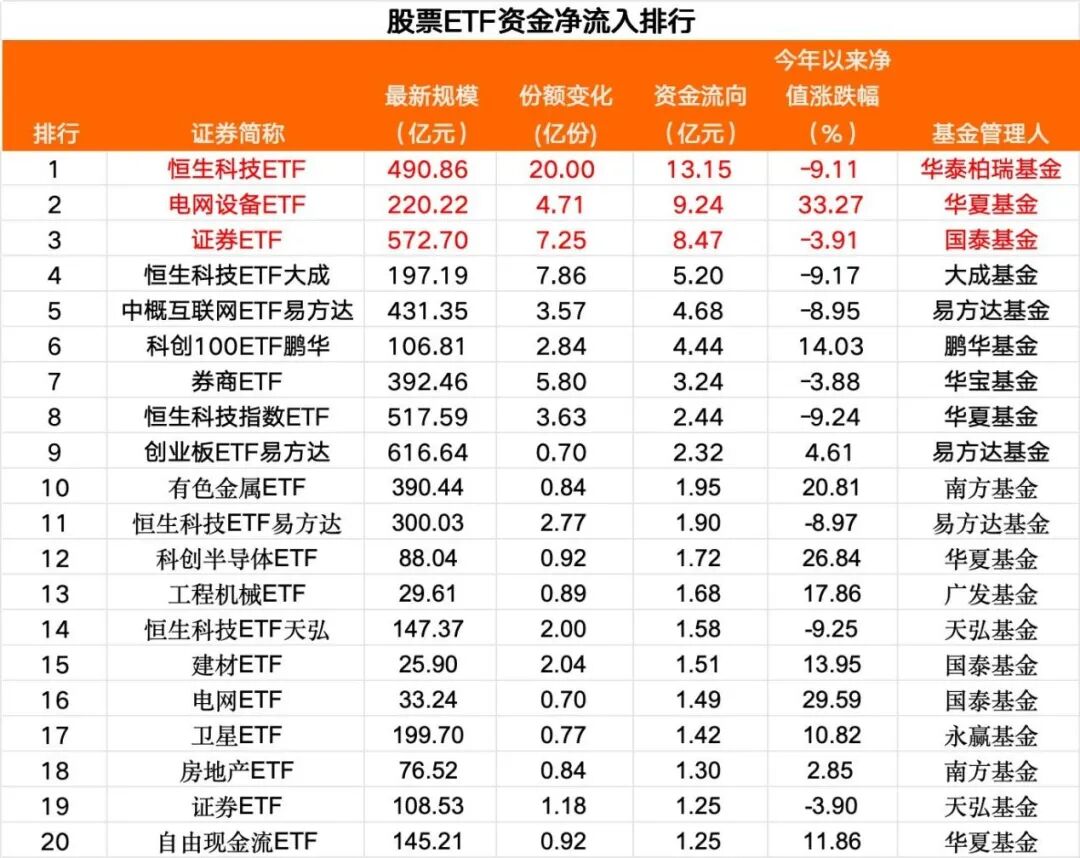
Core Viewpoint - On February 26, the A-share market experienced a high-level fluctuation phase after continuous gains, with a net outflow of over 23.5 billion yuan from stock ETFs, indicating a shift in investor sentiment as some funds opted to exit the market [1][2]. Summary by Category Market Overview - The total trading volume in the A-share market reached 2.54 trillion yuan on February 26, with a total of 1,344 stock ETFs amounting to 4.13 trillion yuan in total scale [2][6]. - The overall market saw a net outflow of 226.5 billion yuan, marking the second consecutive trading day of net outflows [2]. ETF Performance - On February 26, 80.73 million shares of stock ETFs were redeemed, leading to a net outflow of over 23.5 billion yuan, with 23 ETFs seeing inflows exceeding 1 billion yuan [2][3]. - The top three ETFs by net inflow were the Hang Seng Technology ETF (13.15 billion yuan), the Electric Grid Equipment ETF (9.24 billion yuan), and the Securities ETF (8.47 billion yuan) [4][6]. Sector Analysis - The Hang Seng Technology Index saw the highest net inflow of 25.07 billion yuan, while the CSI 500 Index experienced the largest net outflow of 60.08 billion yuan on the same day [3][5]. - From a five-day perspective, the Hang Seng Technology Index-related ETFs attracted over 13.2 billion yuan, and the China Internet 50 Index-related ETFs attracted over 3.7 billion yuan [3]. Fund Management Insights - Leading fund companies like E Fund and Huaxia Fund reported significant inflows in their ETFs, with E Fund's China Internet ETF reaching a scale of 431.35 billion yuan and a net inflow of 4.79 billion yuan [6]. - Huaxia Fund's Electric Grid Equipment ETF and Hang Seng Technology Index ETF also saw substantial inflows, with net inflows of 9.24 billion yuan and 2.44 billion yuan, respectively [6].

2月26日左侧资金和景气策略资金分别在布局哪些ETF?
Mei Ri Jing Ji Xin Wen· 2026-02-27 05:10
Group 1 - The A-share market is experiencing active trading, but the index faces pressure at 4150 points, impacting investor sentiment [1] - The focus of investment is shifting towards traditional physical assets, with foreign investment banks proposing the HALO strategy (Heavy Assets, Low Obsolescence) to redefine asset value in the AI era, emphasizing sectors like electric grids, petrochemicals, and non-ferrous metals [1] - Despite the shift, technology remains attractive, as evidenced by the inflow into the Hang Seng Technology Index, which hit a year-to-date low, prompting a surge of investors looking to "buy the dip" [1] Group 2 - On February 26, the top net inflow was seen in Hang Seng Technology-related ETFs, with a total net inflow of 2.507 billion yuan across 13 ETFs, the largest being the Hang Seng Technology Index ETF (513180.SH) [1] - Other ETFs with significant net inflows included securities ETFs, electric grid equipment ETFs, and gold ETFs, with the electric grid equipment ETF (159326.SZ) alone seeing over 900 million yuan in net inflow on that day, reflecting the HALO strategy [2] - According to Wang Bo from Huaxia Fund, the current market conditions favor "景气策略" (prosperity strategy), "动量策略" (momentum strategy), and "高共识资产" (high consensus assets), with expectations of continued market improvement and a bullish outlook ahead of important meetings in March [2]
ETF市场日报 | 稀土ETF批量涨超6%,巴西ETF换手率超240%领跑
Sou Hu Cai Jing· 2026-02-25 07:51
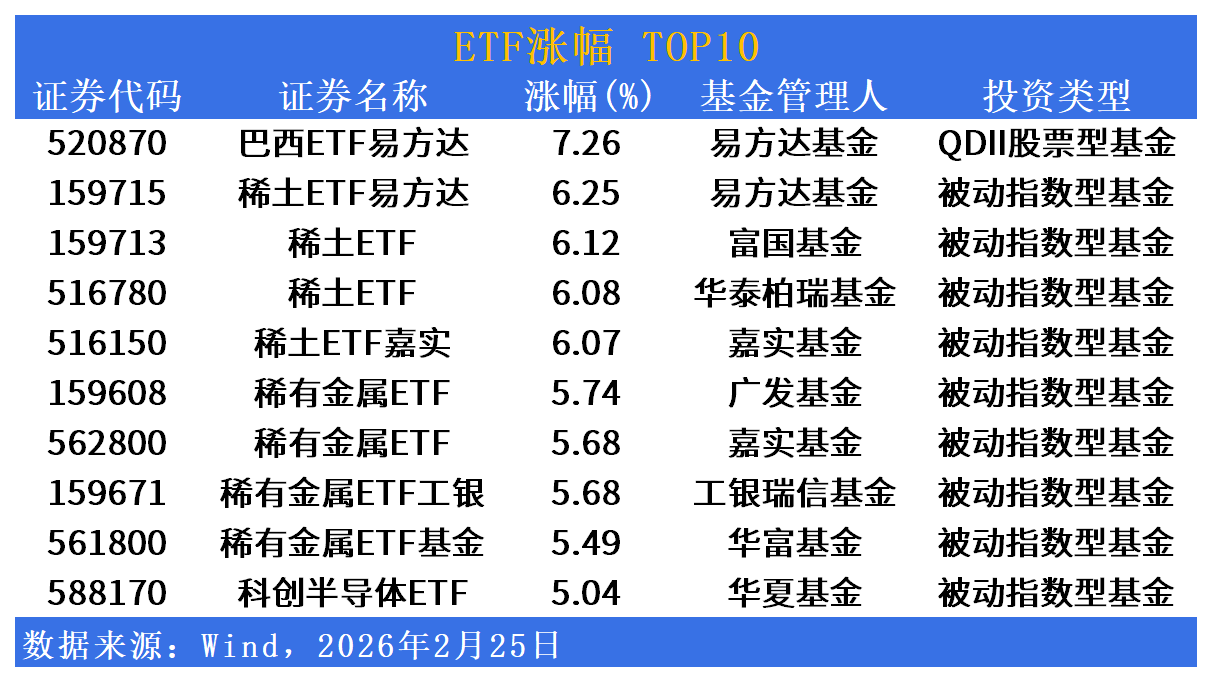
Market Performance - The three major A-share indices collectively rose, with the Shanghai Composite Index increasing by 0.72%, the Shenzhen Component Index by 1.29%, and the ChiNext Index by 1.41% [1] - The total trading volume in the Shanghai, Shenzhen, and Beijing markets reached 24,812 billion, an increase of 2,628 billion compared to the previous day [1] Sector Performance - The rare earth and rare metal sectors led the gains, with the Brazil ETF rising over 7% in a single day [2] - The top-performing ETFs included the Brazil ETF from E Fund, which rose by 7.26%, and several rare earth ETFs, with increases ranging from 6.07% to 6.25% [2] - Conversely, the oil and gas sector experienced a pullback, with the S&P Oil & Gas ETF from E Fund declining by 2.72% [3][4] Trading Activity - The short-term bond ETF had a trading volume exceeding 500 billion, indicating high liquidity in bond-related products [5] - The Brazil ETF showed a turnover rate of 243.29%, indicating significant trading activity in cross-border products [7] ETF Issuance - New ETFs are set to launch, including the Dividend Quality ETF from Southern Fund, which will start fundraising on February 26, and the Securities ETF from Huatai-PB, also launching on the same day [8] - The Southern Fund's Dividend Quality ETF aims to track the CSI Dividend Quality Index, focusing on companies with stable earnings quality and high dividend yields [8]
全球资产大震荡,2026年怎么走?
Xin Lang Cai Jing· 2026-02-09 08:09
Group 1 - Global assets are experiencing significant volatility at the beginning of 2026, with precious metals like gold and silver showing notable pullbacks after initial gains [1][19] - The market is focused on how to allocate assets after the turbulence, particularly regarding fixed income assets as a long-term core allocation [1][19] - The current political climate is shifting towards a "big fiscal" era, with abundant liquidity leading to asset bubbles, particularly in the U.S. stock market [19][21] Group 2 - The U.S. market is entering a bubble phase similar to 1999, with expectations for gold to reach new highs while the dollar index declines [2][19] - Key risks for 2026 include potential loss of Federal Reserve independence, aggressive monetary easing leading to inflation, and possible internal strife in the U.S. [2][19] - If risks arise outside the U.S., dollar assets may serve as a safe haven, similar to the situation in 1998 [2][19] Group 3 - Investors are advised to adopt a diversified asset allocation strategy for 2026, including A-shares, Hong Kong stocks, U.S. stocks, commodities, and bonds, with a focus on a "core + satellite" structure [4][21] - The core investment should be in the CSI A500 ETF, which is expected to outperform traditional indices, while satellite investments should include technology growth and cash flow/dividend assets [4][21] - The main theme for 2026 remains artificial intelligence, with a focus on sectors like communication and semiconductor ETFs [4][21] Group 4 - In equity investments, there is optimism for a shift from valuation recovery to profit improvement, particularly in sectors like non-ferrous metals, new energy, and chemicals [8][24] - Fixed income investments are expected to maintain a positive stance, with a focus on credit strategies and potential trading opportunities as the market adjusts [8][24] - The credit bond market is anticipated to experience wide fluctuations, with a focus on short-term strategies and market sentiment [10][26] Group 5 - The economic environment remains under pressure, with weak consumer demand and a declining real estate market, leading to low inflation expectations [12][28] - Monetary policy is expected to remain accommodative, with potential for further rate cuts and reserve requirement reductions in 2026 [12][28] - Institutional behavior indicates a strong performance in equity markets, but challenges remain for public funds and banks in expanding their balance sheets [12][28]

大逆转!近百亿,加仓!
Zhong Guo Ji Jin Bao· 2026-02-04 05:53
Group 1 - The A-share market experienced a reversal with net inflows after several days of capital outflows, with total trading volume exceeding 2.5 trillion yuan on February 3 [1] - On February 3, nearly 10 billion yuan flowed into the stock ETF market, marking one of the few days of net inflow since January [1][5] - The top-performing ETFs included those tracking the CSI 500, CSI 300, and STAR Market 50 indices, while sectors like non-ferrous metals and photovoltaics saw significant outflows [1][5] Group 2 - As of February 3, the total scale of stock ETFs reached 4.15 trillion yuan, with trading volume for stock ETFs at 298.75 billion yuan, a decrease of nearly 20 billion yuan from the previous trading day [2] - The leading sectors on that day were new energy and non-ferrous metals, with four of the top ten ETFs by increase in price belonging to the new energy sector [2][3] - The worst-performing ETFs included those related to new economy, Hong Kong Stock Connect technology, brokerage, and banking, with declines around 1% to nearly 7% [3] Group 3 - On February 3, the net inflow for stock ETFs was approximately 97.52 billion yuan, with 56 ETFs seeing inflows exceeding 100 million yuan [5][7] - The CSI 500 index led with a net inflow of 3.80 billion yuan, while the SGE Gold 9999 index saw a net outflow of 6.84 billion yuan [6] - Recent inflows into sector-specific indices included over 6.1 billion yuan into the semiconductor index and over 4.6 billion yuan into the STAR Market chip index [6] Group 4 - The top three ETFs by net inflow on February 3 were the CSI 500 ETF with 3.57 billion yuan, the Securities ETF with 1.12 billion yuan, and the A500 ETF with 973 million yuan [7] - Conversely, the ETFs with the highest net outflows included the Non-Ferrous Metals ETF and the Gold Stock ETF, with outflows of 4.18 billion yuan and 714 million yuan respectively [8] Group 5 - Major fund companies like E Fund and Huaxia Fund saw significant inflows into their ETFs, with E Fund's total ETF scale reaching 652.35 billion yuan, an increase of 9.64 billion yuan [9] - Notable inflows for E Fund included 711 million yuan into the CSI 300 ETF and 528 million yuan into the China Concept Internet ETF [9] - Fund manager Huang Yue from Guotai Fund expressed optimism for a spring market rally in Q1 2026, focusing on sectors like securities, new energy, semiconductors, and consumer services [9]
大逆转!本周二股票ETF资金净流入接近百亿元
Zhong Guo Ji Jin Bao· 2026-02-04 05:48
Core Viewpoint - After several days of net capital outflow, the A-share market saw a reversal with significant capital inflow on February 3, 2026, as all three major indices closed higher, with a trading volume exceeding 2.5 trillion yuan [1]. Group 1: Market Performance - On February 3, the total scale of all stock ETFs reached 4.15 trillion yuan, with a trading volume of 298.75 billion yuan, a decrease of nearly 20 billion yuan from the previous trading day [2]. - The top-performing sectors included new energy and non-ferrous metals, with four of the top ten ETFs by increase belonging to the new energy sector [2]. - The worst-performing ETFs included those related to brokerage and banking, with declines around 1% to nearly 7% [2]. Group 2: Capital Inflow and Outflow - On February 3, the net inflow of capital into stock ETFs was approximately 97.52 billion yuan, with 56 ETFs seeing inflows exceeding 100 million yuan [4]. - The net inflow for the entire market was 14.9 billion yuan, with broad-based ETFs and Hong Kong market ETFs leading the inflows at 112.49 billion yuan and 23.6 billion yuan, respectively [4]. - The net inflow for the CSI 500 index was 38.01 billion yuan, while the SGE Gold 9999 index saw a net outflow of 68.46 billion yuan [4]. Group 3: ETF Performance Rankings - The top three ETFs by net inflow were the CSI 500 ETF (35.66 billion yuan), the Securities ETF (11.17 billion yuan), and the A500 ETF (9.73 billion yuan) [5]. - The leading ETFs by trading volume included the CSI 500 ETF with 142.18 billion yuan, followed by the A500 ETF with over 100 billion yuan [2]. - A total of 26 ETFs experienced net outflows exceeding 1 billion yuan, with non-ferrous metals and photovoltaic industry ETFs being the most affected [5]. Group 4: Fund Management Insights - Major fund companies like E Fund and Huaxia Fund reported significant net inflows into their ETFs, with E Fund's total ETF scale reaching 652.35 billion yuan, an increase of 96.4 billion yuan [7]. - Fund managers expressed optimism about the A-share market, anticipating a potential spring rally in Q1 2026, particularly in sectors like securities, new energy, semiconductors, and consumer services [7].