慢牛

Search documents
专访刘俏:中国股市具备慢牛的基础,但散户不一定能赚钱
经济观察报· 2026-03-31 10:57
Core Viewpoint - The perception that higher trading activity indicates a more vibrant market is a misconception; in fact, in the Chinese A-share market, trading volume and pricing efficiency are inversely related, with higher trading volumes leading to lower pricing efficiency due to the dominance of retail investors [1][3]. Market Structure and Pricing Efficiency - Currently, 60% of the trading volume in the A-share market is contributed by individual investors, whose trades often lack informational content, leading to what is termed "noise trading" [3][13]. - To improve pricing efficiency and the informational content of stock prices, it is crucial to change the investor structure towards a more institutionalized model [3][15]. Economic Conditions and Market Outlook - Liu Qiao, a prominent economist, highlighted that some industries are trapped in a cycle of low prices, low profits, and low incomes, which affects overall economic vitality [2][5]. - The Chinese stock market has the foundation for a "slow bull" market, supported by the long-term growth potential of the economy and the continuous improvement in the quality of listed companies [2][12]. - A potential turnaround in the price index is expected by the second half of this year or early next year, which could positively impact the capital market [2][12]. Monetary Policy and Price Recovery - The current monetary policy aims to facilitate a reasonable recovery in prices, which is seen as essential for economic stimulation [5][6]. - Structural interest rate cuts are recommended to lower financing costs for households and small to medium enterprises, which could enhance consumer spending and economic activity [6][7]. Structural Issues in the Economy - The persistent low prices have created a structural cycle that suppresses economic growth, where low product prices lead to low corporate profits and subsequently low labor incomes [5][9]. - Addressing these structural issues requires promoting reasonable price recovery, allowing companies to achieve reasonable profit margins, and enhancing labor income [10][9]. Institutional Investment and Market Dynamics - The dominance of retail investors in the A-share market leads to inefficiencies; thus, accelerating the institutionalization of the market is essential for improving pricing efficiency [15][17]. - The U.S. market successfully reduced the proportion of retail trading from 60%-80% to around 10% over several decades, which is a model for improving the A-share market's efficiency [15][17]. AI and Economic Growth - Current AI applications have limited short-term impact on economic growth, contributing only about 0.06% to total factor productivity growth [18]. - Long-term investment in AI applications is expected to yield more significant economic benefits, although the immediate effects may be overstated [18].


先抑后扬三月收官,慢牛蓄力贯穿四月
Orient Securities· 2026-03-30 00:45
Market Strategy - The market is expected to experience a "slow bull" phase in April after a "first suppress then rise" trend in March, providing a valuable window for long-term investment opportunities [2][6] - The external geopolitical risks, particularly in the Middle East, are anticipated to continue affecting market sentiment, but the internal stability of the market remains intact [6] Style Strategy - The investment style is characterized by a focus on energy security and advanced manufacturing, with the renewable energy sector (solar, wind, and power transmission) being a core theme due to China's competitive advantages [3] - The agricultural sector is highlighted as a potential area for investment due to recent price corrections, presenting opportunities for a second left-side layout [3] Industry Strategy - In the agricultural sector, pig prices have dropped to a historical low of 9.4 yuan/kg, leading to accelerated capacity reduction and production adjustments, which are expected to result in a price rebound before May [7] - The report emphasizes the potential for growth in the livestock breeding sector and related animal health industries [7] Thematic Strategy - The report reaffirms that energy security concerns will accelerate the international expansion of China's new energy vehicles (NEVs), with significant increases in orders from countries like Australia, the Philippines, and Thailand [4][7] - Domestic companies such as BYD and SAIC are noted for their rising sales and market presence in the NEV sector [7]




A股2026年回顾与展望,能否增加居民财产性收入?|资本市场
清华金融评论· 2026-03-10 10:16
Core Viewpoint - The article emphasizes the need for a long-term and steady bull market to increase residents' property income, highlighting the structural slow bull characteristics of the A-share market since 2026, with significant internal differentiation [3][5]. Group 1: Policy and Institutional Support - The importance of the stock market as a means for residents to increase their asset income was first explicitly stated in a Central Political Bureau meeting on April 25, 2025, linking the increase in residents' property income with a stable and active capital market [5]. - The meeting called for addressing the bottlenecks for long-term capital entering the market and enhancing investor protection to provide institutional support for residents to increase income through the stock market [5]. - In March 2026, the government work report mentioned enhancing the inherent stability of the capital market, and the China Securities Regulatory Commission (CSRC) introduced regulations on short-term trading to facilitate long-term capital market entry [5][6]. Group 2: A-share Market Performance - As of early March 2026, the A-share market exhibited structural slow bull characteristics, with the Wind All A Index rising approximately 8.3%, while small and medium-sized growth stocks led the gains with a 17% increase in the Wind Microplate Index [7]. - The large-cap blue-chip stocks (CSI 300) only saw a slight increase of 1.74%, indicating significant index differentiation [7]. - The market showed a dual mainline rotation, with cyclical resource products (non-ferrous metals, petrochemicals, chemicals) rising over 15% due to geopolitical factors and supply-side constraints, while hard technology and new productivity sectors (liquid-cooled servers, semiconductor equipment) attracted continuous investment [7]. Group 3: Future Drivers and Support Logic for A-shares - The policy window period is highlighted, with the national two sessions focusing on new productivity (humanoid robots, 6G, commercial aerospace) and fiscal support for equipment upgrades and security capability construction [8]. - Liquidity is expected to remain loose, with domestic monetary policy being moderately relaxed and expectations of a Federal Reserve rate cut, leading to a continued trend of foreign capital inflow [8]. - Profit recovery is anticipated, with a mild rebound in China's Producer Price Index (PPI) improving profits in upstream resource products and midstream manufacturing [8]. - In Q2 2026, the performance of cyclical sectors (chemicals, non-ferrous metals) and AI leaders (computing power/applications) is expected to be significant, with the Shanghai Composite Index projected to fluctuate between 4000 and 4300 points [8]. - In the second half of 2026, if the Federal Reserve's rate cut materializes and domestic policies are strengthened, the main index may break previous highs, fluctuating between 4300 and 4600 points, with potential resonance from AI applications, cyclical products, and consumer recovery [8].

中国信达宣布减持方正证券后一股未卖
Mei Ri Jing Ji Xin Wen· 2026-02-26 12:58
Core Viewpoint - China Cinda Asset Management Co., Ltd. did not execute its share reduction plan for Founder Securities, citing "market environment changes" as the reason, despite the stock price being lower than the planned reduction price [1][2]. Group 1: Share Reduction Plans - China Cinda has disclosed multiple share reduction plans for Founder Securities since November 2022, with three actual reductions that did not reach the maximum planned amount, and all at prices higher than the current market price [2][3]. - The first actual reduction occurred from August 23, 2023, to February 22, 2024, where China Cinda reduced its holdings by 1%, cashing out 784 million yuan, with a reduction price range of 8.65 to 10.06 yuan per share [2]. - In 2024, two additional reductions were executed, with the first from April 29 to July 28, reducing 0.15% of shares for approximately 117 million yuan at prices between 9.1 and 9.46 yuan per share, and the second from August to December, reducing 0.27% for about 224 million yuan at prices between 10.03 and 10.22 yuan per share [2]. Group 2: Stock Performance and Market Conditions - During the periods when China Cinda planned to reduce its holdings, Founder Securities' stock price remained relatively stable, often below 8 yuan per share, which may have influenced the decision to not execute the reduction [3][4]. - The overall performance of the securities sector has been lackluster, with the CSI All Share Securities Company Index declining by 2.96% since the beginning of 2026 [4]. - Despite the recent underperformance of the securities sector, discussions about its potential value have resurfaced, particularly regarding opportunities arising from the migration of household deposits and the stabilization of the stock market [5][6]. Group 3: Future Outlook for the Securities Sector - The outlook for the non-bank financial sector in 2026 is optimistic, with expectations of increased retail participation in the market and a favorable environment for brokerage and wealth management businesses [6]. - Current market conditions indicate a supportive environment for the securities industry, with core indicators suggesting a solid foundation for growth, although the market sentiment has not yet shifted towards the securities sector [6].

A股收评 | A股探底回升 沪指微跌0.01% 算力股集体走强
智通财经网· 2026-02-26 07:26
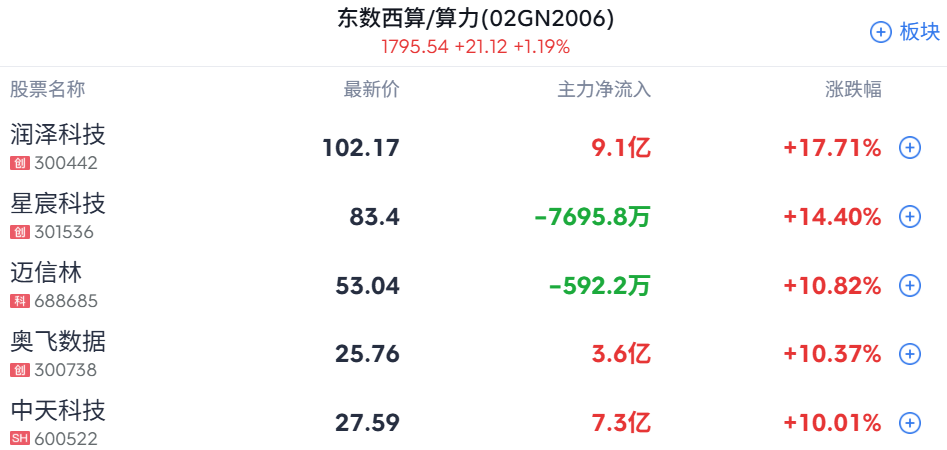
Market Overview - The market experienced fluctuations with mixed results across major indices, where the Shanghai Composite Index fell by 0.01%, the Shenzhen Component rose by 0.19%, and the ChiNext Index decreased by 0.29% [1] - The trading volume in the Shanghai and Shenzhen markets reached 2.54 trillion yuan, an increase of 75.9 billion yuan compared to the previous trading day [1] Key Sectors Computing Power Sector - The computing power sector surged following Nvidia's impressive earnings report, leading to strong performances in related hardware stocks such as optical fiber, optical modules, PCB, and liquid-cooled servers [3][4] - Notable stocks in this sector included Guanghe Technology, Chuanrun Shares, and Farsens, which all hit the daily limit [3] - The computing power leasing concept also saw significant gains, with stocks like Aofei Data and Huasheng Tiancai reaching their daily limits or increasing by over 10% [3] Electric Power Sector - Electric power stocks showed resilience, with companies like Shenneng Power and Huayin Power hitting their daily limits [5][6] - The National Energy Administration's recent report indicated that by 2025, the new installed capacity for renewable energy generation is expected to reach 452 million kilowatts, a year-on-year increase of 21%, accounting for 83% of the new power generation capacity in the country [6] Commercial Aerospace Sector - The commercial aerospace sector continued its upward trend, with stocks like Aerospace Power hitting their daily limits [7][8] - The upcoming launch of the reusable liquid rocket by Zhongke Aerospace is anticipated to enhance investor interest in this sector, which is expected to be one of the most valuable segments by 2026 [8] Rare Metals Sector - The rare metals sector remained active, with Yunnan Zinc Industry and Zhangyuan Tungsten Industry both hitting their daily limits [9][10] - The U.S. government plans to utilize AI models developed by the Department of Defense to establish reference prices for critical mineral trades, including germanium, gallium, antimony, and tungsten [10] Institutional Perspectives - Multiple foreign institutions express optimism about the A-share market entering a "slow bull" phase, indicating a significant shift in market driving logic [2][11] - Morgan Stanley's chief strategist noted that the A-share market has transitioned into a "slow bull" phase, emphasizing the importance of earnings over liquidity for sustainable market growth [12] - Union Investment anticipates a shift from "valuation recovery" to "profit-driven" phases in the A-share market by 2026, highlighting the potential for improved corporate profitability as a key driver for long-term investment value [12]

A股午评 | 创指半日跌0.39% 英伟达“交卷”缓解AI担忧 科技成长重返“C位”
智通财经网· 2026-02-26 03:47
Market Overview - The market experienced fluctuations with mixed performance among the three major indices, where the Shanghai Composite Index fell by 0.08%, the Shenzhen Component rose by 0.28%, and the ChiNext Index decreased by 0.39% [1] - The trading volume in the Shanghai and Shenzhen markets reached 1.64 trillion yuan, an increase of 117.3 billion yuan compared to the previous trading day [1] Key Sectors Computing Power Sector - The computing power sector surged following Nvidia's impressive earnings report, with significant activity in computing hardware stocks, including optical fiber, optical modules, PCBs, and liquid cooling servers [3] - Notable stocks such as Huadian Technology, Guanghe Technology, and Shenzhen Nandian hit the upper limit, while computing leasing concepts also saw strong performance with stocks like Zhongbei Communication and Aofei Data reaching their daily limit or increasing by over 10% [3] Electric Power Sector - Electric power and grid equipment stocks rallied, with companies like Shenneng Power and Huayin Power hitting the upper limit [4] - The National Energy Administration's recent report indicated that by 2025, the newly installed capacity for renewable energy generation in China is expected to reach 452 million kilowatts, a year-on-year increase of 21%, accounting for 83% of the country's new power generation capacity [4] Minor Metals Sector - The minor metals sector showed active performance, with Yunnan Zinc Industry achieving consecutive gains and Zhangyuan Tungsten reaching its upper limit [5] - The White House plans to utilize an AI model developed by the Department of Defense to establish reference prices for critical mineral trades, starting with germanium, gallium, antimony, and tungsten [5] Institutional Insights - Multiple foreign institutions express optimism, suggesting that the A-share market has entered a "slow bull" phase, with a profound shift in market driving logic [6][8] - Morgan Stanley's chief equity strategist for China, Liu Mingdi, noted that the A-share market has genuinely entered a "slow bull" phase, emphasizing that while liquidity is abundant, the market lacks earnings growth to support valuations [7] - According to Lianbo Fund, the A-share market is expected to transition from "valuation repair" to an "earnings-driven" phase by 2026, with sustainable market growth reliant on substantial improvements in corporate profitability rather than mere valuation expansion [8] Sector-Specific News - Citic Securities reported that Zimbabwe's recent ban on lithium ore exports aims to enhance mineral regulation and promote deep processing, which could lead to a significant increase in lithium prices due to supply constraints [10]
明天开盘,股民警惕这个风险信号
Jing Ji Guan Cha Bao· 2026-02-23 07:07
Group 1 - The core viewpoint is that the performance of listed companies falling short of expectations is a primary risk for the market in 2026, with a projected 18% earnings growth for the CSI 300 index if price wars and subsidies in the internet sector stabilize positively [2][16] - The A-share market is expected to continue its "slow bull" trend into 2026, with major institutions predicting double-digit growth for the MSCI China Index and the CSI 300 Index, targeting 100 points and 5200 points respectively [4][16] - The market has shown strong signals of a sustained upward trend, with significant increases in brokerage account openings, fund sales, and daily trading volumes, indicating a consensus on the "slow bull" market [3][4] Group 2 - The technology sector remains a hot investment area, with significant growth in high-tech industries, particularly in AI, robotics, and semiconductor sectors, which have seen substantial market capitalization increases [9][12] - The A-share market's performance is influenced by various factors, including macroeconomic conditions, monetary policy, and global geopolitical changes, which will test the sustainability of the slow bull trend [16] - Analysts emphasize the importance of quality assets and the return of premium leading companies, suggesting that the focus should shift towards companies with strong earnings and valuation potential [13][16]

摩根大通刘鸣镝:A股进入“慢牛” 外资回流可期
Xin Lang Cai Jing· 2026-02-21 00:47
Core Viewpoint - The A-share market has entered a "slow bull" phase, characterized by moderate and sustained performance, supporting steady index growth [1] Group 1: Market Outlook - The current market cycle is categorized into four stages: recovery (spring), expansion (summer), deceleration (autumn), and contraction (winter), with the Chinese market currently in the "summer" phase [1] - The overall trend for 2025 is expected to be better than anticipated, driven by global economic growth exceeding initial forecasts and supportive fiscal and monetary policies [2] - The MSCI World Stock Index returned 19.5% in USD terms, with the best-performing sectors being communication services (31%) and financials (26%) [2] Group 2: Key Highlights of Chinese Assets - Three main characteristics of Chinese assets in 2025 are identified: innovation in AI, IT, healthcare, and new consumption; "anti-involution" driving growth in raw materials and certain industrial sectors; and stable income and performance in sectors like telecommunications and insurance [2] - The decline of the US dollar from 108.5 to 98.3 (a 9.4% drop) has historically correlated with a 25% increase in the MSCI China Index [2] Group 3: Foreign Capital Flow - Foreign investors are expected to become more optimistic about Chinese assets post-September 2024, as central bank measures restore market confidence [3] - The potential for profit margin improvements in listed companies may attract foreign investment, particularly if mid-term profit margins can rise significantly [3] Group 4: Investment Preferences - Global and Asia-focused funds currently have the lowest allocation to mainland stocks, while funds excluding the US recognize the competitive capabilities of Chinese companies [4] - Internet and consumer sectors are anticipated to benefit first from increased foreign allocations, along with leading companies in sectors like energy storage [4] Group 5: Future Expectations - The A-share market is expected to continue its "slow bull" trend into 2026, with a focus on fiscal stimulus and corporate capital expenditure confidence [6] - Growth and performance-oriented stocks are favored, particularly in themes related to AI infrastructure, "anti-involution," exports, and real estate recovery [7] - The differentiation within industries is high, making stock selection increasingly important in the ongoing "slow bull" market [7]


关于慢牛的六个风险
雪球· 2026-02-13 08:07
Group 1 - The article emphasizes that a slow bull market does not mean the absence of bear markets, highlighting that even in a slow bull market, significant downturns can occur [6][24]. - Historical data shows that the S&P 500 has experienced severe bear markets, including declines of over 80% in 1929 and 50% during the 2000-2003 tech bubble [11][21][22]. - Investors should be prepared for the reality of a slow bull market, which can include long periods of stagnation and significant drawdowns [24][26]. Group 2 - The article distinguishes between index performance and individual stock performance, noting that while indices may show a slow bull trend, many individual stocks can perform poorly [30][32]. - For instance, since 2022, the S&P 500 has performed well, but excluding the top seven companies, the overall gains have been limited, with around 3,000 companies delisted in recent years [32][33]. - This indicates that investors may face significant risks even in a rising market, as individual stock performance can vary widely [34][38]. Group 3 - The article discusses the rapid shifts in market styles during a slow bull market, where the index may appear stable while individual stocks experience volatility [40][41]. - This "meat grinder" market condition can lead to significant losses for investors who attempt to chase trends or predict market leaders [42]. Group 4 - The characteristics of the A-share market differ from those of the U.S. market, with A-shares often experiencing long periods of consolidation after initial gains [45][46]. - Historical examples illustrate that even in bullish markets, there can be extended periods of no growth, leading to investor frustration [52][54]. Group 5 - The article warns of potential liquidity shocks that can occur without warning, affecting market stability and investor confidence [57]. - Investors are advised to maintain a balanced approach to their portfolios, especially during market fluctuations, to mitigate risks associated with sudden market movements [61][64]. Group 6 - The article presents a comparative analysis of returns, indicating that while the Shanghai Composite Index has outperformed the S&P 500 since 2005, many investors still face challenges due to poor timing and high entry points [66][71]. - It suggests that slow bull markets can be more conducive to generating profits due to lower volatility, despite not always yielding higher returns than fast bull markets [75][78]. Group 7 - Recommendations for navigating a slow bull market include avoiding high entry points, being cautious with high valuations, and maintaining patience during periods of stagnation [85][88][90]. - Investors should also control their positions and avoid frequent trading to reduce the risk of losses during volatile periods [94][96].

财经早报:中药重大利好!八部门发文,未来5年发展方向明确了丨2026年2月6日
Xin Lang Zheng Quan· 2026-02-05 23:33
Group 1 - The Chinese government has requested state-owned enterprises to suspend negotiations for new projects with Panama following a court ruling that invalidated a contract related to the Yangtze River and Hutchison [4] - The Ministry of Foreign Affairs emphasized China's clear stance on port issues in Panama [4] - The Chinese government is not participating in nuclear disarmament negotiations at this stage, maintaining a responsible nuclear strategy focused on self-defense [7] Group 2 - The Hu Run Research Institute released the "2025 Hu Run China 500 Strong," listing the top non-state-owned enterprises in China, with a total value of 77 trillion yuan, a 38% increase year-on-year [17] - The threshold for entering the list has been raised to 34 billion yuan, indicating a growing competitiveness among Chinese enterprises [17] - The semiconductor, media and entertainment, industrial products, and consumer goods sectors account for half of the total value of the top 500 companies [17] Group 3 - Meituan announced the acquisition of DINGDONG FRESH HOLDING LIMITED for an initial price of 7.17 billion USD (approximately 50 billion yuan), with adjustments possible based on the target group's net cash [20] - The acquisition reflects Meituan's strategy to expand its presence in the fresh food market [20] Group 4 - Multiple small and medium-sized banks have raised deposit rates by 5 to 20 basis points, despite an overall downward trend in market interest rates [11][12] - This increase is seen as a short-term strategy to attract deposits ahead of the Chinese New Year, as these banks face challenges in non-interest income and profit margins [12]