宽基ETF

Search documents
投资者微观行为洞察手册·3月第3期:市场回调之际:公募发行节奏加快,宽基ETF净流入
GUOTAI HAITONG SECURITIES· 2026-03-24 15:37
Market Pricing Status - The market trading activity has slightly decreased, with the profitability effect diminishing. The average daily trading volume for the entire A-share market has dropped to 22.11 trillion yuan, and the proportion of stocks rising has decreased to 10.6% [8][9] - The trading concentration in primary industries has decreased, while it has increased in secondary industries. The turnover rate for the petroleum and petrochemical industry is above 99% [8][16] A-Share Liquidity Tracking - Financing funds, foreign capital, and ETF funds have all seen slight outflows. The new issuance scale of equity funds has decreased to 24.54 billion yuan [8][27] - Foreign capital has flowed out of the A-share market by 5.32 million USD, with the northbound capital transaction proportion rising to 39.5% [8][44] A-Share Industry Allocation Tracking - Financing funds and ETF funds have both flowed out of the non-ferrous metals sector. The electronic and power equipment sectors have seen significant outflows of foreign capital [8][19] - The banking and non-bank financial sectors have experienced net inflows, while non-ferrous metals and basic chemicals have seen net outflows in ETF funds [8][19] Hong Kong and Global Liquidity Tracking - There has been a significant outflow of southbound funds, with global foreign capital marginally flowing into the US and Japanese markets. The Nasdaq index has decreased by 2.1% [8][22] - The net outflow of southbound funds has risen to 6.329 billion yuan, marking a significant level since 2022 [8][22]
风向骤变!资金盯上宽基ETF了。。
格隆汇APP· 2026-03-24 09:55
Core Viewpoint - The article discusses a significant shift in investment trends, with a growing focus on broad-based ETFs as investors seek stability and diversification in uncertain market conditions [1] Group 1 - There has been a notable increase in capital inflow into broad-based ETFs, indicating a change in investor sentiment towards these financial instruments [1] - The article highlights that the performance of broad-based ETFs has outpaced that of sector-specific ETFs, suggesting a preference for diversified investment strategies [1] - Data shows that the total assets under management in broad-based ETFs have reached a new high, reflecting increased investor confidence [1] Group 2 - The article outlines the advantages of broad-based ETFs, including lower expense ratios and better liquidity compared to actively managed funds [1] - It mentions that the current market volatility has prompted investors to prioritize risk management, leading to a surge in demand for broad-based ETFs [1] - The trend towards broad-based ETFs is expected to continue as more investors recognize the benefits of diversification in their portfolios [1]


越跌越买!宽基ETF上周吸金91亿【周观ETF】
和讯· 2026-03-24 08:55
Group 1 - The A-share market experienced significant fluctuations from March 16 to March 20, with a total ETF market size dropping nearly 150 billion, returning to 5.1 trillion [3] - The broad market indices, such as the Shanghai Composite Index and Shenzhen Component Index, saw declines of 3.38% and 2.9% respectively, while broad-based ETFs attracted net inflows of 9.1 billion, indicating a "buy the dip" strategy among investors [4][7] - The inflows were particularly strong in large-cap indices like the CSI 300 and mid-cap indices like the CSI 500, with net inflows of 6.558 billion and 4.644 billion respectively, suggesting institutional recognition of the current price levels as having a safety margin [7] Group 2 - In contrast to the broad-based ETFs, industry-specific ETFs faced significant outflows, with a total net outflow exceeding 26.2 billion, primarily affecting the chemical and non-ferrous metal sectors [8][9] - The chemical sector saw a reduction of nearly 12 billion in ETF size, with net outflows exceeding 5.5 billion and a decline of 11.28% in index value, while the non-ferrous metal sector experienced net outflows over 3.4 billion and a drop exceeding 12% [9] - The outflows in the chemical sector were attributed to the rapid decline of geopolitical premiums and falling international oil prices, which weakened cost support for chemical products [11][12]

ETF配置系列(一):恰逢其时:丰富的资产多元的配置
GUOTAI HAITONG SECURITIES· 2026-03-18 15:21
- The report focuses on ETF allocation strategies, highlighting the performance of various ETF configurations, including 3% and 5% target volatility strategies, equity-enhanced asset allocation strategies, and macro scoring-based allocation strategies[79][86][91][96][106] - The 3% target volatility strategy achieved an average annual return of 6.74% from 2015 to 2025, with a maximum drawdown of -3.72% and an IR of 1.38, demonstrating stable performance under low-risk conditions[86] - The 5% target volatility strategy delivered an average annual return of 8.04% during the same period, with a maximum drawdown of -4.41% and an IR of 1.33, indicating higher returns with moderate risk[91] - The equity-enhanced asset allocation strategy achieved an average annual return of 11.66% from 2015 to 2025, with a maximum drawdown of -8.64% and an IR of 1.67, showcasing its ability to generate higher returns through equity exposure[96] - The macro scoring-based allocation strategy for domestic assets recorded an average annual return of 6.98% from 2017 to 2025, with a maximum drawdown of -4.21% and an IR of 1.77, emphasizing its effectiveness in balancing risk and return[101] - The global macro scoring-based allocation strategy achieved an average annual return of 11.15% from 2017 to 2025, with a maximum drawdown of -3.40% and an IR of 2.76, highlighting its strong performance in a diversified global context[106] - The report also discusses style rotation strategies, including multi-dimensional scoring for ETF style rotation and sector rotation strategies, which leverage fundamental and market indicators to construct high-momentum ETF portfolios[110][127][133]
A股牛市尚能“饭否”?
经济观察报· 2026-03-17 16:26
Core Viewpoint - The recent performance of A-shares is under scrutiny as the market faces both internal and external challenges, raising concerns about whether the Shanghai Composite Index will hold above the 4000-point mark [2][12]. Group 1: A-share Market Performance - The current bull market in A-shares, which began in September 2024, is experiencing difficulties, with significant net redemptions in equity ETFs, particularly those held by institutions [2][8]. - The total share of equity ETFs in China has been declining since reaching a peak of 22,236.69 billion shares at the end of 2025, dropping to 20,977.90 billion shares by the end of February 2026 [2][9]. - The Shanghai Composite Index has struggled to maintain its position above 4000 points, recently closing at 4049.91 points after a 0.85% drop, indicating a potential test of the critical 4000-point level [2][12]. Group 2: Global Market Context - Global stock indices have faced a downturn, with significant declines observed in major markets such as South Korea (down 11.12%), Japan (down 8.67%), and France (down 7.51%) since the onset of geopolitical tensions in the Middle East [5][6]. - Despite the global downturn, the Shanghai Composite Index's decline of only 2.71% during the same period suggests a degree of independence in its performance, attributed to its relatively lower valuation compared to other global markets [5][6]. Group 3: Institutional Behavior - Recent reports indicate that institutional investors have begun to exit the market, with net redemptions in equity ETFs amounting to 10.62 billion yuan, reflecting a trend of profit-taking after substantial gains during the bull market [8][10]. - Regulatory changes, including increased margin requirements, have contributed to a more cautious approach among investors, leading to a reduction in leverage and a focus on stabilizing market conditions [10][11]. - The decline in equity ETF shares is seen as a strategic move by institutions to realize profits while adhering to regulatory guidance, rather than a sign of pessimism regarding the long-term outlook for A-shares [10][14]. Group 4: Future Outlook - Historical analysis shows that the Shanghai Composite Index has only successfully maintained a position above 4000 points on two occasions, both of which were followed by prolonged bear markets [12][13]. - However, experts believe that the current market conditions are more favorable for sustaining the index above 4000 points, citing the increasing importance of the capital market and the attractiveness of Chinese valuations amid global uncertainties [12][13]. - The recent profit-taking by institutions is viewed as a normal operational strategy rather than a negative sentiment towards the market's future, with many institutions remaining optimistic about A-shares [12][14].

金融和理财市场2月报:含权理财收益崛起,宽基ETF规模下行-20260310
Huachuang Securities· 2026-03-10 13:26
Market Overview - As of the end of December 2025, fixed-income wealth management products dominated the market with 39,087 products, accounting for 86.3% of the total, and a scale of 24.31 trillion yuan, representing 76.6% of the total market size[3] - In January 2026, the number of fixed-income products slightly decreased to 38,477, but the scale remained stable at 24.26 trillion yuan, indicating a robust market structure[3] Yield Trends - The weighted average yield of the wealth management market rose significantly, increasing by 71 basis points (bp) to 1.95% in December 2025 and then surging by 176 bp to 3.72% in January 2026, marking a new high since 2025[3] - The rise in yields was primarily driven by the performance of commodity, equity-linked, and fixed-income+ products[3] Fund Market Dynamics - In January 2026, the total scale of public funds was 37.22 trillion yuan, a decrease of 1.21% from the previous month, mainly due to a significant contraction in equity funds[46] - By February 2026, the fund market slightly rebounded to 37.228 trillion yuan, reflecting a 0.03% increase from January, with a year-on-year growth rate of over 12%[47] Savings Trends - As of January 2026, household deposits reached 168.04 trillion yuan, up by 2.15 trillion yuan from December 2025, with a month-on-month growth of 1.29% and a year-on-year increase of 7.19%[28] - The increase in savings was attributed to seasonal factors, including year-end bonuses and consumer spending preparations ahead of the Spring Festival[33] Insurance Market Performance - In 2025, the insurance industry reported a premium income of 6.12 trillion yuan, a year-on-year growth of 7.43%, with life insurance premiums accounting for 76% of the total[8] - The growth in life insurance premiums was primarily driven by the increase in traditional life insurance products, which saw an 11.40% year-on-year growth[8] Risk Factors - Potential risks include slower-than-expected policy implementation, increased uncertainty from overseas factors, and insufficient liquidity in specific market segments[8]
【金工】行业主题基金净值回调,周期主题、商品ETF资金大幅净流入——基金市场与ESG产品周报20260309(祁嫣然/马元心)
光大证券研究· 2026-03-09 23:07
Market Performance Overview - In the week from March 2 to March 6, 2026, oil prices surged while domestic equity market indices experienced a pullback [4] - The oil and petrochemical, coal, and public utilities sectors saw the highest gains, while media, non-ferrous metals, and computer sectors faced the largest declines [4] Fund Product Issuance - A total of 12 new funds were established in the domestic market this week, with a combined issuance of 13.464 billion units [5] - The new funds included 3 bond funds, 6 equity funds, 2 mixed funds, and 1 fund of funds (FOF) [5] - Overall, 45 new funds were issued across various types, including 19 equity funds, 9 FOFs, 8 bond funds, 8 mixed funds, and 1 international (QDII) fund [5] Fund Product Performance Tracking - The net value of industry-themed funds declined across the board this week, with financial and real estate-themed funds performing relatively better [6] - As of March 6, 2026, the net value changes for various themed funds were as follows: financial and real estate -1.10%, cyclical -1.66%, industry rotation -2.30%, pharmaceuticals -2.43%, consumer -2.59%, balanced industry -2.62%, new energy -2.72%, national defense and military -3.54%, and TMT -4.53% [6] ETF Market Tracking - This week, stock ETFs saw a net inflow of funds, with significant increases in cyclical theme ETFs, while mid-cap and large-cap broad-based ETFs experienced notable reductions [7] - The median return for stock ETFs was -2.37%, with a net inflow of 1.424 billion yuan [7] - Hong Kong stock ETFs had a median return of -3.89% and a net inflow of 3.039 billion yuan, while cross-border ETFs had a median return of -2.30% and a net inflow of 1.031 billion yuan [7] - Commodity ETFs had a median return of -0.33% and a substantial net inflow of 13.181 billion yuan [7][8] - Broad-based ETFs maintained net inflows, while other categories experienced net outflows, particularly mid-cap theme ETFs, which saw a total outflow of 17.252 billion yuan [7] ESG Financial Product Tracking - This week, 13 new green bonds were issued, with a total issuance scale of 20.777 billion yuan [9] - The domestic green bond market has steadily developed, with a cumulative issuance scale of 5.29 trillion yuan and a total of 4,569 bonds issued as of March 6, 2026 [9] - The domestic market currently has 210 ESG funds with a total scale of 154.846 billion yuan [9] - In terms of fund performance, the median net value changes for active equity, passive equity index, and bond ESG funds were -2.46%, -0.69%, and +0.10%, respectively, with clean energy, low-carbon environmental protection, and green electricity-themed funds performing better [9]

37.77万亿!公募基金规模连续10个月创新高
Sou Hu Cai Jing· 2026-02-28 00:29
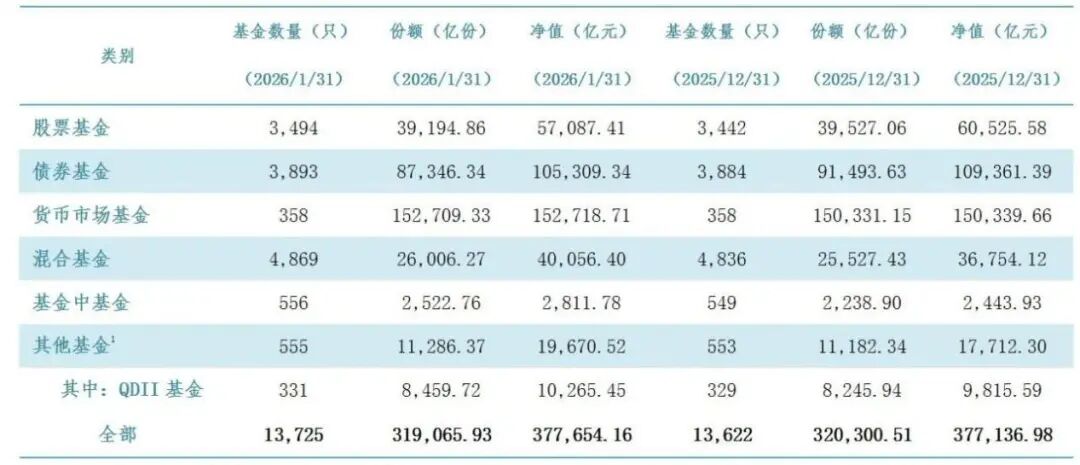
Core Insights - The public fund industry in China has reached a record high in total assets, amounting to 37.77 trillion yuan as of the end of January 2026, marking the tenth consecutive month of growth [1][2][4]. Fund Size and Growth - The total net asset value of public funds managed by 165 institutions, including 150 fund management companies, has increased significantly [2]. - Mixed, money market, and other funds have been the main contributors to this growth, with each category seeing an increase of over 100 billion yuan [1][4]. - Fund of Funds (FOF) has shown remarkable growth, with a 15.05% increase in share and a 12.68% increase in scale, reaching 2,522.76 billion shares and 2,811.78 billion yuan respectively [5][7]. Fund Performance by Type - Stock funds have experienced a decline, with a reduction of over 3,400 billion yuan, while bond funds also saw a decrease of over 4,000 billion yuan due to the "stock-bond seesaw" effect [1][8]. - The total share of public funds reached 31.91 trillion shares, a slight decrease of 0.39% compared to December 2025, but the overall scale still grew by 0.14% [3][4]. Specific Fund Categories - Mixed funds have shown strong performance, with a scale increase of 8.98%, reaching 40,056.40 billion yuan [7][8]. - Money market funds also saw a growth of 1.58%, with a scale of 152,718.71 billion yuan [7][8]. - The significant decline in stock ETFs, which dropped by 6,036.23 billion yuan, has negatively impacted the overall stock fund size [8].
37.77万亿,公募基金规模,连续10个月创新高
Zhong Guo Ji Jin Bao· 2026-02-27 23:13
Core Insights - The public fund industry in China has reached a record high in total assets, amounting to 37.77 trillion yuan as of the end of January 2026, marking the tenth consecutive month of growth [2][4][5]. Fund Size and Growth - The total size of public funds has seen a continuous increase, with significant contributions from mixed, money market, and other funds, all achieving growth in the range of hundreds of billions [2][7]. - The Fund of Funds (FOF) has experienced a remarkable increase, with a 15.05% rise in shares and a 12.68% increase in scale, reaching 2,522.76 billion shares and 2,811.78 billion yuan respectively [9][11]. Fund Type Performance - Stock funds have faced a decline, with a reduction of over 3,400 billion yuan, while bond funds also decreased by more than 4,000 billion yuan due to the "stock-bond seesaw" effect [3][12]. - Mixed funds have shown strong performance, with a scale increase of 8.98%, reaching 40.06 trillion yuan, driven by net value growth [12]. - Money market funds have also seen a slight increase of 1.58%, with a total scale of 152.72 trillion yuan [11]. Market Dynamics - The public fund market has been buoyed by favorable market conditions and an influx of new capital, contributing to the sustained growth in fund sizes [1][7]. - Major commercial banks, such as China Merchants Bank and China Construction Bank, have played a significant role in promoting FOF products, leading to their rapid growth [9][11].
37.77万亿!公募基金规模,连续10个月创新高
Zhong Guo Ji Jin Bao· 2026-02-27 16:05
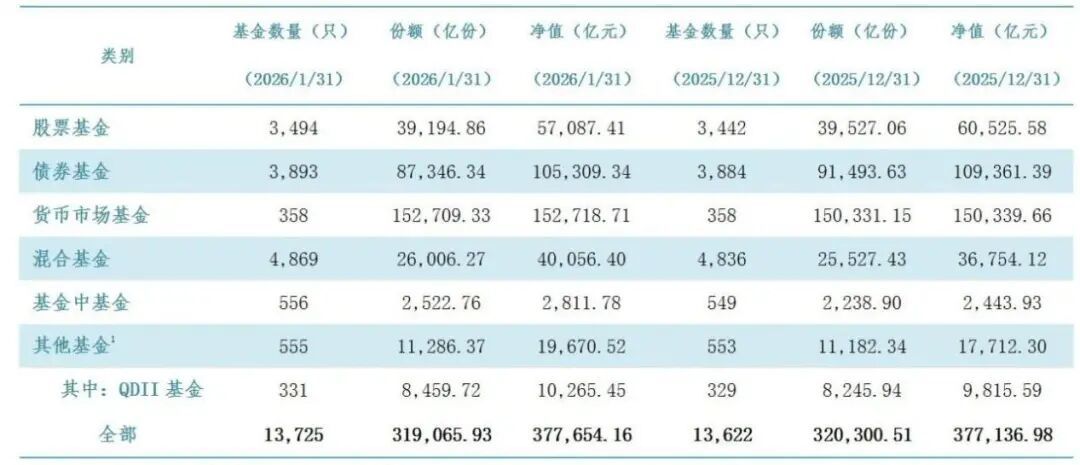
Core Viewpoint - The total scale of public funds in China has reached a historical high of 37.77 trillion yuan, driven by multiple factors including seasonal market activity and an influx of new capital [1][2]. Fund Scale and Growth - As of the end of January 2026, the total scale of public funds has increased for 10 consecutive months, with a net asset value of 37.77 trillion yuan, marking a 0.14% increase from the previous month [2][4]. - The number of public fund management institutions in China stands at 165, including 150 fund management companies and 15 asset management institutions with public qualifications [4]. Fund Type Performance - Mixed, money market, and other funds have been the main contributors to the growth of public fund scale, each achieving a growth of over 100 billion yuan [2]. - Fund of Funds (FOF) has seen a significant increase, with a 15.05% rise in shares and a 12.68% increase in scale, reaching 2,522.76 billion shares and 2,811.78 billion yuan respectively [7][9]. Fund Size Changes - Stock funds have experienced a reduction of over 340 billion yuan, with a total scale of 5.71 trillion yuan, reflecting a 5.68% decrease [3][10]. - Bond funds also faced a decline, shrinking by over 400 billion yuan, with a total scale of 10.53 trillion yuan, a decrease of 3.71% [3][10]. - In contrast, money market funds and mixed funds have shown positive growth, with money market funds increasing by 1.58% and mixed funds by 8.98% [9][10]. Market Dynamics - The market has shown strong momentum, with public fund management scales consistently reaching new highs since April 2025, when it first surpassed 33 trillion yuan [6]. - The significant redemption of broad-based ETFs has impacted the overall scale of stock funds, contributing to the observed declines [3][10].