算力工厂

Search documents
氪星晚报|联想集团与英伟达联合推出“联想人工智能云超级工厂”;OpenAI与盖茨基金会将向非洲医疗人工智能领域投资5000万美元;我国去年电影全产业链产...
3 6 Ke· 2026-01-21 11:40
Group 1: Nuclear Energy - Japan's Tokyo Electric Power Company has restarted the Kashiwazaki-Kariwa Nuclear Power Plant Unit 6, which had been offline since the 2011 earthquake [1] Group 2: Artificial Intelligence and Technology - Lenovo and NVIDIA have announced a collaboration to launch the "Lenovo AI Cloud Super Factory," aimed at transforming traditional data centers into efficient AI factories [1] - OpenAI has introduced an age prediction model in its ChatGPT service to help identify accounts belonging to users under 18, implementing protective measures for minors [2] - OpenAI and the Gates Foundation are investing $50 million in the "Horizon 1000" project to support AI applications in healthcare across Africa, starting with Rwanda [8] - Microsoft CEO Satya Nadella emphasized that the focus in the AI era should be on computational infrastructure and model orchestration rather than a single model [8] Group 3: Strategic Partnerships - Data堂 and 灵心巧手 have signed a strategic cooperation agreement to integrate their capabilities in the field of embodied intelligence, aiming for technological innovation and industry application [4] Group 4: Market Developments - The Qatar Investment Authority, valued at $580 billion, is considering a major restructuring to separate its overseas assets from domestic investments, enhancing its global investment strategy [2] - 永辉超市 has applied for multiple "胖小辉" trademarks, indicating potential expansion into various sectors [6] - 呷哺呷哺集团 is launching a new sub-brand "呷牛排," entering the steak market with its first store opening in February [7] Group 5: Film Industry - China's film industry is projected to reach a total output value of 817.26 billion yuan by 2025, with a box office multiplier of approximately 1:15.77, ranking among the top globally [9]

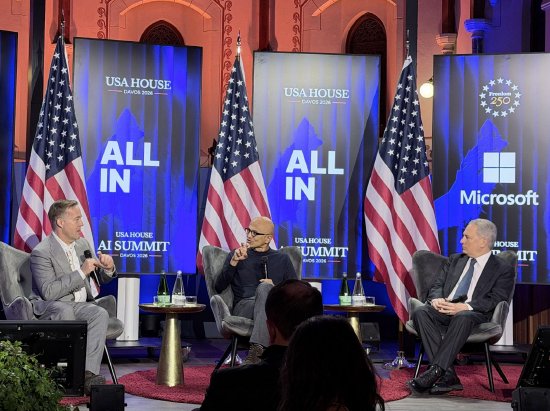
直击达沃斯|微软CEO纳德拉:AI时代的核心不是“单一模型”,而是“模型编排与算力工厂”
Xin Lang Cai Jing· 2026-01-21 08:36
Core Insights - The main strategic focus for Microsoft in the AI era is not on having a single foundational model, but rather on computational infrastructure, model orchestration capabilities, and deep embedding of enterprise knowledge [1][11]. Group 1: AI Strategy - One of Microsoft's core AI strategies is to develop Azure into a large-scale "Token factory" to meet the exponentially growing computational demands of AI applications [3][13]. - Microsoft emphasizes the need for cloud service providers to build heterogeneous infrastructure clusters and enhance utilization through software to lower total cost of ownership (TCO) [3][5]. - Nadella asserts that future AI applications will not rely on a single model; instead, enterprises will use multiple models and orchestrate them for various tasks [3][16]. Group 2: Model Ecosystem - The competition between open-source and closed-source models is likened to the evolution of the database market, suggesting a diverse model ecosystem will emerge, featuring both types of models [3][6]. - The true competitive advantage lies in a company's ability to embed its tacit knowledge into its controllable model weights [3][18]. - Nadella predicts that the number of models will be equivalent to the number of companies in the world, reflecting the transition from a knowledge economy to an AI economy [3][19]. Group 3: Local Computing - Microsoft has developed models that can run locally on Windows desktops, utilizing NPU and GPU resources, indicating a resurgence of high-performance workstations [3][21]. - The desktop computing form factor is regaining strategic value in the AI era, which aligns with Microsoft's inherent advantages in the desktop ecosystem [3][21].