算力税

Search documents
摩擦的终结:2028 年全球智能危机全纪实
阿尔法工场研究院· 2026-02-24 04:05
Core Insights - The article discusses the impending "Global Intelligence Crisis" predicted for 2028, highlighting the collapse of traditional economic structures due to advancements in AI and the resulting implications for employment, profits, and societal contracts [1][19]. Group 1: Economic Changes - The marginal cost of software development is expected to plummet, transforming software from an asset to a commodity, leading to a drastic 85% decline in average contract value (ACV) in the SaaS industry within 18 months [3]. - The concept of "friction" in economics, traditionally seen as negative, is argued to be a source of profit, as it stabilizes wages and ensures the value of inventory; however, AI's efficiency may eliminate these frictions, leading to rapid arbitrage of excess profits [4]. Group 2: Employment Impact - By early 2028, significant job losses are anticipated in knowledge work sectors such as law and accounting, with AI capable of performing tasks that previously required large teams of professionals [7]. - The global unemployment rate in developed economies is projected to reach 10.2% by June 2028, marking a shift from financial crises to a lack of job opportunities, resulting in a structural collapse of consumer spending [8]. Group 3: Market Dynamics - The S&P 500 index is expected to drop from 8000 to 5000, not due to company failures but because the logic of price-to-earnings (P/E) ratios will fail as companies cut jobs to maintain growth while facing declining product prices [12]. - Investment preferences are shifting towards physical assets and commodities, such as energy companies and raw materials like copper and lithium, as a hedge against digital deflation [13]. Group 4: Political and Social Responses - Governments are likely to implement Universal Basic Income (UBI) to mitigate social unrest caused by high unemployment, leading to increased debt issuance [14]. - A new "computing tax" may be introduced for companies with significant computational power, indicating a shift in how data and computing resources are viewed as capital [15]. Group 5: Recommendations for Investors and Individuals - Investors are advised to short industries reliant on information asymmetry and to seek out unique assets that AI cannot replicate, such as human creativity and physical resources [17]. - Individuals should focus on developing aesthetic and decision-making skills, as these are less likely to be automated, and pay attention to offline experiences that may gain value in a digital oversaturated market [18].

算力税第二波,CPU涨价
Hua Er Jie Jian Wen· 2026-01-22 12:28
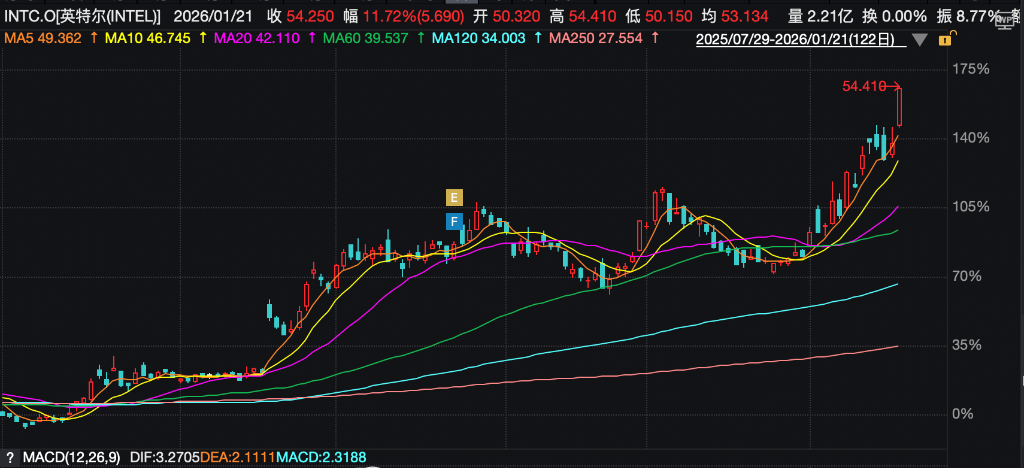
Core Insights - The global semiconductor market is undergoing structural changes, with the CPU sector gaining significant attention from capital markets as it transitions from a traditionally mature category to a focal point for investment [1][3] - The demand for CPUs is driven by the increasing application of AI agents, which require substantial computational resources for tasks beyond traditional AI training, leading to a re-evaluation of CPU's role in the computing ecosystem [3][9] Market Dynamics - Intel's stock reached a nearly four-year high with a year-to-date increase of over 44%, while AMD continues its upward trend; in the A-share market, Longxin Technology and Haiguang Information recorded significant daily gains of 20% and over 13%, respectively [1] - The market is experiencing a re-pricing of the "computing power tax," with CPUs becoming the second wave of cost bearers following the surge in GPU demand due to AI training [1] Supply and Demand Trends - The consensus among institutions indicates that the current changes in the CPU market are not cyclical but are driven by structural transformations due to the scaling of AI applications [3] - IDC forecasts that the number of active AI agents will grow from approximately 28.6 million in 2025 to 2.216 billion by 2030, representing a compound annual growth rate of 139%, suggesting a significant increase in CPU demand [3] - Supply constraints are evident, with Intel's advanced process capacity utilization reaching 120%-130%, and TSMC's advanced packaging capacity bottlenecks extending CPU delivery times from the normal 8-10 weeks to over 24 weeks [3][8] Technological Shifts - The traditional focus on GPU for AI computation is shifting as AI agents evolve to require more complex task execution, with CPUs handling 80%-90% of the workload related to task orchestration and data processing [4][6] - The transition to a "sandbox execution" model in AI platforms is creating new demand characteristics for CPU resources, which are now more closely tied to user scale and task concurrency rather than GPU quantity [5][6] Pricing and Future Outlook - The supply-demand imbalance is leading to expectations of price increases, with Intel and AMD planning to raise server CPU prices by 10%-15% due to the anticipated supply constraints [8] - The strategic value of CPUs is being reassessed as they become central to system management and resource coordination in the evolving landscape of AI applications [9]