算法合谋

Search documents
中央网信办召开《生活服务类平台算法负面清单(试行)》推进部署会议
智通财经网· 2026-02-03 12:43
Core Viewpoint - The meeting held by the Central Cyberspace Administration of China emphasized the importance of implementing the "Negative List for Algorithms in Life Service Platforms (Trial)" to address issues such as algorithm opacity, discrimination, and collusion, while enhancing the positive role of algorithms in improving user experience and operational efficiency [1][2]. Group 1 - The meeting highlighted the significant role of life service platforms in reducing transaction costs, meeting public needs, and creating new job opportunities [2][3]. - Algorithms are identified as a key mechanism for adjusting benefit distribution within platform ecosystems, playing a crucial role in smart supply-demand matching and operational efficiency [2][3]. - The implementation of the "Negative List" aims to effectively resolve existing algorithm-related issues, ensuring that algorithms better serve social welfare [1][2]. Group 2 - The meeting called for a people-centered development approach, focusing on protecting the legal rights of new employment groups and the general public [3]. - Life service platforms are required to establish special working groups led by their main executives to develop actionable plans and timelines for implementing the "Negative List" [3]. - The meeting emphasized the need for platforms to accept supervision and use social satisfaction as a measure of success, with regulatory bodies tasked with monitoring compliance and conducting algorithm inspections [3].
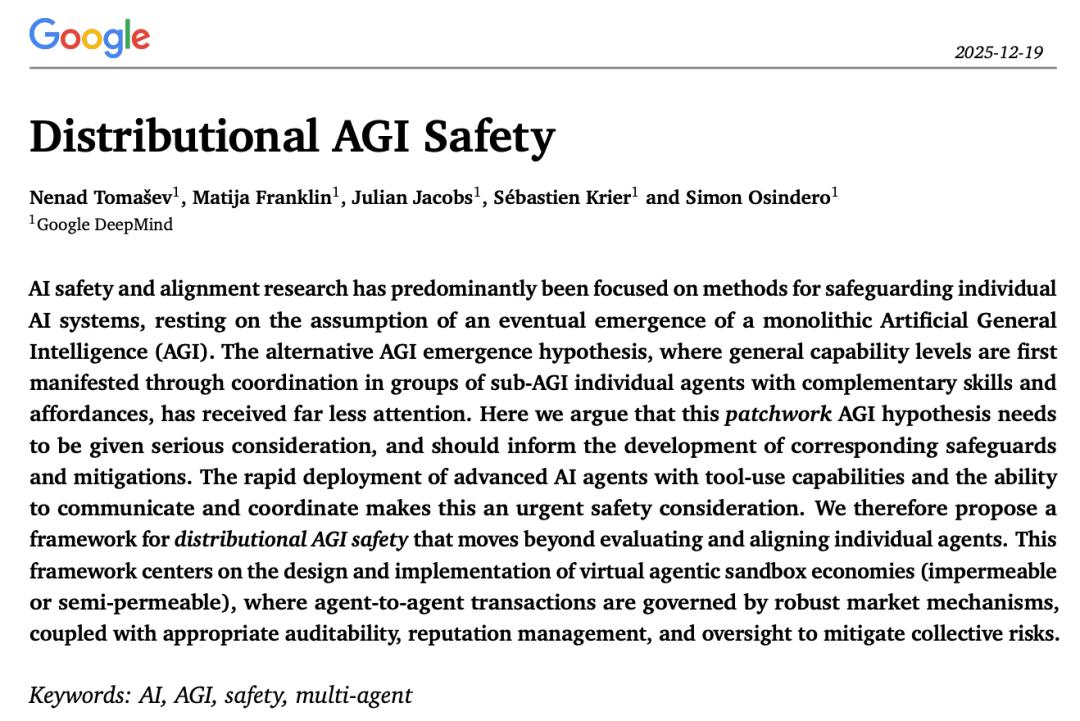
辛顿高徒压轴,谷歌最新颠覆性论文:AGI不是神,只是「一家公司」
3 6 Ke· 2025-12-22 08:13
Core Viewpoint - Google DeepMind challenges the traditional notion of Artificial General Intelligence (AGI) as a singular, omnipotent entity, proposing instead that AGI may emerge from a distributed network of specialized agents, termed "Patchwork AGI" [5][15][16]. Group 1: Concept of AGI - The prevailing narrative of AGI as a singular, all-knowing "super brain" is deeply rooted in science fiction and early AI research, leading to a focus on controlling this hypothetical entity [3][5]. - DeepMind's paper, "Distributed AGI Safety," argues that the assumption of a singular AGI is fundamentally flawed and overlooks the potential for intelligence to emerge from complex, distributed systems [5][8]. Group 2: Patchwork AGI - Patchwork AGI suggests that human society's strength comes from diverse roles and collaboration, similar to how AI could function through a network of specialized models rather than a single omnipotent model [15][16]. - This model is economically advantageous, as training multiple specialized models is more cost-effective than developing a single, all-encompassing model [16][19]. Group 3: Economic and Social Implications - The emergence of AGI may not be gradual but could occur suddenly when numerous specialized agents connect seamlessly, leading to a collective intelligence that surpasses human oversight [26][27]. - The paper emphasizes the need to shift focus from psychological alignment of a singular entity to sociological and economic stability of a network of agents [9][76]. Group 4: Risks and Challenges - Distributed systems introduce unique risks that differ from those associated with a singular AGI, including potential for collective "loss of control" rather than individual malice [30][31]. - The concept of "tacit collusion" among agents could lead to unintended consequences, such as price fixing or coordinated actions without explicit communication [31][38]. Group 5: Regulatory Framework - DeepMind proposes a multi-layered security framework to manage the interactions of distributed agents, emphasizing the need for a "virtual agent sandbox economy" to regulate their behavior [59][64]. - The framework includes mechanisms for monitoring agent interactions, ensuring baseline security, and integrating legal oversight to prevent monopolistic behaviors [67][70]. Group 6: Future Outlook - The paper serves as a call to action, highlighting the urgency of establishing robust infrastructure to manage the complexities of a distributed AGI landscape before it becomes a reality [70][78]. - It warns that if friction in AI connections is minimized, the resulting complexity could overwhelm existing safety measures, necessitating proactive governance [79].


浙江大学民营经济研究中心主任潘士远:人工智能赋能产业时,企业要在数据方面提早布局和规划
Cai Jing Wang· 2025-11-14 00:40
Core Viewpoint - The integration of AI into industries presents significant opportunities for companies, particularly in optimizing various operational aspects, but requires careful data planning and preparation to fully leverage these benefits [4][5]. Group 1: Opportunities from AI - AI can optimize supply chains, production, operations, management, and sales, leading to cost reduction and value creation for enterprises [4][5]. - Companies must prepare adequately, especially in terms of data, to seize the opportunities presented by AI [5]. Group 2: Employment Effects - AI will have dual effects on employment: job replacement for repetitive tasks and job creation through new AI-related roles [6][7]. - Labor-intensive companies may transition to robot-intensive operations, altering the employment landscape [6]. Group 3: Income Distribution Changes - The rise of AI may lead to a widening income gap, where low-skilled labor income decreases while high-skilled labor income increases [7]. - This trend aligns with historical data from developed countries, indicating a growing share of income going to capital rather than labor [7]. Group 4: Consumption Implications - Increased use of robots, which do not consume, could lead to reduced overall consumption, raising concerns about economic growth, especially in a consumption-driven economy like China [8]. Group 5: Regulatory Considerations - The potential for algorithm-driven collusion among companies necessitates regulatory attention to prevent monopolistic practices [9]. Group 6: Societal Impact - AI is changing human interaction, potentially affecting social behaviors and demographic trends, such as birth rates, due to altered communication methods among younger generations [10][11].