生产力J曲线

Search documents
斯坦福专家:美国正跨入“AI收获期”,2025年生产率增速有望翻倍至2.7%
Hua Er Jie Jian Wen· 2026-02-15 11:47
Core Insights - The article argues that the U.S. may be transitioning from an "AI investment phase" to an "AI harvest phase," with productivity gains becoming measurable in GDP statistics [1] - The author predicts that U.S. productivity growth could reach approximately 2.7% by 2025, nearly double the average of 1.4% over the past decade [1] Macroeconomic Data Signals - The U.S. Bureau of Labor Statistics revised employment figures downward by approximately 403,000 jobs, yet the actual GDP remains strong, with a growth rate of 3.7% in the fourth quarter [2] - This scenario of high output with reduced labor input is identified as a hallmark of productivity growth, indicating that more work is being completed with fewer workers [2] J-Curve Explanation - The author places the diffusion of AI within a broader historical context, referencing the "productivity J-curve," where significant productivity gains often follow a period of investment and organizational restructuring [3] - The initial phase of adopting new technologies may not yield immediate productivity improvements, as companies need to reorganize processes and train employees [3] Microeconomic Changes - Research indicates a notable decline of about 16% in entry-level job postings in industries with high AI exposure, while employment for those enhancing their skills with AI is on the rise [4][5] - Many companies are currently using generative AI for basic tasks, but a select few "power users" are leveraging AI to automate entire processes, significantly reducing project timelines [5] Transition to Structural Utility - The article suggests a shift from AI experimentation to structural utility, where the focus will be on integrating AI models into business operations [6] - Companies are advised to embed AI into end-to-end processes, upgrade training objectives, and track performance metrics to ensure scalable benefits [6]
辛顿高徒压轴,谷歌最新颠覆性论文:AGI不是神,只是「一家公司」
3 6 Ke· 2025-12-22 08:13
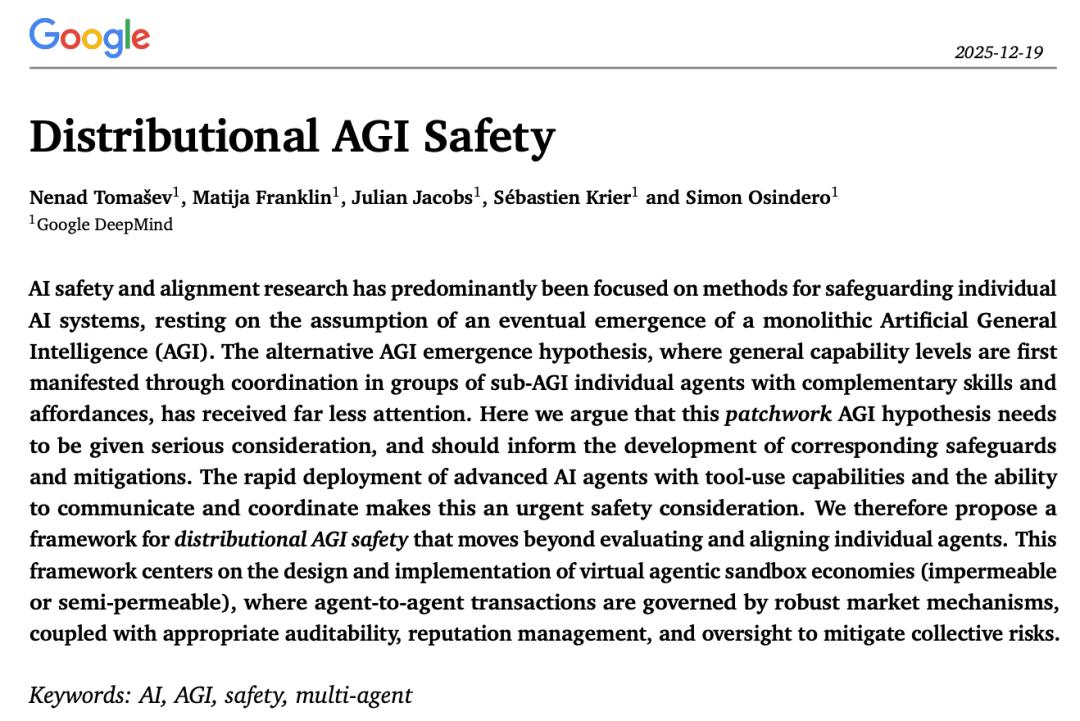
Core Viewpoint - Google DeepMind challenges the traditional notion of Artificial General Intelligence (AGI) as a singular, omnipotent entity, proposing instead that AGI may emerge from a distributed network of specialized agents, termed "Patchwork AGI" [5][15][16]. Group 1: Concept of AGI - The prevailing narrative of AGI as a singular, all-knowing "super brain" is deeply rooted in science fiction and early AI research, leading to a focus on controlling this hypothetical entity [3][5]. - DeepMind's paper, "Distributed AGI Safety," argues that the assumption of a singular AGI is fundamentally flawed and overlooks the potential for intelligence to emerge from complex, distributed systems [5][8]. Group 2: Patchwork AGI - Patchwork AGI suggests that human society's strength comes from diverse roles and collaboration, similar to how AI could function through a network of specialized models rather than a single omnipotent model [15][16]. - This model is economically advantageous, as training multiple specialized models is more cost-effective than developing a single, all-encompassing model [16][19]. Group 3: Economic and Social Implications - The emergence of AGI may not be gradual but could occur suddenly when numerous specialized agents connect seamlessly, leading to a collective intelligence that surpasses human oversight [26][27]. - The paper emphasizes the need to shift focus from psychological alignment of a singular entity to sociological and economic stability of a network of agents [9][76]. Group 4: Risks and Challenges - Distributed systems introduce unique risks that differ from those associated with a singular AGI, including potential for collective "loss of control" rather than individual malice [30][31]. - The concept of "tacit collusion" among agents could lead to unintended consequences, such as price fixing or coordinated actions without explicit communication [31][38]. Group 5: Regulatory Framework - DeepMind proposes a multi-layered security framework to manage the interactions of distributed agents, emphasizing the need for a "virtual agent sandbox economy" to regulate their behavior [59][64]. - The framework includes mechanisms for monitoring agent interactions, ensuring baseline security, and integrating legal oversight to prevent monopolistic behaviors [67][70]. Group 6: Future Outlook - The paper serves as a call to action, highlighting the urgency of establishing robust infrastructure to manage the complexities of a distributed AGI landscape before it becomes a reality [70][78]. - It warns that if friction in AI connections is minimized, the resulting complexity could overwhelm existing safety measures, necessitating proactive governance [79].


中欧国际工商学院决策科学和管理信息系统学教授谭寅亮:AI 如何改写生产力规则? | 36氪2025AI Partner百业大会
3 6 Ke· 2025-08-28 23:48
Group 1 - The conference "2025 AI Partner Conference" was held in Beijing, focusing on the theme of "Chinese Solutions" and discussing the latest breakthroughs and ecosystem of AI in China [1] - Key topics included the potential of superintelligent agents as the core form of the next generation of AI and the integration of AI across various industries [1] - Professor Tan Yinliang from CEIBS presented on how AI drives business value and productivity enhancement, emphasizing the need to understand AI's impact on the economy and society over the next decade [3][5] Group 2 - The historical context of the electricity revolution was used to illustrate how AI might similarly transform productivity, highlighting that initial technological adoption does not guarantee immediate productivity gains [4][5] - The concept of "management" was identified as crucial for realizing productivity improvements, requiring changes in organizational structure and business processes rather than mere technology substitution [5][6] - The evolution of AI is compared to the electricity era, with current stages including initial technological breakthroughs and early applications, indicating that many companies have yet to see significant impacts from AI [7][8] Group 3 - The upcoming "structural transformation period" is seen as critical for Chinese enterprises, where businesses will need to rethink processes and systems to fully leverage AI [7][8] - The final phase of AI development is expected to be a "mature expansion period," where AI will create new business models and competitive advantages through deep integration into core operations [8]

AI为什么还没有替代你的工作?
Hu Xiu· 2025-05-30 05:48
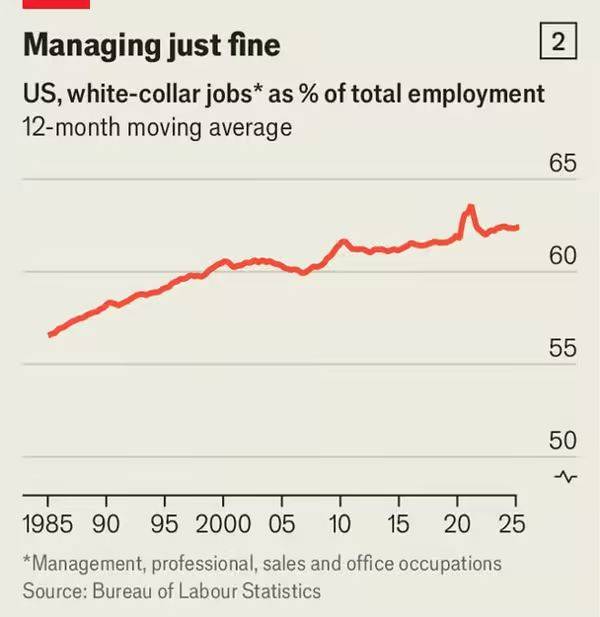
Group 1: Employment Trends - Despite concerns about automation leading to job losses, the number of professionals in interpreting and translation has increased by 7% over the past year in the U.S., indicating that AI may enhance efficiency and create new demand in certain sectors [1] - The unemployment rate for recent graduates is approximately 4%, which is historically low, suggesting that attributing job market challenges solely to AI lacks sufficient evidence [5] - Employment in white-collar jobs has slightly increased over the past year, even in roles considered most susceptible to AI impact [5] Group 2: Corporate Attitudes Towards AI - A notable shift in attitude is observed in companies like Klarna, where the CEO emphasized the continued necessity of human intervention in customer service despite AI automation [3] - Less than 10% of U.S. companies have scaled AI applications in core business processes, indicating that while enthusiasm for AI is high, practical implementation remains limited [7] - AI is primarily enhancing existing employee productivity rather than directly replacing jobs, allowing workers to focus on more creative and strategic tasks [7] Group 3: Investment and Market Sentiment - The capital market has shifted from initial enthusiasm for AI to a more cautious stance, with many companies feeling pressure after failing to achieve expected returns on AI investments [9] - The percentage of companies abandoning AI pilot projects has risen from 17% to 42% over the past year, reflecting challenges in effectively integrating AI into existing business models [9][12] - Major tech companies face significant challenges during this "trough of disillusionment," including data integration issues, talent shortages, high implementation costs, and compliance risks [12] Group 4: Long-term Economic Perspectives - The "Productivity J-Curve" theory suggests that the positive impacts of AI on productivity may not be immediately visible and could initially lead to stagnation as companies invest in necessary adjustments [14] - The "Modern Productivity Paradox" indicates that despite rapid advancements in AI, macroeconomic productivity growth remains sluggish, highlighting a potential disconnect between technological progress and productivity statistics [15] - Historical patterns show that transformative technologies often undergo phases of initial disappointment before leading to significant economic and social changes [16] Group 5: Societal Implications of AI - The focus on whether AI will replace human jobs may distract from more critical discussions about how AI can enhance productivity and overall wealth creation [17] - The historical context of the Industrial Revolution illustrates that while machines replaced many jobs, they also significantly increased overall productivity and wealth [18] - The core question surrounding AI's future is whether it will contribute to overall economic growth or exacerbate wealth distribution issues, impacting societal equity [19][20] Group 6: Future Considerations - Current discussions about AI often center on immediate concerns like job displacement and ethical considerations, potentially overlooking broader strategic issues [21] - The future of AI requires collaborative efforts from businesses, researchers, policymakers, and the public to create supportive frameworks for its development [22] - The ongoing evolution of AI presents both challenges and opportunities, necessitating a collective approach to ensure it serves the greater good of society [23]