米格达尔效应

Search documents
实验室5年无课题,他们在师范大学做出突破成果
Xin Lang Cai Jing· 2026-02-03 01:37
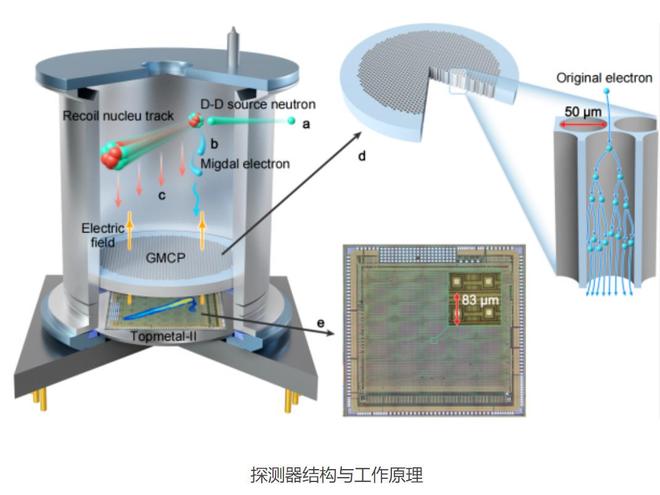
Core Viewpoint - The research team from the University of Chinese Academy of Sciences, along with Guangxi University and Central China Normal University, has successfully observed the Migdal effect for the first time in experiments, confirming a long-standing theoretical prediction in physics [1][2][13]. Group 1: Research and Development - The Migdal effect predicts that when neutral particles collide with atomic nuclei, the recoiling nucleus transfers some energy to outer electrons, allowing them to escape the atomic binding [2][14]. - The research utilized a "micro-structured gas detector + pixel readout chip" to capture the process of single atom movement releasing electrons, effectively acting as a "camera" [2][14]. - The Topmetal pixel readout chip developed by the research team played a crucial role in detecting weak charge signals, overcoming significant challenges in high-energy physics detection [3][15]. Group 2: Technological Innovation - The Topmetal chip, measuring 2cm x 3cm, underwent extensive engineering development, requiring multiple iterations and tests over a five-year period with minimal output initially [19][20]. - The chip's design allows for direct capture of charge signals, bypassing traditional barriers posed by multiple insulating layers, thus enhancing measurement precision [3][16]. - The successful application of the Topmetal-II chip in observing the Migdal effect demonstrated its reliability and advanced capabilities in detecting extremely weak signals, highlighting China's innovation in high-end detection technology [21]. Group 3: Institutional Support and Development - The establishment of the PLAC laboratory at Central China Normal University faced initial challenges due to the lack of existing infrastructure for chip design and testing, but strong institutional support facilitated its development [22][23]. - The laboratory has evolved to include a complete technical chain for chip design, packaging, and testing, and has begun to train undergraduate and graduate students in integrated circuit technology [22][23]. - The supportive environment at the university allowed the research team to persist through initial low-output years, ultimately leading to significant breakthroughs in their research [23].
一群仰望星空的年轻人
Guang Xi Ri Bao· 2026-01-31 03:06
Core Insights - A Chinese research team successfully observed the Migdal effect in neutron collisions, marking a significant milestone in dark matter detection, as reported in the journal Nature on January 15, 2026 [1][2][3] Group 1: Research and Development - The research team, led by the University of Chinese Academy of Sciences and involving multiple universities, developed a highly sensitive gas pixel detector, likened to an "atomic-level camera" [3][4] - The detector was initially designed for X-ray polarization detection but was adapted for observing the Migdal effect, which is crucial for detecting light dark matter [6][7] - The team conducted over 150 hours of experiments, capturing more than one million collision events, ultimately confirming six images that aligned with theoretical predictions [4][10] Group 2: Collaboration and Innovation - The project exemplified a model of "organized free exploration," allowing researchers from various institutions to collaborate effectively while pursuing their scientific interests [7][8] - The collaboration included contributions from different universities, focusing on various aspects such as software algorithms, data analysis, and experimental equipment [7][8] - The initiative also involved a talent development program, encouraging students to engage deeply in research from an early stage [7][8] Group 3: Challenges and Perseverance - The team faced numerous challenges, including harsh working conditions and technical difficulties during experiments, which required resilience and adaptability [3][4][10] - Despite setbacks, such as equipment failures and missed observational opportunities, the team maintained a positive outlook, viewing challenges as part of the scientific process [9][10] - The collaborative spirit and shared enthusiasm for discovery among team members fostered a creative environment, leading to innovative solutions and advancements in their research [9][10]
【人民日报】我国科研团队首次证实米格达尔效应
Ren Min Ri Bao· 2026-01-26 02:31
Core Insights - The article discusses a significant scientific breakthrough published in the journal "Nature," where researchers from the University of Chinese Academy of Sciences, along with Guangxi University and Central China Normal University, have experimentally confirmed the Migdal effect in a neutral particle collision scenario, marking a substantial step forward in the detection of light dark matter [1][2]. Group 1: Research Findings - The Migdal effect, proposed by Soviet physicist Arkadi Migdal in 1939, describes how an atomic nucleus gaining energy can transfer some of that energy to its outer electrons, allowing them to escape the atomic binding and create observable charged tracks [1]. - For over 80 years, the Migdal effect in neutral particle collision scenarios remained unverified due to the challenges in detecting the extremely weak electronic signals and unique tracks produced during the process [1]. - The recent research achievement was made possible by breakthroughs in detector performance, specifically a gas pixel detector developed by Guangxi University, which took over 10 years to create and was completed in 2023 [1][2]. Group 2: Experimental Methodology - The experimental team utilized a highly sensitive detection device, likened to a "camera" capable of capturing the process of electron release during single atomic movements, to validate the Migdal effect [2]. - The setup involved bombarding gas molecules within the detector with a neutron source, resulting in atomic recoil and the generation of Migdal electrons, successfully capturing the unique tracks formed by their interaction [2]. - The experiment also measured the ratio of the cross-section of the Migdal effect to that of atomic recoil, providing crucial calibration data for international dark matter experiments [2].
我国科研团队首次证实米格达尔效应
Ren Min Wang· 2026-01-23 22:33
Group 1 - The core achievement of the research is the first direct experimental confirmation of the Migdal effect in a neutral particle collision scenario, marking a significant step forward in the detection of light dark matter [1] - The Migdal effect, proposed by physicist Arkadi Migdal in 1939, describes how energy gained by an atomic nucleus can transfer to outer electrons, allowing them to escape the atomic binding, thus converting undetectable low-energy nuclear recoil signals into observable electronic signals [1] - The breakthrough in this research is attributed to advancements in detector performance, specifically a gas pixel detector developed by Guangxi University, which took over 10 years to create and was completed in 2023 [1] Group 2 - The experimental team utilized a highly sensitive detection device, likened to a "camera" that captures the process of electron release during atomic motion, successfully "photographing" the unique trajectory formed by nuclear recoil and Migdal electrons [2] - The experiment not only validated the Migdal effect but also provided the first measurement of the ratio of the effect's cross-section to the nuclear recoil cross-section, offering crucial calibration data for international dark matter experiments [2]
中国科学院研究证实87年前量子力学预言
Huan Qiu Wang Zi Xun· 2026-01-20 06:05
Core Insights - The research team from the University of Chinese Academy of Sciences has successfully observed the Migdal effect during neutron-nucleus collisions, providing crucial experimental evidence for detecting lighter dark matter [1][3]. Group 1: Dark Matter and Migdal Effect - Dark matter constitutes approximately 85% of the total mass in the universe, yet it has only been detectable through gravitational effects, with no other methods available [3]. - The Migdal effect, proposed by physicist Arkadi Migdal in 1939, describes a quantum phenomenon where energy from a particle collision can be transferred to an outer electron of the nucleus, potentially allowing low-energy signals to be detected [3][4]. - For over 80 years, the Migdal effect in neutral particle collisions had not been experimentally confirmed, leading to skepticism regarding dark matter detection experiments relying on this theoretical framework [3][4]. Group 2: Research Methodology and Findings - The research team developed a highly sensitive detection device combining a microstructured gas detector and a pixel readout chip, functioning like a "camera" that captures the electron release process during atomic motion [3][4]. - By utilizing a compact deuterium-deuterium fusion reaction neutron source, the team was able to distinguish the Migdal effect from background noise, achieving a statistical significance exceeding five standard deviations, thus meeting the criteria for a physical discovery [4]. - The team plans to further optimize the detector's performance and expand observations of the Migdal effect across different elements, aiming to support the detection of lighter dark matter particles [5].

【央视新闻】我国科研团队首次直接证实量子力学预言的米格达尔效应
Yang Shi Xin Wen· 2026-01-16 03:31
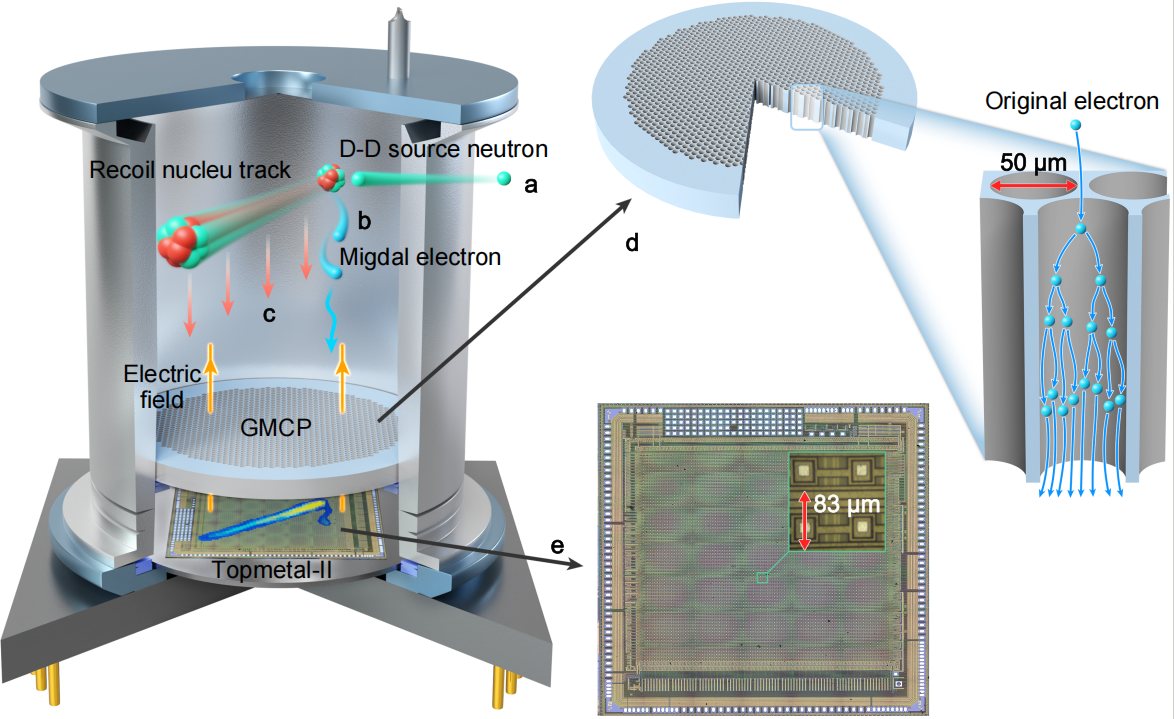
Core Insights - The research team from the University of Chinese Academy of Sciences, in collaboration with several universities, has directly observed the Migdal effect, a phenomenon predicted by quantum mechanics, which provides crucial support for breakthroughs in light dark matter detection [3]. Group 1: Migdal Effect - The Migdal effect, predicted in 1939 by Soviet scientist Migdal, describes how energy is transferred from a recoiling atomic nucleus to outer electrons during collisions with neutral particles [3]. - For over 80 years since the theoretical prediction, the existence of the Migdal effect in neutral particle collision processes had not been confirmed, leading to skepticism regarding dark matter detection experiments relying on this effect [3]. Group 2: Research Methodology - The research team developed a highly sensitive detection device combining a "micro-structured gas detector" and a "pixel readout chip," functioning like a "camera" that captures the process of electrons being released during single atomic movements [4]. - Using a compact deuterium-deuterium fusion reaction neutron source, the device can distinguish the unique tracks formed by nuclear recoil and Migdal electrons, successfully confirming the Migdal effect for the first time [4]. Group 3: Future Plans - The research team plans to further optimize the performance of the detector and expand observations of the Migdal effect across different elements, aiming to provide data support for the detection of lighter dark matter particles [4].
【中国新闻网】中国科学家证实80多年前量子力学理论预言 助力暗物质探测研究
Zhong Guo Xin Wen Wang· 2026-01-16 03:31
Core Viewpoint - Chinese scientists have made a significant breakthrough in dark matter detection by directly observing the "Migdal effect," confirming a quantum mechanics theory proposed over 80 years ago, which may open new avenues for dark matter research [5][9]. Group 1: Research and Development - The research team, led by professors from the University of Science and Technology of China, developed a highly sensitive detection device that can capture the "Migdal effect" [5][8]. - The device combines a micro-structured gas detector with a pixel readout chip, functioning like a "camera" that can observe the release of electrons during atomic movements [8]. - The team successfully distinguished "Migdal events" from background noise, achieving a statistical significance exceeding five standard deviations, which is a gold standard in particle physics [8]. Group 2: Implications for Dark Matter Research - The discovery of six "Migdal events" serves as a calibration tool for future light dark matter detection experiments, providing critical data to enhance detection capabilities [9]. - The research team plans to optimize the detector's performance and expand observations of the "Migdal effect" across different elements, which will support the detection of lighter dark matter particles [9]. - The findings allow for the adjustment of analysis strategies in international dark matter detection projects, potentially improving sensitivity [9].
“广西造”成就世界级发现
Guang Xi Ri Bao· 2026-01-16 02:58
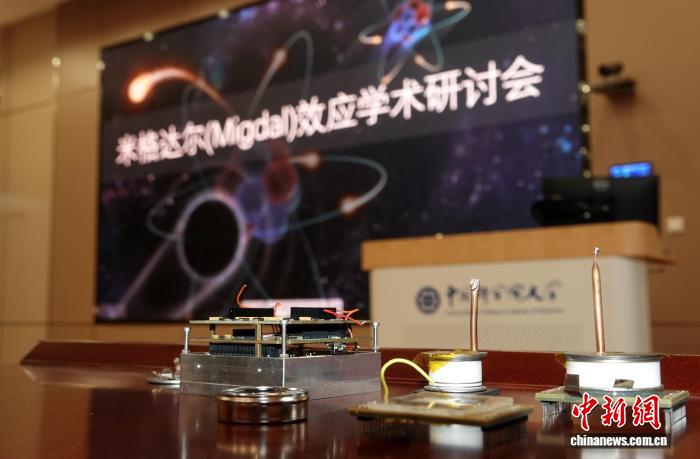
Core Insights - The research led by the University of Chinese Academy of Sciences, in collaboration with Guangxi University and Central China Normal University, has successfully confirmed the Migdal effect in a neutral particle collision scenario, marking a significant advancement in the detection of light dark matter [1][2] - The Migdal effect, proposed by Soviet physicist Arkadi Migdal in 1939, is considered a crucial physical pathway to overcome the detection threshold for light dark matter [1] - The breakthrough in this research is attributed to the performance enhancement of the detector, specifically the gas microchannel plate pixel detector, which was adapted for ground experiments after over a decade of development [1] Research Details - The experimental team utilized a gas pixel detector developed by Guangxi University as the core component to create a highly sensitive detection device, capable of capturing the electron release process during atomic motion [2] - The experiment involved bombarding gas molecules within the detector with a neutron source, successfully capturing the unique trajectory of the resulting atomic recoil and Migdal electrons, thereby validating the Migdal effect [2] - This research not only provides critical support for breaking the detection threshold for light dark matter but also offers the first measurement of the ratio between the cross-section of the Migdal effect and the atomic recoil cross-section, serving as a key calibration reference for international dark matter experiments [2]
我国科研团队首次直接观测到米格达尔效应
Xin Lang Cai Jing· 2026-01-15 23:34
Core Findings - The research team led by the University of Chinese Academy of Sciences has directly observed the Migdal effect for the first time, providing crucial support for breakthroughs in light dark matter detection [1][2] - The Migdal effect, proposed by physicist Arkadi Migdal in 1939, involves energy transfer from an atomic nucleus to its outer electrons during recoil, allowing electrons to escape atomic binding [1] Research Methodology - The team developed a highly sensitive detection device combining a "micro-structured gas detector" and a "pixel readout chip," functioning like a "camera" to capture the process of electron release during single atom motion [2] - Utilizing a compact deuterium-deuterium fusion reaction neutron source, the device distinguishes the unique tracks of nuclear recoil and Migdal electrons from background interference [2] Implications and Future Directions - This achievement fills a long-standing gap in experimental verification of the Migdal effect and strengthens its theoretical foundation, showcasing the capabilities of domestic high-quality gas detection technology [2] - The research team plans to collaborate with dark matter detection experiment teams to integrate these findings into the development of next-generation detectors, emphasizing the importance of dark matter in understanding the universe's origins and evolution [2][3]
中国科学院大学×广西大学等合作发表最新Nature论文
生物世界· 2026-01-15 10:30
Core Viewpoint - The article discusses the first direct observation of the Migdal effect, a significant breakthrough in physics that could aid in the exploration of light dark matter and address a long-standing theoretical gap in the field [3][4]. Group 1: Research Findings - The research team successfully observed the Migdal effect by bombarding gas molecules in a detector with neutrons, distinguishing the "co-vertex" images of simultaneous nuclear and electronic events from complex background noise [6]. - This discovery marks the end of an 80-year wait in the physics community for direct evidence of the Migdal effect, solidifying its theoretical foundation [4][10]. Group 2: Implications - The direct observation of the Migdal effect fills a long-existing experimental validation gap and brings humanity closer to unraveling the mysteries of the universe, particularly regarding dark matter [10].