
粮油安全

Search documents
20余年攻关让大豆、花生安全高产——科技与产业共生共赢的生动样本
Jing Ji Ri Bao· 2026-02-14 10:05
Core Viewpoint - The ARC biological coupling technology, developed by a team led by Li Peiwu, has won the highest award at the 14th China Innovation and Entrepreneurship Competition, indicating its potential to enhance soybean and peanut production while addressing food safety concerns [1][5]. Group 1: Technology Breakthrough - The ARC technology addresses two major challenges in the soybean and peanut industry: controlling aflatoxin contamination and improving nitrogen fixation efficiency [2][3]. - The technology achieves "two fixes, three increases, and five reductions," which includes nitrogen fixation, carbon fixation, increased yield, efficiency, and safety, while reducing bacteria, losses, fertilizer use, costs, and carbon emissions [3][4]. Group 2: Research and Development Journey - The research team began their work in 1999, focusing on the pain points of the soybean and peanut industry, and successfully developed a core technology for efficient aflatoxin detection in 2012 [4]. - The team discovered a "seesaw effect" between root nodule bacteria and aflatoxin-producing fungi, leading to the innovative coupling of these two research areas [4]. Group 3: Policy Support and Implementation - Since 2021, the Chinese government has emphasized increasing soybean production capacity and has shown growing interest in peanuts, with specific policies set for 2025 and 2026 to expand peanut cultivation [6]. - The ARC technology has been demonstrated in 22 provinces, showing strong resistance and quality improvement characteristics, with reported yield increases of over 15% for soybeans and 19% for peanuts [6][7]. Group 4: Future Prospects - The Chinese Academy of Agricultural Sciences plans to launch a major research task in 2024 to further develop the ARC technology, aiming to expand its demonstration area to 3 million acres by 2025 and potentially to 30 million to 50 million acres in the next 3 to 5 years [7]. - The focus on technological innovation is seen as a key driver for increasing the yield of oilseed crops, contributing to national food security and the implementation of carbon neutrality strategies [7].
20余年攻关让大豆、花生安全高产—— 科技与产业共生共赢的生动样本
Jing Ji Ri Bao· 2026-02-13 23:49
Core Viewpoint - The ARC biological coupling technology, developed by a team led by Li Peiwu, has won the highest award at the 14th China Innovation and Entrepreneurship Competition, indicating its potential to enhance soybean and peanut production while addressing food safety concerns [1][3]. Group 1: Technology Breakthrough - The ARC technology addresses two major challenges in the soybean and peanut industry: controlling aflatoxin contamination and improving nitrogen fixation efficiency [2][3]. - The technology achieves "two fixes, three increases, and five reductions," which includes nitrogen fixation, carbon fixation, increased yield, efficiency, and safety, while reducing bacteria, losses, fertilizer use, costs, and carbon emissions [3][4]. Group 2: Research and Development Process - The research team began their work in 1999, focusing on the pain points of the soybean and peanut industry, and successfully developed a core technology for efficient aflatoxin detection by 2012 [3][4]. - They discovered a "seesaw effect" between root nodule bacteria and aflatoxin levels, leading to the innovative coupling of these two research areas [4][5]. Group 3: Policy Support and Implementation - Since 2021, the Chinese government has emphasized increasing soybean production capacity and has begun to pay more attention to peanuts, with specific plans for expansion in future policy documents [6]. - The ARC technology has been demonstrated in 22 provinces, showing strong resistance and quality improvement characteristics, with significant yield increases reported [6][7]. Group 4: Future Prospects - The Chinese Academy of Agricultural Sciences plans to launch a major research task in 2024 to further develop the ARC technology, aiming for a demonstration area exceeding 3 million mu by 2025, with potential expansion to 30 million to 50 million mu in the next 3 to 5 years [7]. - The focus on technological innovation is seen as a key driver for increasing oilseed crop yields and ensuring food security in China [7].
科技与产业共生共赢的生动样本
Xin Lang Cai Jing· 2026-02-13 22:46
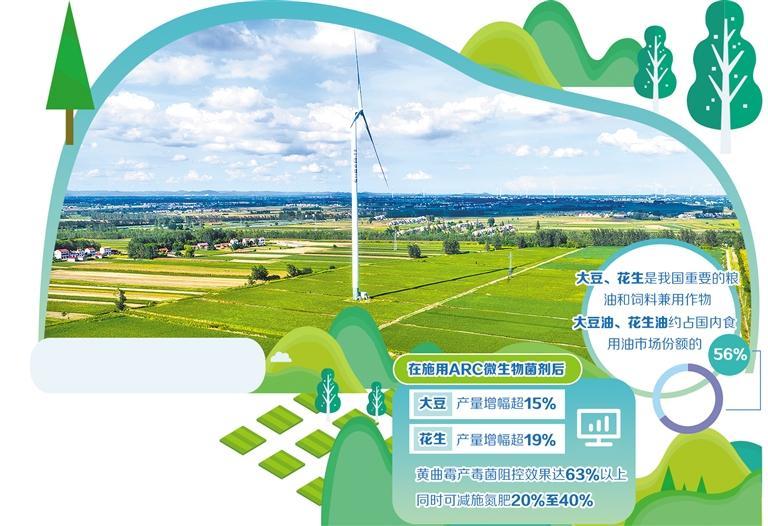
Core Viewpoint - The ARC biological coupling technology, developed by a team led by Li Peiwu, addresses two major challenges in the soybean and peanut industries: aflatoxin contamination and low nitrogen-fixing efficiency, thereby enhancing both yield and quality of these crops [2][4][5]. Group 1: Technology Breakthrough - The ARC technology combines aflatoxin control and nitrogen fixation induction, achieving simultaneous improvements in crop yield and safety [4][5]. - The technology allows for a reduction in chemical fertilizer use by 20% to 40%, while increasing soybean and peanut yields by over 15% and 19% respectively, and achieving a 63% effectiveness in controlling aflatoxin-producing fungi [7][8]. Group 2: Industry Significance - Soybeans and peanuts are crucial for China's edible oil market, accounting for approximately 56% of the market share, highlighting the importance of enhancing domestic production to ensure food security [2][3]. - The technology has been implemented in 22 provinces, demonstrating strong resistance and yield enhancement characteristics, with reports of increased income of about 300 yuan per mu in affected areas [7][8]. Group 3: Policy Support - Since 2021, the Chinese government has emphasized the importance of increasing soybean and peanut production through various policy initiatives, with specific mentions in the Central No. 1 Document for 2025 and 2026 [7]. - The ongoing support for the ARC technology aligns with national goals for agricultural innovation and food safety, aiming for a demonstration area expansion to 3 million to 5 million mu in the next 3 to 5 years [8].

广西香花油茶:“花果同枝”孕育产业新篇
Yang Shi Wang· 2025-12-26 09:57
Core Viewpoint - The Guangxi oil tea industry is experiencing significant growth, driven by innovative research and development, with a focus on high-quality varieties and sustainable practices [1][2]. Group 1: Industry Development - Guangxi is a major oil tea production area in China, implementing the "Double Thousand" plan to promote high-quality development in the oil tea industry [1]. - In 2024, the total production of fresh oil tea fruit in Guangxi is expected to reach 2.753 million tons, with tea oil production at 176,400 tons, both showing significant year-on-year growth [1]. - The area under oil tea cultivation in Guangxi has surpassed 10.5 million acres, with a comprehensive output value of approximately 63 billion yuan, benefiting over 1.5 million farmers [4]. Group 2: Research and Innovation - Since 2005, Guangxi Academy of Forestry has collaborated with various institutions to develop new oil tea varieties, significantly enriching local genetic resources [2]. - The "Xianghua" oil tea variety, developed in Guangxi, exhibits strong resistance, fast growth, high oil content, and stable yields, with an average oil content of 10%, which is 3%-5% higher than ordinary varieties [1][2]. - The "Y" series and "An" series of oil tea varieties have been created to enhance fruit size and yield, with the latter expected to expand suitable planting areas northward [2]. Group 3: Technological Advancements - The "high grafting" technique using "Xianghua" oil tea as a scion has shown effectiveness, with yields reaching 300 kg per acre by the third year after grafting [4]. - A portable small vibrating harvester developed by Guangxi University of Science and Technology and Guangxi Academy of Forestry has achieved a 95% fruit harvesting rate for certain varieties, reducing costs and increasing efficiency [4]. Group 4: Economic Impact - The oil tea industry has significantly increased farmers' incomes, with one couple managing 79 acres of oil tea trees earning 306,300 yuan from tea seed sales in 2021 [4]. - The high content of beneficial components like squalene in "Xianghua" oil tea has led local companies to develop skincare and cosmetic products, further enhancing the industry's value [4].

报名:第四届粮油质量安全及品质检测新技术网络会议
仪器信息网· 2025-10-17 09:10
Core Viewpoint - The article emphasizes the importance of grain and oil safety for national health, social stability, and economic development, while highlighting the current challenges in the industry, including contamination risks and quality control issues [2]. Group 1: Industry Challenges - The safety situation of grain and oil in China is generally stable, but there are increasing risks from biological toxins and heavy metal pollution in the raw material planting stage [2]. - Issues such as insufficient quality control during processing and transportation, as well as fraud, continue to pose significant challenges [2]. - There is a growing consumer demand for higher nutritional value and hygiene standards in grain and oil products [2]. Group 2: Upcoming Conference - The "Fourth Grain and Oil Quality Safety and Quality Detection New Technology Online Conference" will be held on October 21, 2025, organized by Instrument Information Network [2][4]. - The conference will feature industry experts and technical personnel from relevant manufacturers to present the latest research findings and detection technologies [2]. - A detailed agenda includes discussions on regulations, analysis techniques, and advancements in rapid detection technologies for agricultural products [4][5].
