红利替代

Search documents
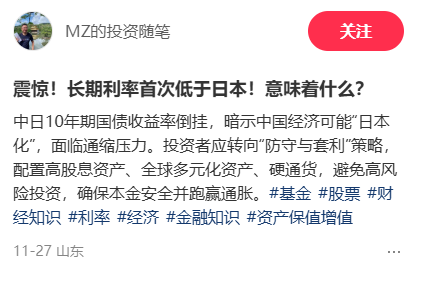
震惊!长期利率首次低于日本!意味着什么?
Xin Lang Cai Jing· 2025-12-12 02:54
Core Insights - The inversion of the 10-year government bond yields between China and Japan suggests that the Chinese economy may be facing a "Japanification" scenario, indicating potential deflationary pressures [1][20][22] - Investors are advised to shift towards "defensive and arbitrage" strategies, focusing on high-dividend assets, global diversification, and hard currencies to safeguard capital and outperform inflation [1][20][22] Group 1: Macro Economic Implications - The inversion signifies a macroeconomic cycle misalignment, with China in a recession/recovery early stage facing deflationary pressures, necessitating low interest rates to stimulate borrowing and consumption [5][23] - In contrast, Japan is in a recovery/overheating early stage, emerging from deflation with rising wages and normalizing monetary policy, allowing interest rates to rise [5][23] Group 2: Currency and Capital Flow Pressures - There is a depreciation pressure on the Renminbi, as global capital tends to favor higher-yielding assets, leading to a preference for Japanese yen or US dollar assets over Renminbi assets [6][24] Group 3: Asset Pricing Logic Changes - The previous high yield in China supported high valuations in real estate and stocks; now, in a "low interest rate era," all assets need to be repriced according to the new risk-free rate, which is around 1.8% or lower [8][26] Group 4: Specific Asset Allocation Strategies - The strategy for A-shares and Hong Kong stocks should shift from "growth speculation" to "yield spread capture," focusing on stable assets with a dividend yield of 3%-5%, which are now seen as "quasi-bonds" [9][27] - Caution is advised against high-debt and pseudo-growth stocks, as corporate earnings are unlikely to experience explosive growth in a deflationary environment [10][28] Group 5: Cross-Border Asset Allocation - The inversion of the China-Japan yield spread signals the need to hold non-Renminbi assets for risk hedging, such as Japanese equities, which may benefit from rising interest rates [12][30] - Holding US Treasury bonds and dollar deposits is recommended, as US dollar rates remain significantly higher than Renminbi rates, providing a hedge against potential Renminbi depreciation [14][32] Group 6: Gold as a Safe Haven - In a scenario where actual interest rates are extremely low or negative, and the economy faces "Japanification" risks, gold is positioned as a counter asset to Renminbi, likely to appreciate in value [16][34] Group 7: Real Estate Market Dynamics - The logic surrounding real estate has fundamentally reversed; low long-term interest rates do not guarantee rising property prices, as low rates often correlate with reduced demand and lending [17][35]

“现金奶牛”来了!这只ETF今日上市
券商中国· 2025-02-27 03:35
Group 1 - The core viewpoint of the article highlights the launch of the first cash flow-themed ETF in China, which has garnered significant investor interest, raising 1.431 billion yuan with 14,900 effective subscriptions, indicating a strong recognition of cash flow ETFs among individual investors [1][3] - The ETF is positioned as an innovative tool for "dividend replacement," focusing on high free cash flow companies, and is expected to evolve passive investment tools in the A-share market towards more refined and strategic approaches [1][3] - The ETF tracks the FTSE China A-Share Free Cash Flow Focus Index, which selects the top 50 listed companies based on free cash flow rate, aiming to achieve higher cash flow returns than the benchmark [3][4] Group 2 - The index associated with the ETF has a significant overweight in the oil, petrochemical, and telecommunications sectors compared to similar cash flow indices, indicating a strategic focus on these industries [4] - Historical performance data shows that the index has achieved a cumulative increase of 602.17% from December 31, 2013, to December 31, 2024, significantly outperforming the China Securities Dividend Index, which rose by 287.57% during the same period [4] - The ETF is designed to provide monthly assessments for potential cash distributions, allowing for up to 12 distributions per year, thereby offering investors a continuous cash flow return [7] Group 3 - The market style has shifted towards large-cap value stocks in 2024, with the FTSE China A-Share Free Cash Flow Focus Index showing a price-to-earnings (PE) ratio of 11.2 and a dividend yield of 4.44%, highlighting its attractive investment characteristics [6] - The ETF is managed by a strong passive investment team at Guotai Fund, which has a significant track record in managing various ETFs, further enhancing the product's credibility and potential for success [7] - The regulatory environment is becoming more favorable for cash flow-focused investments, with policies encouraging high-quality development and increased cash dividends from listed companies, suggesting a long-term trend towards improved free cash flow returns [7][8]