经济基本面复苏

Search documents
国债期货:震荡为主,等待政策指引
Ning Zheng Qi Huo· 2026-03-30 11:00
Report Summary 1. Report Industry Investment Rating No relevant information provided. 2. Core View of the Report - The economy's fundamental recovery might be accelerating as the profits of industrial enterprises above a designated size from January to February increased by 15.2% year - on - year, with the growth rate 14.6 percentage points faster than the previous year. Economic data shows increased economic vitality, which is bearish for the bond market. - After the Two Sessions, the policy has shifted to prioritize stability. Considering the impact of the Middle East on inflation, Fed's monetary policy, and international capital flows, and with the continuous appreciation of the RMB exchange rate, the central government's monetary and fiscal policies are more cautious. - The bond market maintains a top - level oscillatory pattern. Without incremental policies, stock market fluctuations are an important reference for bond market fluctuations. In the short term, the bond market will mainly be in an oscillatory pattern, awaiting further guidance from the economic fundamentals and policies. The Politburo meeting in April is an important observation point. [2] 3. Summaries by Relevant Catalogs 3.1 Market Review and Outlook - On March 27, the National Bureau of Statistics released the profit data of industrial enterprises above a designated size from January to February. The profits of these enterprises increased by 15.2% year - on - year, and the growth rate was 14.6 percentage points faster than the previous year. - The People's Bank of China emphasized actively and steadily resolving financial risks in key areas at an enlarged meeting, aiming to maintain a dynamic balance among economic growth, economic structure adjustment, and financial risk prevention at the macro - level. - After the Two Sessions, the policy shifted to stability. The situation in the Middle East affects inflation, Fed's monetary policy, and international capital flows. With the continuous appreciation of the RMB, the central government's policies are more cautious. - Economic data indicates increased economic vitality, which is bearish for the bond market. The bond market maintains an oscillatory pattern at the top, and without incremental policies, stock market fluctuations are an important factor for bond market fluctuations. In the short term, the bond market remains oscillatory, waiting for economic fundamentals and policy guidance, with the April Politburo meeting being an important observation point. [2] 3.2 Factors to Watch - The stock - bond seesaw, economic data, and the Middle East geopolitical war are the factors to watch. [3] 3.3 Other Sections (Data Visualization) - The report presents multiple charts, including those related to long - term and short - term treasury bond futures prices, trading volumes, and open interest; various macro - economic indicators such as official PMI, GDP, industrial added value, fixed - asset investment, social consumer goods retail, inflation, and import - export data; policy - related data like general public budget, M2, new RMB loans, central bank open - market operations, and M2 - social financing gap; and capital - related data such as inter - bank certificate of deposit issuance rates, interest rate swaps, and capital costs. [4][8][15]
3500点之后 接下来如何演绎? A股的下一个目标又是什么?
Sou Hu Cai Jing· 2025-07-13 03:11
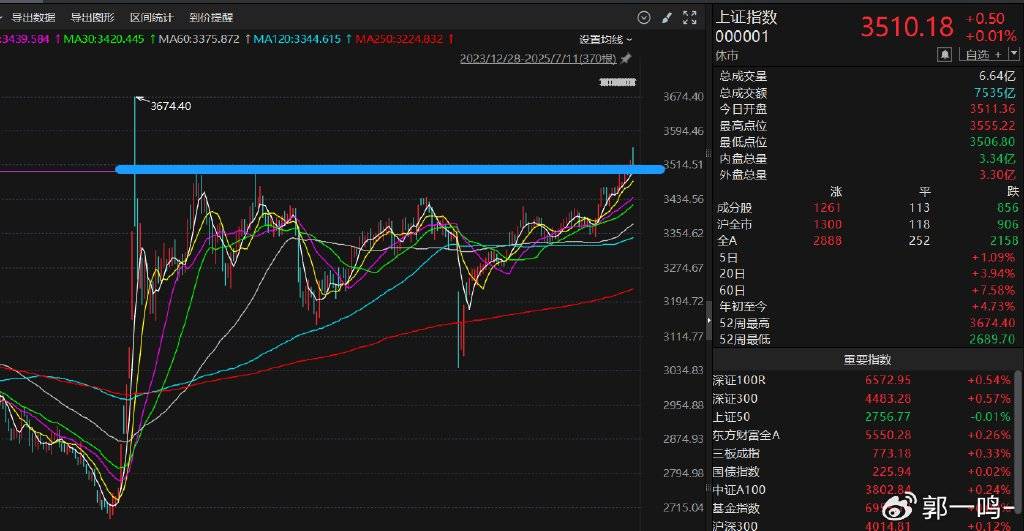
Core Viewpoint - The successful breakthrough of the Shanghai Composite Index above 3500 points has injected confidence into the A-share market, opening up upward potential towards previous highs and optimistic targets [1][3] Technical Analysis - The next key resistance level is identified in the range of 3600-3674 points, which holds significant technical and psychological importance due to its status as a previous high during the "924" rally [3] - A sustained breakthrough above 3500 points, especially with a confirmation pullback, could attract trend traders and direct attention towards the next significant high of 3674 points [3][4] - The market may experience fluctuations and corrections above 3500 points, which is a common occurrence during such upward movements [6] Fundamental Factors - Positive mid-term factors supporting the challenge of previous highs include ongoing domestic economic recovery and a sustained loose fiscal and monetary policy to bolster this recovery [4] - Key economic indicators such as the manufacturing PMI and non-manufacturing business activity index showed improvements, indicating a general expansion in economic activity [4] - Anticipated liquidity resonance in the second half of the year, particularly with expectations of a Federal Reserve rate cut, could further enhance domestic monetary policy space [4] Market Sentiment and Risks - The path to challenge previous highs may not be smooth, with potential for significant selling pressure as the index approaches historical resistance levels [7] - Concerns regarding the strength and sustainability of the economic recovery persist, with monthly economic data potentially causing fluctuations in market sentiment [7] - External uncertainties, such as persistent inflation in the U.S. and geopolitical tensions, could negatively impact global risk appetite and, consequently, the A-share market [8] Short-term and Mid-term Outlook - The immediate target post-3500 points is 3674 points, which is seen as a feasible technical goal supported by market trends and policy backing [8] - Achieving the more challenging target of 4000 points will require stronger economic recovery, more substantial policy support, and favorable external conditions [9]