结果即服务(RaaS)

Search documents
计算机行业专题研究:AI时代,关注结果交付模式
East Money Securities· 2026-03-02 07:27
Investment Rating - The report maintains an "Outperform" rating for the computer industry, indicating a positive outlook compared to the broader market [3]. Core Insights - The report emphasizes the shift from traditional Software as a Service (SaaS) models to a results-oriented service model known as Results as a Service (RaaS), which ties service fees directly to measurable business outcomes [7][13]. - The adoption of RaaS is being accelerated by advancements in artificial intelligence (AI) and large model technologies, which enhance the ability of businesses to deliver measurable results [22][26]. - Companies that integrate deep industry knowledge and data into their AI solutions are expected to deliver higher returns on investment (ROI) and are recommended for investment consideration [51]. Summary by Sections 1. RaaS Model Accelerating Adoption - RaaS represents a fundamental shift in business logic, moving from paying for software usage to paying for tangible results [13][14]. - The report highlights successful international examples of RaaS implementation in sectors like fraud prevention and identity verification, showcasing its viability [26][29]. - Domestic companies are increasingly exploring RaaS, with AI driving the transition from providing tools to delivering results across various industries [7][38]. 2. Configuration Recommendations - Companies with strong data and industry expertise in AI applications, such as advertising and transaction facilitation, are likely to achieve higher ROI and are recommended for investment [51]. - Enterprise IT service providers whose products are deeply integrated with business systems are also positioned to transition to a results-based payment model, enhancing customer retention and willingness to pay [51].
传统To B的「双输」困境,会被RaaS终结吗?
雷峰网· 2025-12-21 03:05
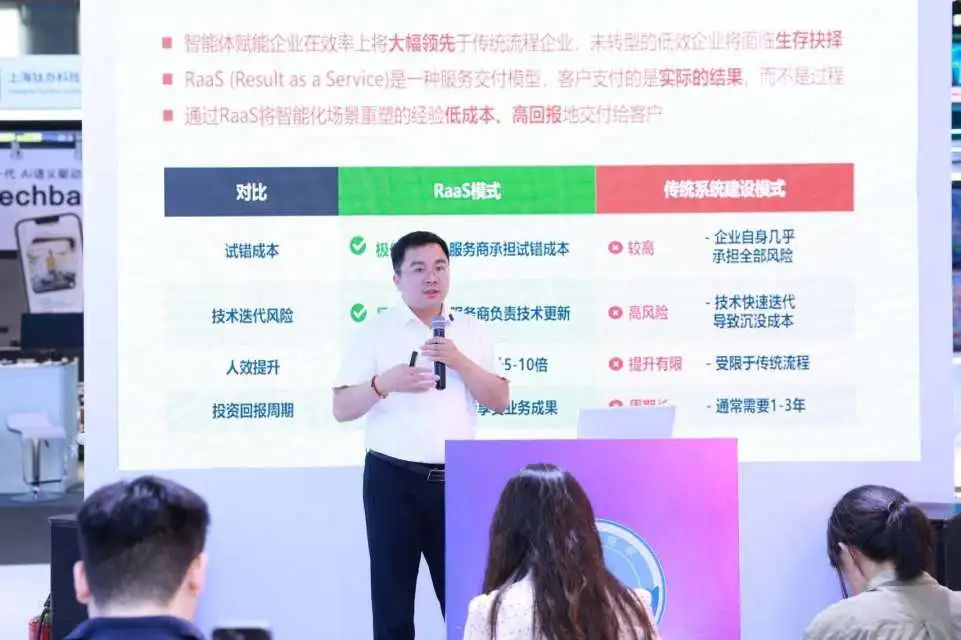
Core Viewpoint - The article discusses the challenges and transformations in the To B (business-to-business) sector, emphasizing the need for a new partnership model between service providers (乙方) and clients (甲方) that focuses on shared risks and benefits, rather than traditional transactional relationships [2][6][28]. Group 1: Traditional To B Challenges - The To B sector has been characterized by a "double loss" situation where clients demand high-quality services at low costs, leading to dissatisfaction on both sides [4][5]. - The traditional procurement logic of clients is based on a bidding mentality, which pressures service providers to deliver under tight budgets, resulting in a cycle of dissatisfaction and inefficiency [5][6]. - The industry faces dilemmas such as the conflict between standardization and customization, where service providers often compromise on product standardization to meet individual client needs, leading to inefficiencies [5][6]. Group 2: New Business Model - RaaS - The article introduces the concept of "Results as a Service" (RaaS), which aims to align the income of service providers with the quantifiable business value they create for clients [6][12]. - 百融云创 has initiated the RaaS model, transitioning from traditional software sales to a partnership approach where both parties share risks and rewards [6][12]. - The RaaS model includes innovative pricing strategies, such as charging based on the roles of digital employees (硅基员工) rather than traditional software sales, allowing for a more flexible and performance-based payment structure [12][13]. Group 3: Engineering and Technological Support - The "Results Cloud" platform is introduced as the technological backbone supporting the RaaS model, enabling efficient management and operation of digital employees [15][16]. - The platform integrates various AI capabilities and models to ensure that digital employees can deliver reliable and measurable outcomes [16][20]. - Key engineering capabilities include a unified connection protocol, high-precision document parsing, and a robust DevOps system to ensure the quality and continuous improvement of AI agents [19][21][22]. Group 4: Collaboration Between Human and Digital Employees - The article highlights the potential for collaboration between human employees (碳基员工) and digital employees, suggesting a model where both can coexist and complement each other rather than one replacing the other [24][25]. - The focus is on redefining workflows to optimize efficiency and quality around shared business outcomes, moving away from traditional cost-cutting negotiations [27][28]. - The ultimate goal is to create a new production relationship that allows for fair distribution of the benefits of technological advancements among creators, users, and enablers [29][30].


金融壹账通:智能体驱动数字员工体系,成为金融转型关键力量
Zhong Jin Zai Xian· 2025-07-30 06:27
Group 1 - The core theme of the 2025 World Artificial Intelligence Conference is the financial industry's transition towards intelligent finance, with a focus on "implementation," "trustworthiness," and "embodiment," indicating a shift from exploration to substantial integration of AI in financial services [1] - Financial technology companies are accelerating the integration of AI technologies with financial operations to explore more feasible transformation paths in response to diverse business needs [1] - Financial One Account's Chief Architect, Wu Lei, introduced a new paradigm of financial RaaS (Results as a Service) that emphasizes payment based on business outcomes, reducing upfront investments and technology sunk costs for clients [1] Group 2 - The advancement of AI large models has enabled Agentic AI technologies to possess autonomous planning and multi-agent collaboration capabilities, evolving AI from a "chat tool" to a "digital workforce" [3] - Financial One Account has established a digital employee system centered around intelligent agents, which has been piloted in outsourced operations, significantly enhancing efficiency in various business segments within Ping An Group [3] - The deployment of AI services has resulted in 1.84 billion service interactions, accounting for 80% of total customer service volume, with AI resolution rates increasing from 38% to 92% and customer net promoter scores rising from 49% to 78% [3] Group 3 - The value of intelligent agents lies not only in replacing single-point tools but also in optimizing business processes through task decomposition, multi-agent collaboration, and tool utilization [4] - In wealth management, intelligent systems can generate personalized investment advice based on client portfolios and market dynamics, while in marketing, AI has doubled the conversion rate of outbound calls by optimizing communication strategies [4] - In debt collection, intelligent agents can create personalized repayment plans and dynamically adjust strategies, leading to a nearly fourfold increase in collection efficiency and improving repayment rates from 40% to 70% within 30 days of delinquency [4] Group 4 - Financial One Account, as the sole external financial technology output window for Ping An Group, continues to invest in the integration of AI with business operations [4] - The company aims to enhance its intelligent agent and RaaS service systems to promote assessable and deliverable intelligent outcomes across various financial scenarios, contributing to the high-quality development of the financial industry [4]