
维修负担指数

Search documents
车价便宜了,那零整比呢?
Zhong Guo Qi Che Bao Wang· 2026-02-02 01:13
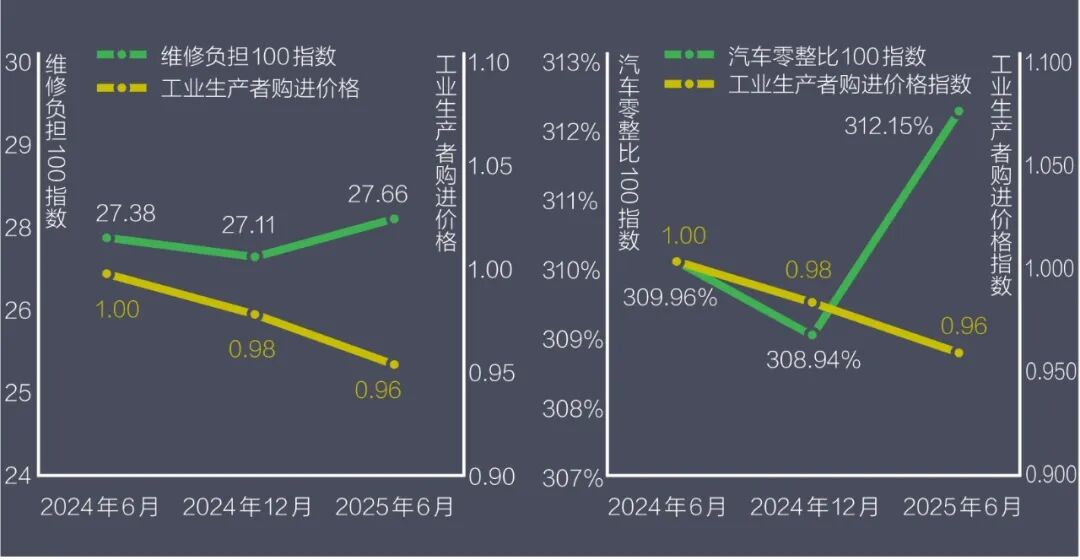
Core Insights - The latest research from the China Insurance Research Institute indicates an increase in both the "Auto Zero-Whole Ratio Index" and the "Repair Burden Index" for both fuel and new energy vehicles, suggesting higher costs for consumers and increased pressure on the insurance industry [1] - The average price of domestic passenger cars is projected to decrease in 2025, with fuel vehicles dropping to 182,000 yuan and new energy vehicles falling to 161,000 yuan [2] - The disparity between declining car prices and rising repair costs is attributed to several factors, including profit strategies of car manufacturers, changes in vehicle technology, and high repair barriers [3] Group 1 - The "Zero-Whole Ratio" and "Repair Burden Index" have increased, indicating higher post-purchase costs for consumers and greater claims pressure on insurers [1] - The average price of new energy vehicles is on a downward trend, with a significant drop from 180,000 yuan in 2024 to 161,000 yuan in 2025 [2] - The increase in repair costs is linked to manufacturers maintaining or increasing parts profit margins to offset reduced sales profits [3] Group 2 - The complexity of vehicle technology, particularly in new energy vehicles, has led to higher costs for repairs due to the integration of high-value components that are difficult to repair [3] - The lack of standardized repair techniques and certification in the industry has resulted in concentrated repair channels, keeping repair costs high [9] - The rising "Zero-Whole Ratio" reflects the increasing proportion of high-value, easily damaged components in accidents, complicating repair costs [12] Group 3 - The cost of battery materials has decreased, but this does not necessarily translate to lower overall repair costs due to structural changes in vehicle design that require complete replacements rather than modular repairs [11] - The insurance industry faces challenges as the average claim amounts continue to rise, contributing to increased insurance premiums for new energy vehicles [3][12] - The industry is encouraged to focus on the economic viability of vehicle repairs throughout their lifecycle, rather than solely on battery costs [12]

维修负担及保险赔付压力加重
Xin Lang Cai Jing· 2026-01-06 21:35
Core Insights - The report from China Insurance Research Institute indicates a rising trend in maintenance costs for both fuel and new energy vehicles since 2025, increasing the financial burden on consumers and insurance payout pressures [1] Fuel Vehicles - The "Automobile Zero-Whole Ratio 100 Index" for fuel vehicles increased to 391.07%, up by 2 percentage points from the previous report [2] - The "Maintenance Burden 100 Index" for fuel vehicles rose to 20.86, an increase of 0.1, reflecting a 0.47% rise [2] - Among 18 commonly used parts, 11 showed an increase in single part zero-whole ratios, with the rearview mirror assembly seeing the highest increase of 4.82% [3] - The average single part zero-whole ratio for front headlights increased to 3.2%, up by 0.02 percentage points [3] New Energy Vehicles - The "Automobile Zero-Whole Ratio 100 Index" for new energy vehicles rose to 312.24%, an increase of 3.3 percentage points [4] - The "Maintenance Burden 100 Index" for new energy vehicles increased to 27.66, reflecting a rise of 2.03% [4] - Among 18 commonly used parts, 16 showed an increase in single part zero-whole ratios, with the rear tail light having the highest increase of 11.59% [4] - The average single part zero-whole ratio for front headlights in new energy vehicles increased to 2.43%, up by 0.17 percentage points [4] Battery Costs - The average single part zero-whole ratio for power batteries in new energy vehicles decreased to 49.59%, down by 0.38 percentage points [6] - The average unit energy price for power batteries was 1538.83 yuan/kWh, reflecting a decrease of 2.23% [6]