
综合交通体系

Search documents
北京中心城区绿色出行比例76.5%,同比增长0.9个百分点
Bei Jing Shang Bao· 2026-01-21 03:15
同时,轨道线网持续扩容提质,开通17号线中段等3条(段)线路,运营里程达909公里;新增8号线大 红门、16号线丽泽商务区2个站点,实现4号线菜市口站等5个站口与周边商业连通改造,网络通达性显 著提升;行车组织持续优化,全年17次优化运力,10条线路组成夜间"小网",在节假日、跨年夜延时保 障,最大限度满足市民出行需求。 北京商报讯1月21日,记者从北京市交通委获悉,2025年,北京交通主要交通指标实现"两升一降",客 货周转量增速6.2%,高于年度目标1.2个百分点;中心城区绿色出行比例76.5%,同比上升0.9个百分 点;高峰时段平均道路交通指数5.79,同比下降4.77%。 具体来看,2025年,北京系统推进多种交通方式围绕轨道交通深度融合、协同增效,加速构建以轨道交 通为骨干、地面公交为支撑、多种出行方式为补充的"鱼骨状"综合交通体系,绿色出行吸引力持续增 强,中心城区绿色出行比例达76.5%。 地面公交与轨道加速融合。围绕轨道交通"内面外廊"结构,优化调整242条公交线路、新增线网覆盖道 路297.6公里,开行352条通学、通医、通游等公交专线,开通22条"短频快"地铁接驳线路;持续强化公 轨联动, ...
北京副中心综合交通枢纽年底将具备开通运营条件
Zhong Guo Xin Wen Wang· 2025-11-20 11:47
Core Points - Beijing's sub-center comprehensive transportation hub is set to be operational by the end of the year, completing the "eight stations and two airports" hub layout established over the past five years [1][3] - The city aims to enhance its transportation network with a focus on convenience, efficiency, sustainability, intelligence, and safety, achieving a vision of smooth travel for people and goods [3][4] Transportation Network Development - The construction of high-speed railways such as the Beijing-Harbin and Beijing-Xiong'an intercity lines has been completed, facilitating a 1 to 1.5-hour travel circle among major cities in the Beijing-Tianjin-Hebei region [3][4] - The highway network has expanded significantly, with 108 kilometers of new highways added over five years, bringing the total to 1,276 kilometers, creating a national highway backbone centered around Beijing [3][6] Urban Rail and Public Transport - Over the past five years, 19 new subway lines totaling 180 kilometers have been opened, contributing to a total rail network of 1,244 kilometers, the largest in the country [5][6] - The integration of bus and rail services has improved, with 90% of subway stations allowing transfers to buses within 50 meters, enhancing the overall public transport experience [5][6] Road Infrastructure Improvements - The city has added 140 kilometers of urban roads, increasing the total to 6,296 kilometers, which supports urban development and industrial growth [6] - The slow-moving traffic system has been enhanced, with the construction of 22 slow traffic corridors and improvements to existing pathways, promoting a more organized and efficient last-mile connectivity [6]

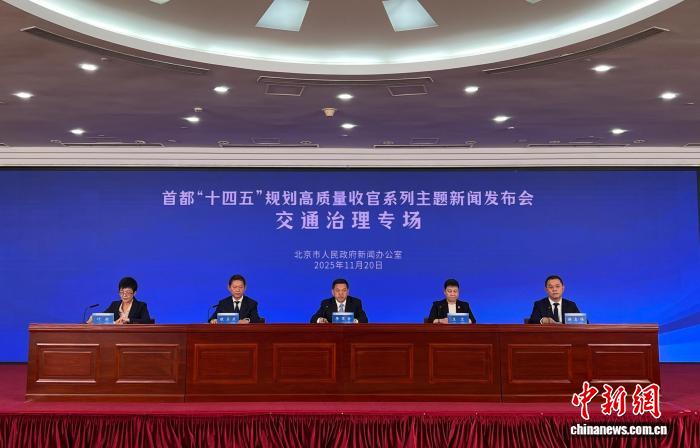
过去五年北京开通19条(段)地铁新线,城轨运营总里程全国第一
Xin Jing Bao· 2025-11-20 08:03
Core Insights - Beijing has significantly expanded its transportation infrastructure over the past five years, with the opening of 19 new subway lines totaling 180 kilometers, contributing to a total rail network of 1,244 kilometers, the largest in the country [1][2] - The city has implemented measures to optimize bus lanes, enhancing the efficiency of road network resource utilization [1] - A comprehensive transportation system has been established, integrating rail transit as the backbone, supported by surface public transport and various travel modes [1] Group 1: Rail Transportation - The total operational mileage of urban rail transit in Beijing is now the highest in the nation, with 1,244 kilometers of track [1] - Cross-line operations have been achieved between Line 1 and the Batong Line, as well as between the Fangshan Line and Line 9, improving connectivity [1] - The city has introduced night service on eight lines during major holidays, ensuring coverage for key transport hubs [1] Group 2: Bus and Road Infrastructure - 90% of rail stations are within 50 meters of bus transfer points, indicating a deep integration of bus and rail services [1] - Over the past five years, the urban road network has expanded by 140 kilometers, reaching a total of 6,296 kilometers [2] - The total length of highways has increased by approximately 200 kilometers, exceeding 22,000 kilometers, supporting urban development and industrial growth [2] Group 3: Non-Motorized Transport - The city has developed 22 slow-moving corridors and improved pedestrian spaces, enhancing connectivity for non-motorized transport [2] - A campaign for "civilized riding and orderly parking" has been launched, focusing on the management of non-motorized vehicle parking around key areas [2] - Systematic improvements have been made at 103 rail stations and 40 surrounding areas to maintain order in non-motorized vehicle parking [2]
四大市级工程全速推进 宝山交通迎重大利好 高效联动“大吴淞”“大东方”
Jie Fang Ri Bao· 2025-09-13 01:11
Core Insights - The article highlights the significant advancements in transportation infrastructure in Baoshan District, Shanghai, which is becoming a key hub for the city's connectivity to the northern Yangtze River Delta region [1][6][7] Group 1: Major Infrastructure Projects - The S16 Wencuan Expressway is a crucial part of Shanghai's urban planning, designed to enhance connectivity between Shanghai and Jiangsu Province, with a total length of approximately 17.6 kilometers and expected to open in early 2026 [2] - The construction of the S16 Expressway will improve transportation efficiency in the Baoshan area, connecting key regions and reducing cargo transport time by 40% after its completion [3] - The Jun Gong Road Expressway is part of the northern ring system, expected to be completed by 2025, which will create a new north-south corridor in the eastern part of the city [4] Group 2: Traffic Efficiency Improvements - The S16 Expressway's design includes a "separation of passenger and freight" approach, which is projected to increase freight speed by 60% and reduce logistics costs by 15% [2] - The new construction of the Yixian Road elevated exit ramp is set to alleviate traffic pressure on the surrounding roads, significantly improving congestion issues in the area [5] - The overall transportation network in Baoshan will be enhanced through the integration of various transport modes, including high-speed rail and expressways, creating a comprehensive transportation hub [6][7]
