美元末日论

Search documents
“货币贬值”交易只是情绪驱动?桥水前主管建议同时持有美元和黄金!
Jin Shi Shu Ju· 2026-01-28 13:23
Group 1 - The core viewpoint of the articles is that the current panic surrounding the US dollar is exaggerated, and a diversified investment strategy involving both the dollar and gold is recommended [1][2]. - Alexander Campbell suggests that holding gold positions is essentially equivalent to shorting the dollar, as gold is priced in dollars and tends to attract speculative funds when the dollar weakens [1][2]. - The so-called "currency devaluation" trade is more driven by market sentiment rather than actual trading behavior, with investors not fleeing the dollar en masse but rather under-allocating to gold and silver due to a long-term bull market and low inflation [2]. Group 2 - Campbell highlights that significant concerns regarding the dollar's future, such as large-scale liquidation of US Treasuries by Japanese insurers or a drop in the dollar's share of international payments, have not materialized [3]. - For those believing in a "dollar doomsday," Campbell advises shorting US stocks and bonds, as actual selling of these assets would reflect genuine bearish sentiment towards the dollar [3]. - Investors anticipating a controlled decline of the dollar are encouraged to hold a mix of gold, dollars, and short-term assets, drawing parallels to market strategies from 2000 to 2010 when the dollar also experienced a downtrend [3].
新台币点燃亚洲货币升值预期,哪些货币有望走强?
Di Yi Cai Jing· 2025-05-07 13:06
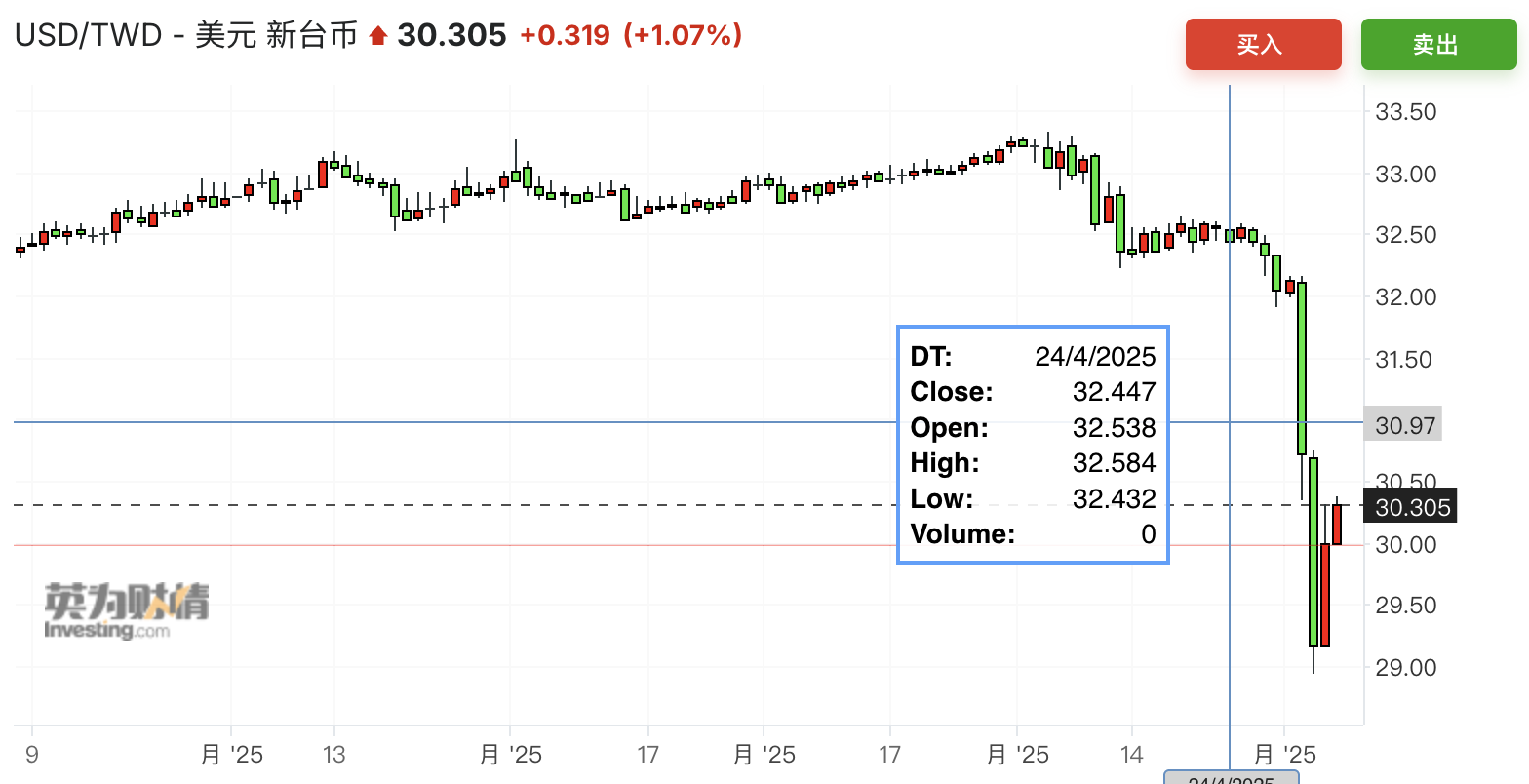
Core Viewpoint - The recent volatility of the New Taiwan Dollar (TWD) against the US Dollar (USD) has raised concerns among market participants, with expectations of further intervention from Taiwan's monetary authorities to stabilize the currency [1][5][9]. Group 1: Currency Volatility - As of May 7, the USD/TWD exchange rate returned to approximately 30.33, indicating a calming of market sentiment after a significant drop to 28.93 on May 5, which represented a nearly 10% decline from over 32 on May 2 [4][5]. - The dramatic depreciation of the TWD was triggered by local banks reportedly halting USD purchases, leading to fears that Taiwan's monetary authorities would not closely monitor the exchange rate, resulting in panic selling [5][6]. - The TWD's nominal effective exchange rate (NEER) has strengthened, prompting speculation that Taiwan's monetary authorities may increase market intervention to manage volatility [7][9]. Group 2: Market Reactions and Implications - The recent fluctuations have led to a significant increase in hedging activities among Taiwanese life insurance companies, which typically hold substantial overseas assets and require foreign exchange hedging [6][7]. - Despite the volatility, there is a notable lack of strong buying interest in USD assets from actual investors, reflecting a prevailing bearish sentiment towards the USD [9][10]. - Other Asian currencies, particularly those with export-oriented economies and high USD holdings, such as Malaysia, Thailand, and the Philippines, are also under scrutiny for potential appreciation pressures [9][10]. Group 3: Broader Economic Context - Taiwan's first-quarter exports reached a record high of $130 billion, contributing to a consistent current account surplus exceeding $100 billion for four consecutive years, which supports the TWD's strength [6]. - The influx of foreign capital into Taiwan's stock market, with net inflows exceeding $20 billion this month, has further bolstered the TWD [6][9]. - The overall trend in Asia shows a growing concern regarding currency risks, with countries like South Korea and Malaysia also experiencing increased foreign currency deposit ratios [9][10].