美元霸主地位

Search documents
李迅雷专栏 | 央行将抛售还是增持黄金:我最想贴的一张图
中泰证券资管· 2026-01-14 11:33
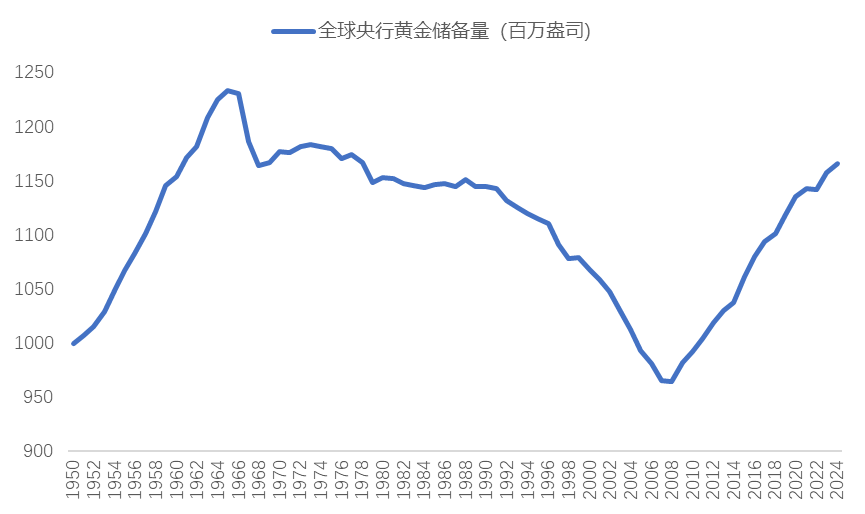
Core Viewpoint - The article emphasizes the increasing importance of gold as a hedge against inflation and geopolitical risks, highlighting its dual attributes of value preservation and risk aversion, especially in the context of ongoing financial, trade, and technological conflicts among major nations [1][11]. Group 1: Historical Context of Gold Holdings - Global central banks held 12.25 billion ounces of gold in 1964, which decreased to 11.66 billion ounces by 2024, despite significant monetary expansion over the same period [3]. - The price of gold has increased dramatically from $35 per ounce in 1964 to approximately $2,639 per ounce by the end of 2024, representing a nearly 75-fold increase [3]. - The broad money supply (M2) grew from $0.98 trillion in 1964 to $156.67 trillion in 2024, a growth of 159 times, indicating a much faster expansion compared to gold prices [3]. Group 2: Current Gold Reserves and Market Value - By the end of 2024, the market value of central bank gold reserves exceeded $3 trillion, yet this value remains low relative to the total global broad money supply [5]. - The proportion of gold reserves in relation to global broad money has only increased from 4.3% in 1964 to 1.9% in 2024, indicating a significant decline over the decades [5][8]. - The share of foreign exchange reserves in total central bank reserves rose from 31% in 1960 to 90% during 2006-2008, before declining to 77% by 2024, reflecting a shift away from gold [8]. Group 3: Implications for Future Gold Holdings - Since 2022, central banks have been increasing their gold reserves due to concerns over U.S. debt and the weakening dollar, which has been a significant factor driving up gold prices [11]. - The global gold stock has increased by approximately 1.5 times over the past 60 years, yet central banks currently hold only about 17.5% of the total gold stock, suggesting a potential for increased gold accumulation [11]. - China's gold holdings are relatively low, projected to be around 0.74 billion ounces by the end of 2025, which is only 6.3% of global central bank holdings [11]. Group 4: Economic and Geopolitical Considerations - The article notes that the post-World War II era has seen a significant accumulation of debt, with few countries successfully implementing reforms, leading to a reliance on monetary expansion, which supports the rising prices of non-yielding assets like gold [14]. - Despite the decoupling of the dollar from gold post-Bretton Woods, the dollar's international status remains strong, influenced by the U.S. economic position [14]. - The article suggests that to enhance the international status of the renminbi and optimize central bank reserves, China should consider reducing its holdings in U.S. and Japanese government bonds while increasing its gold reserves [14].


李迅雷:央行将抛售还是增持黄金,先看一张图
Sou Hu Cai Jing· 2026-01-07 12:25
Core Viewpoint - The article emphasizes the increasing importance of gold as a hedge against inflation and geopolitical risks, highlighting its dual attributes of value preservation and risk aversion, particularly in the context of ongoing financial, trade, and technological conflicts among major nations [1]. Group 1: Gold Holdings and Central Banks - Global central banks held 12.25 billion ounces of gold in 1964, which decreased to 11.66 billion ounces by 2024, despite significant monetary expansion over the same period [3]. - The price of gold has increased nearly 75 times from $35 per ounce in 1964 to approximately $2639 per ounce in 2024, indicating a substantial rise in value despite the reduction in physical gold holdings [3]. - The total value of central bank gold reserves is projected to exceed $3 trillion by the end of 2024, yet this represents a low percentage of global broad money supply, increasing from 4.3% in 1964 to only 1.9% in 2024 [5]. Group 2: Monetary Expansion and Gold Value - The broad money supply (M2) grew from $0.98 trillion in 1964 to $156.67 trillion in 2024, a 159-fold increase, which outpaces the growth in gold prices [3]. - The ratio of broad money to GDP has risen significantly, from 53.4% in 1964 to 141.17% by the end of 2024, indicating a trend of monetary overexpansion [3]. Group 3: Central Bank Strategies - The share of foreign exchange reserves in total central bank reserves increased from 31% in 1960 to a peak of 90% between 2006 and 2008, before declining to 77% in 2024, reflecting a shift in reserve management strategies [7]. - The proportion of gold in central bank reserves was 59% in 1964, but this dropped to around 10% from 2000 to 2019, with a slight recovery to 17% by 2024, still below historical levels [7]. Group 4: Future Outlook and Recommendations - The article suggests that central banks should continue to increase their gold reserves in response to concerns over U.S. debt and the weakening dollar, which has prompted a shift towards gold accumulation since 2022 [10]. - For China, increasing gold reserves relative to U.S. and Japanese government bonds is recommended to enhance the international status of the Renminbi and optimize reserve structures [14].