美国增长例外论

Search documents
都怪特朗普!美元录得8年来最差年度走势,2026年会继续走弱?
Di Yi Cai Jing· 2025-12-31 08:00
Core Viewpoint - The erosion of the fundamental basis of the US dollar's dominance, influenced by factors such as Trump's policies and the Federal Reserve's actions, is expected to lead to a prolonged period of dollar weakness, with significant implications for global markets and economies [1][6]. Group 1: Dollar Performance and Market Expectations - The dollar index is set to record its largest annual decline since 2017, with a drop of 9.5% this year, marking the worst performance in eight years [3]. - Following Trump's "reciprocal tariffs" in April, the dollar index experienced a significant drop of 15%, raising concerns about the US economy and the dollar's status as a safe-haven asset [3]. - Traders have begun to short the dollar for the first time since October, with options pricing reflecting a heightened bearish sentiment towards the dollar [3]. Group 2: Future Projections and Central Bank Policies - Analysts predict that the dollar bear market will continue into 2026, albeit with potentially smaller declines compared to this year, as the Federal Reserve is expected to lower interest rates again [4]. - The divergence in monetary policy, with the Fed remaining accommodative while other central banks, like the European Central Bank, may hold rates steady or even increase them, is likely to further pressure the dollar [4][5]. - By the end of 2026, the euro is expected to strengthen to 1.20 USD, while the British pound may rise from 1.33 USD to 1.36 USD [5]. Group 3: Impact on Global Markets and Investor Behavior - The weak dollar has mixed effects; it benefits US exporters but poses challenges for European companies operating in the US market [5]. - Concerns about the potential for a new Fed chair to implement aggressive rate cuts at the behest of the White House could lead to further dollar depreciation [5]. - The ongoing strength of the US economy, as indicated by a 4.3% annualized GDP growth rate in Q3, may counterbalance some of the bearish sentiment towards the dollar, potentially leading to a rebound [7].


图解特朗普“大漂亮”法案:财政刺激力度、899条款“资本税”、对美债、美元影响有多大?
Hua Er Jie Jian Wen· 2025-06-10 04:43
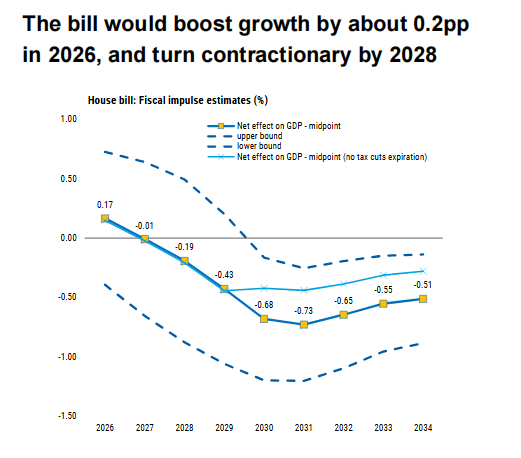
Core Insights - The "Big Beautiful" bill is projected to add up to $2.8 trillion in deficits over the next decade, but its short-term economic stimulus effect is minimal, with only a 0.2 percentage point increase in growth expected by 2026, turning negative by 2028 [2][16] - The bill features a "discriminatory tax" clause (Section 899) that introduces significant uncertainty for foreign investors holding U.S. assets, potentially increasing their investment costs [7][17] - Morgan Stanley is bearish on the U.S. dollar, predicting a 4-5% decline in the dollar index by the end of 2025, as the era of U.S. economic exceptionalism comes to an end and capital inflows face risks [7][29][31] Fiscal Impact - The bill's deficit growth is front-loaded, with two-thirds of the total deficit occurring between 2025 and 2029 [6] - Additional tax relief measures are concentrated in the early years and will expire by 2028 [10] - Spending cuts will not begin until 2027, with Medicaid cuts peaking only in 2032 [13] Debt Market Implications - The combined effects of tariff revenues and spending cuts have led to a reduction in deficit expectations, alleviating concerns about oversupply in the U.S. Treasury market [18] - The U.S. Treasury has significant flexibility in financing, relying on short-term bills due to low issuance levels and high demand for short-term debt [23] - Risks remain regarding foreign investor behavior, particularly the impact of Section 899 on different maturities of U.S. Treasuries [26] Investment Environment - The investment climate in the U.S. is facing deterioration risks, with the dollar expected to weaken [29] - The end of U.S. economic exceptionalism suggests that future growth will align more closely with the rest of the world, complicating financing for large deficits [29] - The reliance on foreign capital to cover the current account deficit is significant, with portfolio inflows projected to exceed the deficit by 125% in 2024, making the implications of Section 899 particularly concerning for European investors [31][33]