美妆与医美跨界融合

Search documents
欧莱雅加仓高德美股权至20%,这场跨界融合玩得多大?
Sou Hu Cai Jing· 2025-12-19 07:42
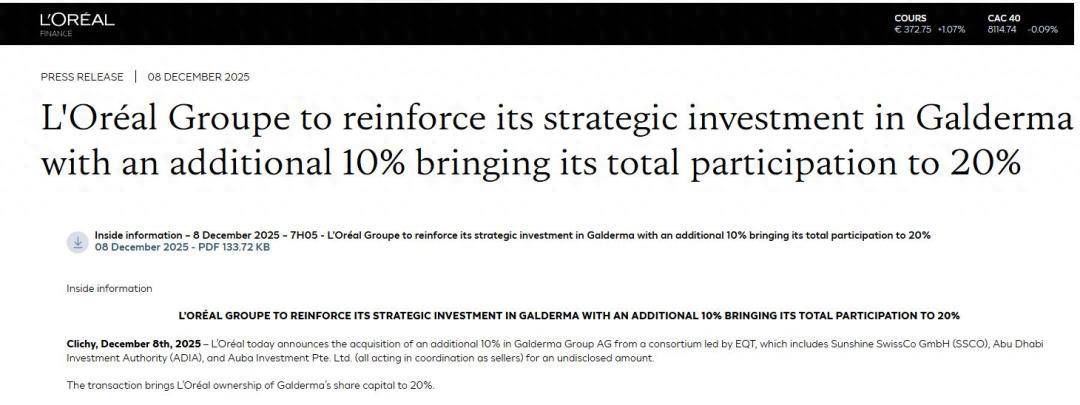
Core Viewpoint - The boundary between beauty and medical aesthetics is increasingly blurred, with major beauty companies like L'Oréal investing in medical aesthetics firms, reflecting a strategic shift in the industry towards a more integrated approach to consumer beauty needs [1][5]. Group 1: Company Actions - L'Oréal announced the acquisition of an additional 10% stake in Galderma, increasing its ownership from 10% to 20%, marking a significant move into the medical aesthetics sector [1][3]. - The transaction involves Sunshine SwissCo GmbH, backed by EQT, Abu Dhabi Investment Authority (ADIA), and Auba Investment Pte. Ltd., and is expected to finalize in Q1 2026 [3]. - L'Oréal plans to nominate two non-independent directors with L'Oréal backgrounds to Galderma's board, enhancing its influence over strategic decisions [4]. Group 2: Industry Trends - The integration of beauty and medical aesthetics is becoming a necessity, with companies like Estée Lauder and Shiseido also making moves into the medical aesthetics space, indicating a broader industry trend [7]. - The driving force behind this trend is the demand for a comprehensive ecosystem that combines daily skincare, medical devices, and professional medical aesthetics [7]. - The Chinese medical aesthetics market is seen as a key growth area for beauty companies, as consumer demand for "scientific beauty" continues to rise [7]. Group 3: Challenges and Opportunities - The fusion of beauty and medical aesthetics presents challenges due to differing business models and channel logic, with beauty companies focusing on mass production and marketing, while medical aesthetics emphasize personalized services and compliance [9]. - The entry of beauty companies into the medical aesthetics field is expected to enhance consumer education and push for safer, more convenient medical technologies [9]. - Successful integration of technology transfer, channel adaptation, and compliance operations will be crucial for capturing opportunities in the rapidly growing medical aesthetics market [10].

美妆已死,医美当道?
阿尔法工场研究院· 2025-06-16 13:05
Core Insights - The beauty industry is transitioning from a phase of "easy growth" to a "complex new stage" globally, with significant challenges ahead [2][5] - The McKinsey report predicts a global beauty market size of $441 billion in 2024, with a growth rate of 7% from 2022 to 2024, but a decline to 5% from 2024 to 2030 [3][4] - The Chinese beauty market is projected to account for 15% of the global market in 2024, with a compound annual growth rate (CAGR) of 3% from 2019 to 2024, but a significant drop to -3% from 2021 to 2024 [7][10] Regional Analysis - The Chinese beauty market has lost $6.33 billion (approximately 454 billion yuan) over four years, indicating a downturn post-pandemic [7] - The beauty giants are now looking for growth opportunities in emerging markets, particularly in the Middle East, Africa, and India, which are showing higher growth rates [11][12] - In 2024, major companies like L'Oréal and Unilever are increasing investments in emerging regions, with Unilever investing in seven Indian brands [13][14] Category Opportunities - Skincare remains the largest category in the beauty market, accounting for 41%, followed by haircare (21%), color cosmetics (19%), and fragrance (19%) [17] - Fragrance has shown the highest growth rate of 8% from 2019 to 2024, and is expected to continue leading with a growth rate of 4-6% from 2024 to 2030 [18][20] - The demand for health, sun protection, and personal care products is rising, indicating a shift in consumer preferences towards efficacy and certainty [22][24] Growth Drivers - Future growth in the beauty industry will primarily come from volume rather than price increases, as consumers are increasingly focused on the real value of products [26][30] - Price increases have been met with consumer resistance, as seen with Estée Lauder and L'Oréal, indicating a need for brands to focus on product quality and differentiation [28][31] - The beauty market is being segmented into five price tiers, and brands must compete on product strength or pricing rather than simply lowering prices [30][32] Consumer Trends - There is a noticeable shift in consumer spending towards emotional and experiential purchases, as evidenced by high-value art sales and changing preferences in the beauty sector [33][34] - The focus on value, differentiation, and individuality will be key opportunities in the current market landscape [34]