美联储鹰派转向

Search documents
全球资产集体暴跌,谁是罪魁祸首?
吴晓波频道· 2025-11-19 00:51
Core Viewpoint - The article discusses the recent global asset sell-off, attributing it to various factors including the Federal Reserve's policy shifts, concerns surrounding Nvidia's earnings report, and geopolitical tensions involving Japan. It emphasizes that all asset classes, including traditionally safe havens like gold, have been affected by this market turmoil [3][5][21]. Global Market Overview - The U.S. stock market experienced significant declines, with the Dow Jones dropping 1.18%, Nasdaq down 0.84%, and S&P 500 falling 0.92% on what was termed "Black Monday" [8]. - Following this, the Dow Jones faced a rare four-day losing streak, with maximum declines reaching 1.45% for the Dow and 2% for Nasdaq [9]. - The S&P 500 and Nasdaq broke below their 50-day moving averages for the first time in 138 trading days, signaling strong bearish sentiment [10]. - The cryptocurrency market also suffered, with Bitcoin dropping from $126,000 in October to below $90,000, erasing all gains for 2025 [12][13]. - Asian markets mirrored these declines, with Japan's Nikkei 225 index falling 3.22%, marking its largest single-day drop since April [15]. Causes of the Sell-off - The Federal Reserve's shift towards a more hawkish stance has been identified as a primary driver of the recent market volatility, with a significant drop in the probability of interest rate cuts for December [22][24]. - Nvidia's upcoming earnings report is seen as a critical indicator for the AI sector and the broader market, with major investors like Peter Thiel's hedge fund and SoftBank selling off their Nvidia shares [31][36]. - Geopolitical tensions, particularly Japan's comments regarding Taiwan, have also contributed to market instability, leading to a significant drop in Japanese stocks and concerns over the impact on tourism and the economy [39][44]. A-shares and Market Sentiment - The Shanghai Composite Index has approached critical support levels, with the lowest point recorded at 3926.59, raising concerns about the potential for further declines [60][63]. - Analysts suggest that while external pressures from the U.S. market are significant, internal factors also indicate a need for adjustment within the A-share market [64]. - Despite the current bearish sentiment, many analysts remain optimistic about the long-term outlook for A-shares, predicting a favorable environment for investment in 2026 [69][70]. Gold as a Safe Haven - Traditionally viewed as a safe haven, gold has not performed as expected during the recent market downturn, with prices dropping below $4,000 per ounce [19]. - The liquidity crisis has forced investors to sell gold to raise cash, leading to a correlation between gold and risk assets [71][75]. - Historical data indicates that gold is a high-risk asset with significant volatility, challenging the perception of it being a reliable safe haven [76][78]. Conclusion - The article concludes that the current market volatility is likely to persist in the short term, driven by the Federal Reserve's policies, Nvidia's performance, and geopolitical uncertainties. However, it emphasizes the importance of long-term investment strategies and the eventual return to rational market behavior [80][81].


全球资产集体杀跌之际,德银安抚市场:基本面依然稳健,目前尚不具备历史上大规模抛售的条件
Hua Er Jie Jian Wen· 2025-11-18 07:08
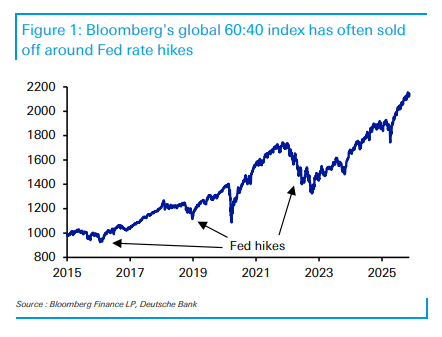
Core Viewpoint - Since mid-October, there has been a significant rise in risk aversion, leading to a cross-asset sell-off in global markets, affecting nearly all asset classes, including technology stocks, cryptocurrencies, and gold. The S&P 500 index has fallen below the critical support level of 6725 points, and Bitcoin has dropped below $90,000, reversing a year-to-date gain of over 30% into negative territory. Despite this, Deutsche Bank's report indicates that the current macroeconomic and financial fundamentals remain robust, not meeting the conditions for a large-scale, sustained bear market [1][10]. Group 1: Market Dynamics - The primary driver of recent market turmoil is the Federal Reserve's hawkish shift, with Chairman Powell questioning the likelihood of a rate cut in December, leading to a drop in the market's expectations for a rate cut to 42% [1][2]. - Historical patterns show that previous large-scale sell-offs were often triggered by the Fed adopting a more aggressive stance and moving towards rate hikes [2][4]. - The current sell-off model shares similarities with historical events but is less severe. The Fed's hawkish tone is largely due to persistently high inflation and the delayed effects of tariff policies [4]. Group 2: Market Corrections - The report notes that the market experienced an "unrelenting and unusual" rise before the sell-off, with the S&P 500 index showing a rolling gain of 23% over the six months ending in October, marking the strongest performance since the post-COVID recovery [6]. - Unlike the post-pandemic surge driven by massive fiscal and monetary stimulus, the current rebound is fueled by waning fears of a recession, making the market's cyclical correction unsurprising given the high valuation levels [8]. Group 3: Fiscal Concerns - Ongoing fiscal deficits in developed economies are exerting pressure on various asset classes, including bonds. For instance, UK government bonds faced significant pressure ahead of the budget announcement, and Japan's 10-year government bond yield reached a new high since 2008 [9]. - This fiscal concern is not limited to the bond market but also affects equities, as evidenced by the poor performance of the French CAC 40 index, one of the worst-performing major European indices this year [9]. Group 4: Fundamental Resilience - Despite the aforementioned headwinds, Deutsche Bank emphasizes that the market's fundamental backdrop remains "robust." The recent sell-off has only caused the S&P 500 index to retreat about 3% from its historical peak [10]. - Key positive factors include the Fed's cumulative rate cuts of 150 basis points since September 2024, the fastest pace of cuts in a non-recession period since the 1980s, and the current market focus on the pace of future rate cuts rather than the need for rate hikes, which is a positive signal [12]. - Additionally, recent easing of trade tensions has further alleviated market anxiety, and overall financial conditions remain loose, with market pressure indicators like the VIX index and high-yield credit spreads still below their October peaks [12].