胡焕庸线

Search documents
“中国人口增减分化与区域均衡发展”学术研讨会在上海举行
Zhong Guo Jing Ji Wang· 2025-12-01 06:07
Core Viewpoint - The conference commemorating the 90th anniversary of the discovery of the "Huhuan Line" highlighted the importance of geographical and demographic studies in China's regional development and the need for innovative approaches to address current population trends and challenges [1][2]. Group 1: Conference Overview - The conference featured various formats including opening and closing ceremonies, keynote speeches, sub-forum discussions, results presentations, and a doctoral student forum, showcasing the latest advancements and future directions in "Huhuan Line" research [1]. - The event was held at East China Normal University, emphasizing the institution's significant role in geography and population studies in China [1]. Group 2: Academic Contributions - Academics emphasized the "Huhuan Line" as a foundational work transitioning Chinese geography from qualitative to quantitative analysis, maintaining its relevance in guiding regional economic development amidst modern challenges [2]. - The conference underscored the need for geography and population studies to adapt to new demographic, resource, and environmental dynamics to achieve high-quality development [2]. Group 3: Research Achievements - The conference achieved significant breakthroughs in academic results, notably the introduction of "Huhuan Digital Human," which represents a new height in the integration of digital technology with humanities and social sciences [3]. - This achievement utilized extensive resources from the university's library and advanced digital technologies to create a dynamic representation of Huhuan's academic legacy, transcending traditional static archives [3].
黄奇帆:农民人均收入低的重要原因在于土地不够
和讯· 2025-08-20 09:26
Core Viewpoint - The article emphasizes that urban-rural integration is a necessary requirement for China's modernization, aiming to enhance the level of planning, construction, and governance to promote equal exchange and flow of urban and rural elements, thereby reducing disparities and fostering common prosperity [2][3]. Summary by Sections Urbanization Progress - Urbanization rate increased from 53.10% in 2012 to 67% in 2024, a rise of 13.9 percentage points over twelve years [3]. - The poverty alleviation campaign has successfully lifted 98.99 million rural poor out of poverty, with all 832 impoverished counties and 128,000 impoverished villages achieving this goal [3]. - The income ratio between urban and rural residents decreased from 3.03:1 in 2013 to 2.34:1 in 2024, indicating a narrowing income gap [3]. Challenges in Urban-Rural Integration - Issues such as insufficient urban-rural integration, significant disparities, and low farmer income remain weak links in the national economy [4]. - The low income of 600 million farmers is a primary reason for the urban-rural gap, with potential annual income increase of 12 to 13 trillion yuan if farmer incomes rise [5]. Proposed Measures for Urban-Rural Integration - The goal is to raise the permanent urban population rate from 67% to 78% by 2040, which would involve nearly 200 million farmers moving to cities [5][6]. - The household registration (hukou) urbanization rate should also increase from 48% to 78%, addressing the 2.5 billion people in a "semi-urbanized" state [6][7]. - Cities, except for a few megacities, should relax their household registration systems to encourage voluntary urban residency [7]. - Protecting the land rights of farmers who move to cities is crucial, ensuring their land use rights and collective income distribution rights are maintained [8]. Expected Outcomes of Urban-Rural Integration - Increased farmer income is anticipated as the average land per household rises from 7.8 acres to approximately 30 acres, potentially aligning farming income with urban worker income [9]. - Rural reforms will deepen as the average operational scale of farms increases, allowing for better economies of scale and reducing production costs [10]. - Agricultural economic development is expected to benefit from the influx of capital and technology, transforming agriculture into a "sixth industry" [10]. - Farmers' property income will rise as land resources are effectively utilized, improving their financial situation [11]. - Urbanization will lead to the development of new mega and large cities, enhancing labor supply and reducing excess real estate inventory [12]. Conclusion - The integration of urban and rural areas is essential for China's modernization, requiring a comprehensive understanding of the policies and strategies outlined in the recent government directives to effectively implement urban-rural integration [12][13].

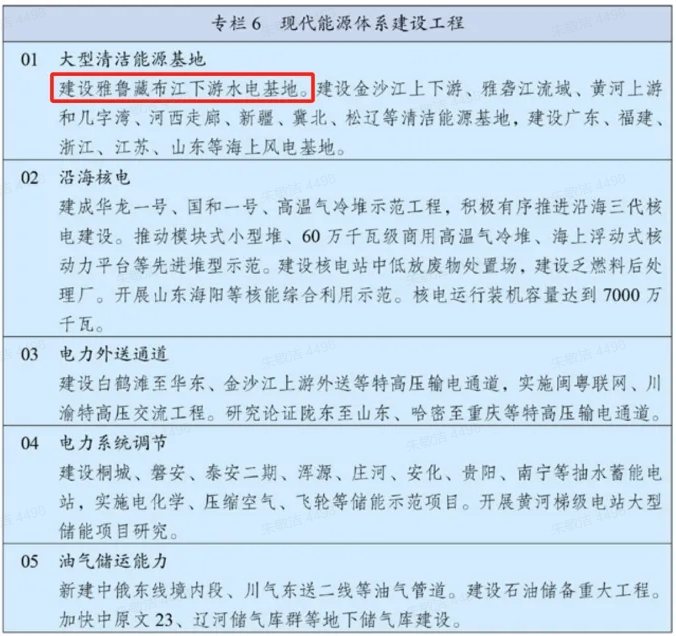
心智观察所:雅鲁藏布江的世纪工程,西方媒体错误解读了
Guan Cha Zhe Wang· 2025-07-22 04:08
Core Viewpoint - The Yarlung Tsangpo River downstream hydropower project, known as the "Yaxi Project," has officially commenced construction, marking a significant milestone in China's clean energy development strategy, with a total investment of approximately 1.2 trillion yuan [1][3]. Group 1: Project Overview - The Yaxi Project is located in Nyingchi City, Tibet, and plans to construct five hydropower stations using a diversion tunnel approach, primarily for electricity export while also catering to local demand [1]. - The project was included as a major clean energy base in China's 14th Five-Year Plan and received official approval from the central government in December of the previous year [1][3]. Group 2: Technical Aspects - The Yaxi Project is expected to have a generating capacity that surpasses that of the Three Gorges Project, despite having a lower annual runoff volume of 1,654 billion cubic meters compared to the Yangtze River's Three Gorges [4][5]. - The unique geographical features of the Yarlung Tsangpo River, including a significant elevation drop of over 2,000 meters, provide a substantial hydropower advantage [5][6]. - The project involves the construction of long tunnels exceeding current world records, requiring advanced tunneling technology and engineering expertise [7][8]. Group 3: Broader Implications - The Yaxi Project is seen as a demonstration of solutions to global challenges, contributing to the concept of a community with a shared future for humanity [3]. - The project is part of a larger trend in China towards ambitious water resource management and energy projects, similar to historical examples like the Hoover Dam in the United States [10][12].